All recordingsPrices shown exclude VAT. (UK tax is not payable for deliveries to United States.) See Terms & Conditions for p&p rates. | |  | Matthias Goerne Sings German Arias
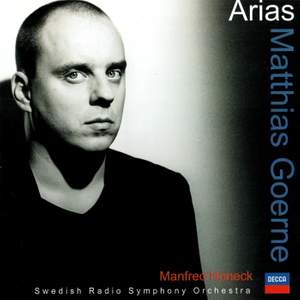
‘Operatic justice’, writes J.B. Steane in his informative and amusing note for this album, ‘is a law unto itself, and the baritone has been prominent among its victims. Unlucky in love, he is seen in the most favourable light as a father-figure and is otherwise all too often the villain of the piece. He may be manly but is rarely heroic. He will have his arias, his moments of glory, yet (uncannily, it must seem to him) their place is rarely at the centre of the opera, or for that matter, part of its last-act climax.’ Beginning with a bracket of Mozart arias, this colourful recital, recorded by Matthias Goerne in 2000, takes us through the terrains of mid- and late-19th century opera – Wagner, Humperdinck, Richard Strauss – to the early 20th-century with the moving ‘Mein Sehnen, mein Wähnen’ from Korngold’s Die tote Stadt, to two brief excerpts from Berg’s Wozzeck. Matthias Goerne both works within the tradition and extends it. Like his predecessors, from Schlusnus to Fischer-Dieskau, he has developed his careers in opera and song side by side, though it is true that his fame and hitherto his work as a recording artist have centred less on opera than on Lieder and oratorio. His operatic recording debut was spotted by Gramophone magazine and described as ‘an impressive appearance’, as Prometheus in the large cast of Braunfels’s Die Vögel. “he is heart-rending in the Tannhauser extracts, dancing in the Korngold and moving as Berg's Wozzeck.” BBC Music Magazine, December 2012 **** “[Goerne’s] powerful Count [makes for] a strong, wilful presence … Faust's solo from the end of the second part of Schumann's work, the Spielmann's lovely piece from the close of the Humperdinck and the aria from Die tote Stadt are all sung with feeling and beauty, especially the Korngold, which is wholly beguiling, the real piece of gold in this programme.” Gramophone Magazine “This is a voice with a honeyed, mellow beauty right through its range, and considerable power when needed’” MusicWeb International | | | (Sorry, download not available in your country) | In stock - usually despatched within 1 working day. |
|
|
| |  | Great Opera Duets
Bach, J S: | Bist du bei mir, BWV508 | Berlioz: | Ah! le ciel, cher époux (from Benvenuto Cellini) Quand des sommets (from Benvenuto Cellini) | Bizet: | Au fond du temple saint (from Les Pêcheurs de Perles) | Boieldieu: | Eh! Mais, quel est ce bruit? (from La Dame Blanche) | Delibes: | Lakmé: Dôme épais (Flower Duet) | Donizetti: | C’est moi Lucie (from Lucie de Lammermoor) Sur la tombe de mon père (Lucie de Lammermoor) Qu'une lettre en ma misere (from Lucie de Lammermoor) | Gluck: | Viens, suis un époux qui t'adore (from Orphée) | Handel: | Dixit Dominus: De Torrente in via bibet Caro autor di mia doglia, arcadian duet HWV 182a: Dagli amori flagellata Scherzano sul tuo volto (from Rinaldo) Ritorna nel core vezzosa (from Arminio) Son nata a lagrimar (from Giulio Cesare) Duetto: Sorge il di Aci/Galatea from Aci, Galatea e Polifemo | Legrenzi: | Ave Regina coelorum | Monteverdi: | Tornate, o cari baci (Book 7) Pur ti miro (I gaze upon you) from L'Incoronazione di Poppea | Mozart: | La ci darem la mano (from Don Giovanni) Bei Männern, welche Liebe fühlen (from Die Zauberflöte) Pa-pa-pa-pa-Papagena (from Die Zauberflöte) | Offenbach: | C'est le ciel qui m'envoie (from La belle Hélène) O grandes leçons du passé (from La Grande-Duchesse de Gérolstein) | Pergolesi: | Stabat mater: Opening duet | Purcell: | Your Counsel all is urg'd in vain (from Dido & Aeneas) | Rossini: | Duetto buffo di due gatti (Comic Duet for Two Cats) | Strauss, R: | Mir ist die Ehre widerfahren (from Der Rosenkavalier) | Verdi: | Libiamo, ne' lieti calici (from La Traviata) Un dì felice, eterea (from La traviata) Parigi, o cara (from La Traviata) |
| | | In stock - usually despatched within 1 working day. |
|
|
| |  | Mozart: Arias & DuetsHighlights from Le Nozze di Figaro, Cosi fan tutte, Don Giovanni & Die Zauberflöte
Mozart: | Non piu andrai, farfallone amoroso (from Le Nozze di Figaro) John Pringle (baritone) Crudel! perché finora farmi languir così? (from Le nozze di Figaro) Isobel Buchanan (soprano) Hai gia vinta la causa! (from Le nozze di Figaro) John Pringle (baritone) E Susanna non vien! … Dove sono i bei momenti (from Le nozze di Figaro) Isobel Buchanan (soprano) Come scoglio (from Così fan tutte) Isobel Buchanan (soprano) Donne mie la fate a tanti (from Così fan tutte) John Pringle (baritone) La ci darem la mano (from Don Giovanni) Isobel Buchanan (soprano), John Pringle (baritone) Batti, batti, o bel Masetto (from Don Giovanni) Isobel Buchanan (soprano) Vedrai, carino (from Don Giovanni) Isobel Buchanan (soprano) Bei Männern, welche Liebe fühlen (from Die Zauberflöte) Isobel Buchanan (soprano), John Pringle (baritone) Ach, ich fühl's (from Die Zauberflöte, K620) Isobel Buchanan (soprano) Pa-pa-pa-pa-Papagena (from Die Zauberflöte) Isobel Buchanan (soprano), John Pringle (baritone) |
| | | Usually despatched in 2 - 3 working days. |
|
|
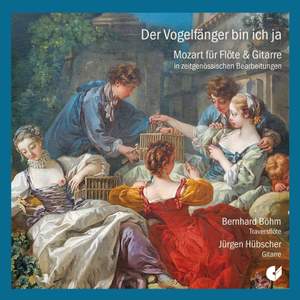
| |  | Der Vogelfänger bin ich jaMozart for flute and guitar in contemporary arrangements
Bernhard Böhm (transverse flute) & Jürgen Hübscher (guitar) In Mozart’s day it was quite common practice to adapt popular opera melodies for dancing or in the home. In this way the success of an opera was reflected just as nowadays a recording of highlights is an indicator of popularity. Six arias were selected for this recording from the numerous opera arrangements for flute instruments – three are from the 'Magic Flute' and three from the 'Entführung aus dem Serail'. Preference was given to the arias which are either thematically connected to the flute (Wie stark ist nicht dein Zauberton / Der Vogelfänger bin ich ja) or which seem to be particularly suited to the flute and guitar in character. The CD is completed by Fernando Carulli’s arrangement of Mozart’s Quartet K478 and by Matteo Carcassi’s 'Air des Mysteres d’lsis' variations modelled on the choral passage 'Was klinget so herrlich' from the finale of the first act of 'Zauberflöte'. | | | Usually despatched in 3 - 4 working days. |
|
|
| |  | Berliner Philharmoniker: Gala From Berlin – Songs of Love and DesireLive Recording from the Philharmonie Berlin, 1998
Berlioz: | Le carnaval romain Overture, Op. 9 | Bizet: | L'Arlesienne Suite No. 1: IV. Carillon L'Arlesienne Suite No. 2: IV. Farandole | Mozart: | Le nozze di Figaro, K492: Overture Deh vieni, non tardar (from Le nozze di Figaro) Christine Schäfer (soprano) Deh! vieni alla finestra (from Don Giovanni) Simon Keenlyside (baritone) Bei Männern, welche Liebe fühlen (from Die Zauberflöte) Christine Schäfer (soprano), Simon Keenlyside (baritone) La ci darem la mano (from Don Giovanni) Christine Schäfer (soprano), Simon Keenlyside (baritone) Fin ch'han dal vino (from Don Giovanni) Simon Keenlyside (baritone) | Rossini: | La gazza ladra Overture | Tchaikovsky: | Polonaise (from Eugene Onegin, Op. 24) Puskay pogibnu ya 'Tatiana's Letter Scene' (from Eugene Onegin) Mirella Freni (soprano) | Verdi: | Addio, addio, speranza ed anima (from Rigoletto) Christine Schäfer (soprano), Marcelo Alvarez (tenor) Caro nome (from Rigoletto) Christine Schäfer (soprano) La donna è mobile (from Rigoletto) Marcelo Alvarez (tenor) Libiamo, ne' lieti calici (from La Traviata) Christine Schäfer (soprano), Marcelo Alvarez (tenor) |
Love is the motto of the 1998 New Year‘s Eve Concert. And who wrote better music about love than Mozart and Verdi? Maestro Claudio Abbado has chosen two of the best Mozart interpreters of our day, Christine Schäfer and Simon Keenlyside, for this traditionally meaningful event. Marcelo Álvarez from Argentina, compared by some to a young Domingo, sings highlights of the tenor repertoire, and Italian Primadonna Mirella Freni tops the occasion with a breathtaking performance of the Letter scene of Tchaikovsky‘s Eugene Onegin. Sound Format: PCM STEREO, DD 5.1 Picture Format: 16:9 DVD Format: DVD 9, PAL Running Time: 90 mins FSK: 0 Directed by Hans Hulscher | | | Usually despatched in 2 - 3 working days. |
|
|
| |  | Great Operatic Arias 19 - Sir Thomas Allen Volume 2Sung in English
Mozart: | Der Vogelfänger bin ich, ja (from Die Zauberflöte) Sung in English as I’m sure that there could never be’ Non piu andrai, farfallone amoroso (from Le Nozze di Figaro) Sung in English as 'Here’s an end to your life as a rover’ Madamina, il catalogo è questo (from Don Giovanni) Sung in English as ‘Little lady! Here’s a list I’ve assembled...' Bravo, signor padrone…Se vuol ballare (from Le nozze di Figaro) Sung in English as 'Bravo, my lord and master!...So, little master, you’re dressed to go dancing’ Bei Männern, welche Liebe fühlen (from Die Zauberflöte) Sung in English as ‘A man in search of truth and beauty’ Susan Gritton (Pamina) Fin ch'han dal vino (from Don Giovanni) Sung in English as ‘Now that the wine has stopped them from thinking’ Deh! vieni alla finestra (from Don Giovanni) Sung in English as 'Come softly to your window’ Pa-pa-pa-pa-Papagena (from Die Zauberflöte) Susan Gritton (Papagena) | Verdi: | É sogno, o realta? (from Falstaff) Sung in English as 'I’m dreaming? Or is this true?’ Dio, che nell'alma infondere (from Don Carlo) Sung in English as 'God who has brought us together’ Gwyn Hughes Jones (Carlos) Geoffrey Mitchell Choir Perfidi!…Pietà, rispetto, amore (from Macbeth) Sung in English as 'Treachery!...When you are old and full of tears’ Pura siccome un angelo (from La Traviata) Sung in English as ‘I have a daughter sent from God’ Claire Rutter (Violetta) Son io, mio Carlo... Io morro (from Don Carlo) Sung in English as ‘I’m here, Carlos!...‘My last day has dawned for ever’ Gwyn Hughes Jones (Carlos) | Weill, K: | September Song |
Over a long and still flourishing career Sir Thomas Allen has given benchmark performances in several operatic roles of which Mozart and Verdi operas figure strongly. With two spicy exceptions, every item in this programme comes from an opera by Mozart or Verdi. Part of the design of this recital series is to highlight the particular type of voice and explore its repertoire. The works chosen for this disc provide a unique showcase of Sir Thomas Allen’s unique gifts and that of the baritone in general. The Sunday Telegraph wrote of volume one, “How good to have this anthology of Thomas Allen’s versatility in a wide range of his operatic roles… anyone who cherishes good singing will rejoice in this great baritone’s smooth legato, perfect diction, subtle characterisation and, of course, beautiful and unmistakable voice,” and The Guardian noted “As always, Allen was a supremely intelligent recitalist, matching sound with sense, probing the meaning of a text without fracturing the vocal line.” As in previous issues, the solos are interspersed with longer excerpts, duets and ensembles, including performances with Susan Gritton and Claire Rutter. With Ford’s monologue in Falstaff, Sir Thomas extends his lyrical voice to encompass the more theatrical style of late Verdi and in the lighter Weill ‘September Song’, he extends it further, albeit in a different direction altogether. Other repertoire includes recitatives and arias from Verdi’s Macbeth and La Traviata, arias from Mozart’s Marriage of Figaro and Don Giovanni, and duets from The Magic Flute. All tracks sung in English “The voice is beautifully captured by the clear recording and, as ever, David Parry and the Philharmonia provide sterling support. Pure pleasure. ” Gramophone Magazine, June 2008 “Unfailingly beautifully phrased and enunciated, Allen's singing for the most part has too little dramatic presence and character here… Allen is better in soliloquy and in duet. Falstaff's great dream of cuckoldry, and Macbeth's vision of desolate old age are magnificent.” BBC Music Magazine, April 2008 *** | | | (also available to download from $10.50) | Usually despatched in 2 - 3 working days. (Available now to download.) |
|
|
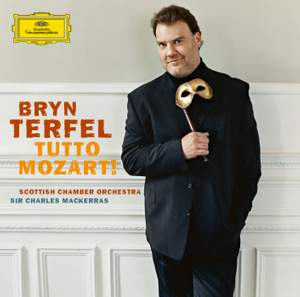
| |  | Tutto Mozart!
Mozart: | Non piu andrai, farfallone amoroso (from Le Nozze di Figaro) lo ti lascio, oh cara…, addio 621a/K.Anh245/ Soave sia il vento (from Così fan tutte) Warnung 'Männer suchen stehts zu naschen', K433 Così dunque tradisci … Aspri rimorsi atroci, K432 Il core vi dono (from Così fan tutte) Un bacio di mano, K541 La ci darem la mano (from Don Giovanni) Ein Mädchen oder Weibchen (from Die Zauberflöte) Hai gia vinta la causa! (from Le nozze di Figaro) Nun, liebes Weibchen, ziehst mit mir, K625 Der Vogelfänger bin ich, ja (from Die Zauberflöte) Crudel! perché finora farmi languir così? (from Le nozze di Figaro) Deh! vieni alla finestra (from Don Giovanni) Diggi, daggi, schurry, murry (from Bastien und Bastienne) Pa-pa-pa-pa-Papagena (from Die Zauberflöte) Madamina, il catalogo è questo (from Don Giovanni) Bei Männern, welche Liebe fühlen (from Die Zauberflöte) |
“…half the pleasure of this disc is the contribution of the Scottish Chamber Orchestra, with Sir Charles Mackerras setting the perfect pace for Così's great terzettino… Best of all, perhaps, are Terfel's own excited discoveries: the priceless 'Cat duet', with Persson again, from Der Stein der Weisen; his noble and tender valediction in the concert aria, 'Io ti lascio, oh cara'... the totally authenticated nonsense sorcery, 'Diggi, daggi' from Bastien und Bastienne;...” BBC Music Magazine, September 2006 **** “Technically he can't be faulted -his performances appear absolutely effortless -and he conveys so much emotion and expression that you can almost see the tilt of his head, the glint in his eye.” Liz Mundler, bbc.co.uk, 8th September 2006 BBC Music Magazine
Opera Choice - September 2006 |
| | | Usually despatched in 8 - 10 working days. |
|
|
| |  | Mozart: Arie e Duetti
Isabel Bayrakdarian (soprano), Michael Schade (tenor), Russell Braun (baritone) | |
|
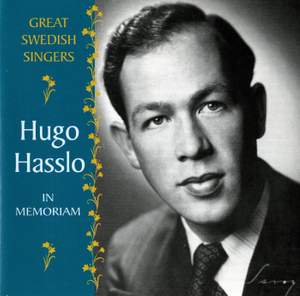
| |  | Great Swedish Singers: Hugo Hasslo In Memoriam
The Stockholm Opera was one of the leading European houses at the middle of the last century, partly due to the fact that so many great Sw. singers stayed at home. One of them, Hugo Hasslo, possessed a beautiful tenor-baritone voice. He even tried Cavaradossi once, but wisely kept to his baritone roles, in Verdi, Mozart, Donizetti and Rossini. After his retirement in the 60s he became a beloved and successful voice teacher. | |
|
| |  | Von der Königlichen Hofoper zur Staatsoper Unter den Linden
Albert, E: | Nun hab ich nichts als dich (from Tiefland) Max Roth | Bellini: | Casta Diva (from Norma) Lilli Lehmann | Bizet: | Votre toast je peux vous le rendre 'Toreador Song' (from Carmen) Karl Armster Si tu m'aimes, Carmen (from Carmen) Sung in German Walter Großmann | Cherubini: | Les Deux Journées: excerpt Sung in German | Donizetti: | Il segreto per esser felici (from Lucrezia Borgia) Sung in German Ernestine Schumann-Heink Povero Ernesto...cercherò lontano terra (from Don Pasquale) Sung in German Gino Sinimberghi | Flotow: | Ach, so fromm (from Martha) Richard Tauber | Gluck: | Cette nuit … O toi qui prolongeas mes jours (fromIphigénie en Tauride) Sung in German Zinaida Jurjewskaja | Gounod: | Il se fait tard ! Adieu ! (from Faust) Sung in German Karl Jörn Le veau d'or est toujours debout (from Faust) Sung in German Ludwig Hofmann | Leoncavallo: | No! Pagliaccio non son! (from I Pagliacci) Sung in German Josef Mann | Lortzing: | Du lässt mich kalt von hinnen scheiden (from Der Waffenschmied) Herbert Janssen | Meyerbeer: | Ah, mon fils! (from Le Prophète) Sung in German Marianne Brandt Adamastor, re dell'onde profonde (L'Africana) Sung in German Baptist Hoffmann | Mozart: | O Isis und Osiris, schenket (from Die Zauberflöte) Paul Knüpfer Ich baue ganz auf deine Stärke (from Die Entführung aus dem Serail) Crudel! perché finora farmi languir così? (from Le nozze di Figaro) Sung in German Lola Artot de Padilla Porgi amor (from Le nozze di Figaro) Sung in German Lilly Hafgren Der Hölle Rache kocht in meinem Herzen (from Die Zauberflöte) Gitta Alpar Ach, ich fühl's (from Die Zauberflöte, K620) Käthe Heidersbach La vendetta (from Le nozze di Figaro) Sung in German Alexander Kipnis Non piu andrai, farfallone amoroso (from Le Nozze di Figaro) Sung in German Willi Domgraf-Fassbänder Bei Männern, welche Liebe fühlen (from Die Zauberflöte) Margherita Perras Sull' aria che soave zeffiretto (from Le Nozze di Figaro) Sung in German Erna Berger Dies Bildnis ist bezaubernd schön (from Die Zauberflöte) Peter Anders | Mussorgsky: | Uf, tja zhelo! (from Boris Godunov) Sung in German Leo Schützendorf | Offenbach: | Elle a fui, la tourterelle (from Les Contes d' Hoffmann) Sung in German Emmy Bettendorf | Puccini: | Ah, quegli occhi… (from Tosca) Sung in German Mafalda Salvatini Recondita armonia (from Tosca) Sung in German Tino Pattiera O soave fanciulla (from La Bohème) Sung in German Hedwig von Debitzka Si, mi chiamano Mimi (from La Bohème) Sung in German Maria Cebotari Quando me'n vo (from La Bohème) Sung in German Carla Spletter | Saint-Saëns: | Amour, viens aider ma faiblesse (Samson et Dalila) Sung in German Marie Goetze | Strauss, J, II: | Dieser Anstand, so manierlich (from Die Fledermaus) Emilie Herzog Spiel’ ich die Unschuld vom Lande from Die Fledermaus Marie Dietrich | Verdi: | Un dì felice, eterea (from La traviata) Sung in German Frieda Hempel D'amor sull'ali rosee (from Il Trovatore) Sung in German Barbara Kemp Tutte le feste (from Rigoletto) Sung in German Claire Dux Stride la vampa (from Il Trovatore) Sung in German Emmi Leisner Vanne, la tua meta gia vedo…Credo in un Dio crudel (from Otello) Michael Bohnen Un ballo in maschera (excerpts) Sung in German Vera Schwarz Qui Radamès verrà!... O patria mia (from Aida) Gertrud Bindernagel Il Trovatore (excerpts) Heinrich Schlusnus Re dell’abisso affretati (Un ballo in maschera) Sung in German Theodor Scheidl Alla vita che t'arride (from Un ballo in maschera) Sung in German Theodor Scheidl Una macchia è qui tutt'ora (from Macbeth) Sung in German Gertrude Rünger Ella giammai m'amò (from Don Carlo) Sung in German Josef von Manowarda Pace, pace mio Dio! (from La forza del destino) Sung in German Hilde Scheppan | Wagner: | Athmest du nicht mit mir die sussen Dufte? (from Lohengrin) Wilhelm Grüning Das susse Lied verhallt (from Lohengrin) Ernst Kraus Dir töne Lob (from Tannhäuser) Francis MacLennan Vollendet das ewige Werk (from Das Rheingold) Hermann Bachmann Du Ärmste kannst wohl nie ermessen (from Lohengrin) Thila Plaichinger Als du in kuhnem Sange uns bestrittest (from Tannhäuser) Cornelis Bronsgeest Johohoe! Traft ihr das Schiff im Meere an 'Senta's Ballad' (from Der fliegende Holländer) Melanie Kurt Das ist nun der Liebe schlimmer Lohn (from Siegfried) Julius Lieban Siegmund heiß ich und Siegmund bin ich! (from Die Walküre) Rudolf Berger So ist’s denn aus...Deiner ew’gen Gattin (from Die Walküre) Margarete Arndt-Ober Winterstürme wichen dem Wonnemond (from Die Walküre) Walther Kirchhoff Athmest du nicht mit mir die sussen Dufte? (from Lohengrin) Robert Hutt Ewig war ich (from Siegfried) Helene Wildbrunn Brünnhilde, heilige Braut! (from Götterdammerung) Fritz Soot Verachtet mir die Meister nicht (from Die Meistersinger von Nürnberg) Friedrich Schorr Lass sie mich heilen (from Tristan und Isolde) Göta Ljungberg Hier sitz ich zur Wacht (from Götterdämmerung) Emanuel List Athmest du nicht mit mir die sussen Dufte? (from Lohengrin) Fritz Wolff Der Männer Sippe (from Die Walküre) Delia Reinhardt Dir töne Lob (from Tannhäuser) Max Lorenz Dich, teure Halle (from Tannhauser) Maria Müller Abendlich strahlt der Sonne Auge (from Das Rheingold) Rudolf Bockelmann Starke Scheite schichtet mir dort 'Brünnhilde's Immolation Scene' (from Götterdämmerung) Anny Konetzni War es so schmählich, was ich verbrach? (from Die Walküre) Eugen Fuchs Fanget an! (Die Meistersinger von Nürnberg) Set Svanholm Auf hohem Felsen lag ich (from Der fliegende Holländer) Irmgard Langhammer Das schöne Fest, Johannistag (from Die Meistersinger) Josef Greindl Dank, König, dir, daß du zu richten kamst! (from Lohengrin) Jaro Prohaska In fernem Land (from Lohengrin) Ludwig Suthaus Mild und leise 'Isolde's Liebestod' (from Tristan und Isolde) Paula Buchner | Weber: | Und ob die Wolke sie verhülle (from Der Freischütz) Tiana Lemnitz |
| | | Usually despatched in 2 - 3 working days. |
|
|
| |
|