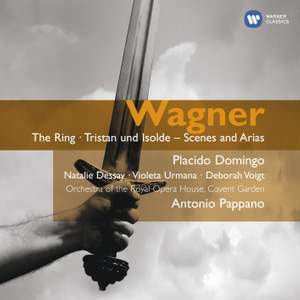
Prices shown exclude VAT. (UK tax is not payable for deliveries to United States.) See Terms & Conditions for p&p rates. | |  | Wagner - Arias & Love Duets
| | | In stock - usually despatched within 1 working day. |
|
|
| |  | Wagner: Siegfried (excerpts)
Erich Zimmermann (tenor), Max Lorenz (tenor), Bernd Aldenhoff (tenor), Wilma Lipp (soprano), Hermann Uhde (baritone), Hans Hopf (tenor), Herold Kraus (tenor), Emilie Feuge (soprano), Bruno Seidler-Winkler (piano) Bayreuth Festival Orchestra, Hans Knappertsbusch, Heinz Tietjen, Herbert von Karajan, Rudolf Kempe | 
| |
|
| |  | Wagner's Mastersinger, Hitler's SiegfriedThe life and times of Max Lorenz
| | A Film by Eric Schulz and Claus Wischmann DVD Interviewees: Dietrich Fischer-Dieskau, Klaus Geitel (writer);Walter Herrmann (Lorenz's biographer);Waldemar Kmentt, René Kollo, Lieselott Tietjen, Michael Wessolowski (expert on Max Lorenz); Hilde Zadek (soprano) | Wagner: | Siegfried: Act 1 Max Lorenz (Siegfried), Erich Witte (Mime), Herbert Janssen (Wanderer) & Emmanuel List (Fafner) Orquesta Estable del Teatro Colon, Erich Kleiber Siegfried (excerpts) Act 2 Max Lorenz (Siegfried), Erich Witte (Mime), Herbert Janssen (Wanderer) & Emmanuel List (Fafner) Orquesta Estable del Teatro Colon, Erich Kleiber |
Max Lorenz was the leading Wagner tenor of his day. As Siegfried, he was the principal protagonist on the stage of the Bayreuth Festival throughout the years of Hitler's association with the Festival. But his marriage to a Jewish singer and his homosexuality were a thorn in the flesh to many Nazis, and it was only his exceptional qualities as a singer that ensured that whenever the going got tough he was protected by the powers that be: when he was indicted for homosexual actions, Hitler ordered the case to be dropped, while Hermann Göring came to the support of Lorenz and his wife when members of the SS turned up at their house with a warrant for their deportation. The story of Max Lorenz is closely bound up with that of Bayreuth's Villa Wahnfried from the time of the Weimar Republic to the early years of the Federal Republic. No attempt to retrace the singer's steps can avoid taking in the wider picture and seeing this fascinating artist against the background of his age.The present television documentary examines the heroic ideal and the way in which Wagner's characters were portrayed onstage during this period, while also seeking answers to questions about Max Lorenz's career under the Third Reich and exploring the complications to which he was exposed. Central to our portrait is Max Lorenz as a singer. Our film depicts him in archival recordings from four decades. Comments are provided by numerous colleagues and contemporaries, including Dietrich Fischer-Dieskau, who admired Lorenz from an early date before finally appearing onstage with his idol; René Kollo, who regards his predecessor as "arguably the most important Wagner tenor of all"; the soprano Hilde Zadek; and the tenor Waldemar Kmentt.All of them knew Lorenz as a colleague over a period of many years.Another eyewitness is the dancer Lieselott Tietjen, the widow of the most powerful theatrical figure under the National Socialists, Heinz Tietjen.These and other interviewees are present whenever Max Lorenz sings: in the film, they are seen listening to him singing, allowing the camera to register their individual reactions and comments. In this way the art of Max Lorenz - in itself testimony to a bygone age in operatic history - becomes a fascinating part of the present day. This gripping, well - researched documentary boasts original footage of Max Lorenz, Haus Wahnfried and Hitler's visits to Bayreuth (e.g. the first coloured picture of Hitler) “just about the greatest thing that thrives in the way of tenors…He has the figure, the presence, the stature of a Wagnerian hero. He has an abundance of Bayreuth training." The New York Times (1937) “Max Lorenz, as this hour-long German TV documentary reminds us… was tall, personable and with a marvellously open-throated, lyrical voice, lighter-toned than Melchior's but more fluent and nuanced. …it is interesting to hear the admiring memories of singers like Waldemar Kmentt and Hilde Zadek, not to mention René Kollo and the great Fischer-Dieskau himself, and see Lorenz, still impressive in 1960s television footage.” BBC Music Magazine, May 2009 **** | | | Usually despatched in 2 - 3 working days. |
|
|
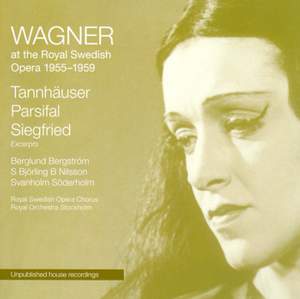
| |  | Wagner at the Royal Swedish Opera 1955-1959Royal Swedish Opera Archives Vol. 7
All excerpts sung in Swedish | | | Usually despatched in 4 - 5 working days. |
|
|
| |  | Wagner: Siegfried (excerpts)The 100th performance at the Royal Opera House, 25/6/1954
| | | Usually despatched in 3 - 4 working days. |
|
|
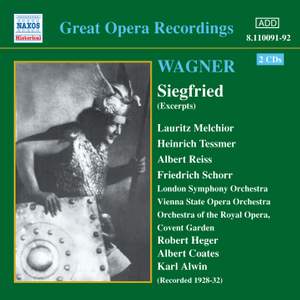
| |  | Wagner: Siegfried (excerpts)
Recorded 1928-1932 | |
|
| |  | Lauritz Melchior: Red Polydors and Blue Parlophones 1923-26Arias sung in German
| | | (also available to download from $21.00) | Usually despatched in 4 - 5 working days. (Available now to download.) |
|
|
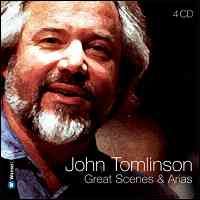
| |  | John TomlinsonGreat Scenes & Arias from Mozart, Wagner, and others
A bass baritone in the forefront of his profession, John Tomlinson is a singer and actor with tremendous vocal and stage presence regularly in demand for his portrayals of some of the most demanding roles in opera today. In a career that has lasted over three decades, he has performed with Glyndebourne Opera, Kent Opera, the New Opera Company at Sadler’s Wells, the Royal Opera House, Covent Garden and English National Opera, with whom he has had a 25-year association and performed 50 roles. Internationally, Tomlinson has made important appearances at San Francisco Opera, San Diego Opera, L’Opéra de Paris, the Salzburg Easter Festival, Deutsche Oper, Berlin Staatsoper, and at the opera houses of Munich, Dresden and Vienna. In 1988, John Tomlinson starred in Harry Kupfer’s new production of Der Ring des Nibelungen at the Bayreuth Festival with Daniel Barenboim conducting. It was with these performances that Tomlinson firmly established himself as the greatest living interpreter of Wotan (in Das Rheingold and Die Walküre) and of the Wanderer (in Siegfried) - these roles present what are generally regarded as being among the greatest vocal challenges in the entire operatic repertoire. He has sung at Bayreuth every year since. “…a generous offering to an artist whose own largesse, of voice and personality, has won him over many years now a special place in the affection of music lovers, particularly in his native country.” Gramophone Magazine, Awards Issue 2005 “Tomlinson's is a voice that carries the soul of the music in its every breath” Daily Telegraph | | | Usually despatched in 4 - 5 working days. |
|
|
| |  | Kirsten Flagstad: The Voice of a Century
The Norwegian soprano Kirsten Flagstad is considered to be one of the greatest Wagnerian singers of all time. This 10-CD set features recordings from the beginning of her international career in 1935 through to a few years before her death in 1962. In addition to her celebrated performances of the music of Wagner, she was also capable of delicate feeling in the interpretation of works by Handel, Gluck, Purcell, Weber and Beethoven, and music by these composers, together with a series of Grieg songs, are included in the collection. Finally, no survey of her art would be complete without her famous recording of Richard Strauss’s Four Last Songs from 1950. | | | Usually despatched in 4 - 5 working days. |
|
|
| |
|