Prices shown exclude VAT. (UK tax is not payable for deliveries to United States.) See Terms & Conditions for p&p rates. | |  | Fischer-Dieskau sings Brahms & Schumann
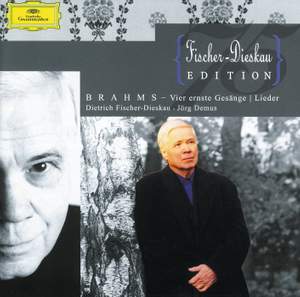
Brahms: | Vier ernste Gesänge, Op. 121 Sommerabend, Op. 85 No. 1 Mondenschein, Op. 85 No. 2 Es liebt sich so lieblich, Op. 71 No. 1 Meerfahrt, Op. 96 No. 4 Es schauen die Blumen, Op. 96 No. 3 Der Tod, das ist die kühle Nacht, Op. 96 No. 1 Mit vierzig Jahren, Op. 94 No. 1 Steig auf, geliebter Schatten, Op. 94 No. 2 Mein Herz ist schwer, Op. 94 No. 3 Kein Haus, keine Heimat, Op. 94 No. 5 Herbstgefühl, Op. 48 No. 7 Alte Liebe, Op. 72 No. 1 Abenddämmerung, Op. 49 No. 5 Heimweh, Op. 63 No. 8 Auf dem Kirchhofe, Op. 105 No. 4 Verzagen, Op. 72 No. 4 Regenlied (No. 3 from Acht Lieder und Gesänge, Op. 59) Nachklang (No. 4 from Acht Lieder und Gesänge, Op. 59) Fruhlingslied, Op. 85, No. 5 Auf dem See (No. 2 from Acht Lieder und Gesänge, Op. 59) Feldeinsamkeit, Op. 86 No. 2 An eine Äolsharfe, Op. 19 No. 5 Der Frühling, Op. 6 No. 2 Wie die Wolke nach der Sonne (No. 5 from Sechs Gesänge, Op. 6) Treue Liebe, Op. 7, No. 1 Heimkehr, Op. 7 No. 6 Juchhe! (No. 4 from Sechs Gesänge, Op. 6) Nachwirkung, Op. 6 No. 3 Mondnacht, WoO 21 Ein Sonett, Op. 14 No. 4 (Herder) Ständchen, Op. 14 No. 7 Vor dem Fenster Op. 14 No. 1 Scheiden und Meiden, Op. 19, No 2 Gang zur Liebsten, Op. 14 No. 6 Von verwundeten Knaben, Op. 14 No. 2 Murrays Ermordung, Op. 14 No. 3 Sehnsucht 'Mein Schatz ist nicht da', Op. 14 No. 8 Volkslied Kerstin Meyer (contralto) Duette (4), Op. 28 | Schumann: | Dichterliebe, Op. 48 |
‘You sing as if you had written it yourself!’ Jean Cocteau once told Dietrich Fischer-Dieskau. This anthology of lieder by Brahms and Schumann is a prime example of the great singer doing just that, mining every nuance of emotion from a song while, at the same time, sounding as spontaneous and free as if he were making it up on the spot. One of the hallmarks of Fischer-Dieskau’s legacy is the ease with which he creates the spell of each individual song, drawing the listener – apparently effortlessly – into the drama created by the words and the music. Fischer-Dieskau recorded extensively for Deutsche Grammophon, and the bulk of his archive has been mined on CDs. These recordings, however, are rarities. The songs on CD1 appeared only as part of the Fischer-Dieskau Edition for his 75th birthday. The Brahms songs on CD2 make their first appearance on CD. And the 1957 recording of Schumann’s Dichterliebe with his long-time pianist Jörg Demus, only appeared as part of Deutsche Grammophon’s centenary edition. CD2 includes the Four Duets, Op. 28 in which Fischer-Dieskau is partnered by an artist not heard enough on records, the contralto Kerstin Meyer. This release marks the launch of an Eloquence series of notable recitals of songs and opera arias by some of the great voices of Decca and Deutsche Grammophon. “Fischer-Dieskau is a superb interpreter of the cycle” Gramophone Magazine (Dichterliebe) “this is a masterly performance, a towering interpretation of these dark, noble songs” Gramophone Magazine (Brahms: Four Serious Songs) “Fischer-Dieskau is splendid in the furious little Hahm setting, Kein Haus, keine Heimat, the shortest of all Brahms’s songs, and gives a ravishing account of Feldeinsamkeit. … [His] performance is clearly among the greatest” Gramophone Magazine (Brahms) “A moving Brahms Four Serious Songs from a young and physically impassioned Fischer-Dieskau, and a fascinatingly exploratory Dichterliebe from 1957, both incomparably accompanied.” BBC Music Magazine, June 2012 ***** | | | In stock - usually despatched within 1 working day. |
|
|
| |  | Fischer-Dieskau 85th Birthday Edition: Brahms LiederBerlin Philharmonie, 1972 (live)
Brahms: | Nachtwandler, Op. 86 No. 3 Wehe, so willst du mich wieder, Op. 32 No. 5 Abenddämmerung, Op. 49 No. 5 Meerfahrt, Op. 96 No. 4 Wie rafft' ich mich auf Op. 32,1 (v.Platen) Geheimnis, Op. 71 No. 3 Wir wandelten, wir zwei zusammen Op. 96/2 Botschaft, Op. 47 No. 1 Lindes Rauschen in den Wipfeln, Op. 3, No. 6 Regenlied (No. 3 from Acht Lieder und Gesänge, Op. 59) Ständchen, Op. 106 No. 1 Wie bist du, meine Königin Op. 32 No. 9 Fruhlingslied, Op. 85, No. 5 Unüberwindlich, Op. 72 No. 5 Sonntag, Op. 47 No. 3 Der Gang zum Liebchen, No. 1, Op. 48 Wehe, so willst du mich wieder, Op. 32 No. 5 Feldeinsamkeit, Op. 86 No. 2 |
These releases from the archives of the RIAS and the Sender Freies Berlin document the unequalled quantitative and qualitative spectrum which baritone Fischer-Dieskau acquired during the five decades of his career. They offer a fascinating insight into the breadth of his repertoire as well as his artistic approach, with which he maintained a careful balance of development and continuity until the end. These recordings – spanning Beethoven’s sacred songs Op. 48 of 1806, through Schumann, Brahms, Mahler and Reger, to Heinrich Sutermeister’s expressive psalm setting of 1948 – demonstrate the essential Fischer-Dieskau. Not only do they document the artistic partnership with pianists such as Hertha Klust, Daniel Barenboim, Cord Garben, Aribert Reimann and Tamás Vásáry, but also the delightful collaboration with the organist Ulrich Bremsteller. Furthermore, Dietrich Fischer-Dieskau can be heard together with his wife and musical partner, Julia Varady. This is a documentary edition both in the sense of a historic and an artistic legacy: it reveals the riches of lieder from the last two centuries which Fischer-Dieskau, in his role of musical chronicler, made accessible for the present age; and it is an impressive record of an incomparable interpretational art, according to which word and music were always treated and realised as a unit. | | | Usually despatched in 3 - 4 working days. |
|
|
| |  | Brahms: The Two Viola Sonatasand other works arranged for viola and piano by Ettore Causa
Ettore Causa (viola), Marc Pantillon (piano) | | | Usually despatched in 4 - 5 working days. |
|
|
| |  | Janet BakerBrahms - Lieder
Brahms: | Heimweh, Op. 63 No. 8 O kühler Wald, Op. 72 No. 3 Geheimnis, Op. 71 No. 3 Wir wandelten, wir zwei zusammen Op. 96/2 Meerfahrt, Op. 96 No. 4 Ständchen, Op. 106 No. 1 Ein Wanderer, Op. 106 No. 5 Regenlied (No. 3 from Acht Lieder und Gesänge, Op. 59) Das Mädchen spricht, Op. 107 No. 3 Mädchenlied, Op. 107 No. 5 Mondnacht, WoO 21 Auf dem Kirchhofe, Op. 105 No. 4 Feldeinsamkeit, Op. 86 No. 2 Vergebliches Ständchen, Op. 84 No. 4 An die Nachtigall, Op. 46 No. 4 (Text: L.C.H. Hölty) Meine Liebe ist grün, Op. 63 No. 5 Herbstgefühl, Op. 48 No. 7 Abendregen, Op. 70 No. 4 Verzagen, Op. 72 No. 4 Nachtwandler, Op. 86 No. 3 Komm bald, Op. 97 No. 5 (Groth) Der Tod, das ist die kühle Nacht, Op. 96 No. 1 Von ewiger Liebe, Op. 43 No. 1 |
Recorded: BBC Studios, London, 16 September 1960 / 4 January 1968 / 7 February 1961 “Listening to these Brahms songs culled from BBC broadcasts one realises just why Dame Janet's reputation continues to remain so high and why so many of her successors don't quite match her standards. To every song here, familiar or unfamiliar, she brings her special ability of making it her own and reaching to its heart. It's an almost uncanny gift, and not one easy to explain, but it makes every song in this programme momentous. Wondrous is the sustained half-voice with which she invests Nachtwandler with its intimate, sad feeling. Then there's the outpouring of joy that is Meine Liebe ist grün to which she brings the most lustrous tone and an outgoing manner, and finally the gentle sense of fun, never overdone, which she brings to the very familiar VergeblichesStändchen. If Brahms had written no other songs than Feldeinsamkeit, Der Tod, das ist die kühle Nacht and Von ewiger Liebe, he would surely be hailed as a great Lieder composer. Baker obviously understands their astonishing high quality. The first is sung, as it should be, with a kind of inner wonder, each amazing line given its full due. In the second, a Liebestod avant la lettre, she sings with the proper impassioned feeling, while the last, a happier statement of eternal love, is sung with the rugged conviction that always showed the singer at her very best. Lush and Hamburger, especially the latter, are fully cognisant of what to do with Brahms's intricate writing for the piano. The sound is admirable, catching early Baker in full flow.” Gramophone Classical Music Guide, 2010 “This is an important disc and one that will give great pleasure since it contains so much fine and deeply committed singing. It’s certainly a mandatory purchase for all admirers of Brahms’s lieder or of Dame Janet Baker.” MusicWeb International “what singing: what a voice, what beauty of line, variety of colour, incisive diction and unforced mastery of the whole difficult art of Lieder…the disc is a feast.” The Times | | | (also available to download from $10.50) | Usually despatched in 2 - 3 working days. (Available now to download.) |
|
|
| |  | Brahms: | Sommerabend, Op. 85 No. 1 Mondenschein, Op. 85 No. 2 Es liebt sich so lieblich, Op. 71 No. 1 Meerfahrt, Op. 96 No. 4 Es schauen die Blumen, Op. 96 No. 3 Der Tod, das ist die kühle Nacht, Op. 96 No. 1 | Liszt: | Vergiftet sind meine Lieder, S.289 Du bist wie eine Blume Im Rhein, im schönen Strome, S272 Morgens steh ich auf und frage, S290 Die Lorelei | Schumann: | Dichterliebe, Op. 48 |
Deon van der Walt (tenor), Charles Spencer (piano) | | | Usually despatched in 2 - 3 working days. |
|
|
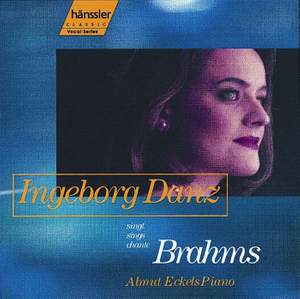
| |  | Ingeborg Danz sings Brahms
Brahms: | In Waldeseinsamkeit, Op. 85 No. 6 Alte Liebe, Op. 72 No. 1 Nachklang (No. 4 from Acht Lieder und Gesänge, Op. 59) Verzagen, Op. 72 No. 4 Regenlied (No. 3 from Acht Lieder und Gesänge, Op. 59) Es liebt sich so lieblich, Op. 71 No. 1 Feldeinsamkeit, Op. 86 No. 2 An eine Äolsharfe, Op. 19 No. 5 Auf dem See (No. 2 from Acht Lieder und Gesänge, Op. 59) Geheimnis, Op. 71 No. 3 Sommerabend, Op. 85 No. 1 Dämmrung senkte sich von oben (No. 1 from Acht Lieder und Gesänge, Op. 59) Mondenschein, Op. 85 No. 2 So wünsch' ich ihr ein gute Nacht (No. 18 from Deutsche Volkslieder, WoO 33) Schwesterlein, WoO posth. 37 No. 1 Feinsliebchen, du sollst mir nicht barfuß gehen (No. 12 from Deutsche Volkslieder, WoO 33) Die Sonne scheint nicht mehr (No. 5 from Deutsche Volkslieder, WoO 33) In stiller Nacht (No. 42 from Deutsche Volkslieder, WoO 33) Da unten im Tale (No. 6 from Deutsche Volkslieder, WoO 33) Es schauen die Blumen, Op. 96 No. 3 Der Tod, das ist die kühle Nacht, Op. 96 No. 1 Meerfahrt, Op. 96 No. 4 Wiegenlied, Op. 49 No. 4 (Lullaby) Ach, englische Schäferin (No. 8 from Deutsche Volkslieder, WoO 33) |
Ingeborg Danz (Alto), Almut Eckels (piano) | |
|
| |
|