All recordingsPrices shown exclude VAT. (UK tax is not payable for deliveries to United States.) See Terms & Conditions for p&p rates. | |  | Schubert: Symphonies Nos. 1-9 (Complete)Live recordings from Munich’s Prinzregententheater made in March 2001.
With his works by single composer, Lorin Maazel made history as Chief Conductor of the Symphonieorchester des Bayerischen Rundfunks. After the successful release of the album containing the complete symphonic works of Anton Bruckner, the BR-KLASSIK label now presents the complete symphonies of Franz Schubert, recorded in 2001. The present Chief Conductor of the Munich Philharmonic had already conducted Schubert’s “Unfinished Symphony” at the age of eight. The second album featuring the long-standing Chief Conductor of the BR Symphonieorchester. Live recordings from Munich’s Prinzregententheater made in March 2001. First release at an attractive midprice. “These interpretations are by and large more tense and taut than the genial, relaxed manner typified by many previous, celebrated interpreters...Maazel’s treatment of the Fourth is urgent and vital...The performance of D.759 is graced by gorgeous instrumental tone in every department.” MusicWeb International, 24th May 2013 | 
| | | (also available to download from $25.25) | Usually despatched in 2 - 3 working days. (Available now to download.) |
|
|
| |  | Schubert: Symphonies Nos. 1-9 (Complete)
In the course of the 1996-97 season, Anima Eterna played and recorded Schubert's complete symphonies in the particularly innovative interpretation of their conductor, Jos van Immerseel. This interpretation, based on the study of Schubert's manuscripts and on the instruments used at the time of their first performance, allows us to discover sound colours that combine freshness and profundity. Upon its initial release, this series of 4 CDs was recognized internationally as a new reference. “these pieces gain most from the transparent textures, woody woodwinds and natural, alfresco-sounding brass.” Sunday Times, 18th November 2012 | | Zigzag - ZZT308 (CD - 4 discs) Normally: $35.00 Special: $26.95 |
| | In stock - usually despatched within 1 working day. |
|
|
| |  | Schubert: Symphonies Nos. 1-9 (Complete)
Following the extremely successful recording of Haydn complete London Symphonies released in 2010, Marc Minkowski, Naïve and the Wiener Konzerthaus set up a new project, even more ambitious although similar in form: to perform for the Viennese audience and record the complete symphonies of Schubert in the same week, in March this year. 2012 marks the 30th anniversary of Les Musiciens du Louvre Grenoble. Major concerts will take place in Paris this Autumn to celebrate this event. This 4-CD set on period instruments sheds a new light on all the Symphonies, some not as highly considered as perhaps they should be. Les Musiciens du Louvre Grenoble use instruments of the Classical era, laid out according to Viennese tradition, with the violins on either side of the conductor and the double basses in a line facing him. The oboe too is of Viennese manufacture: its highly idiosyncratic bore produces a sound, at once nasal and tender, that is immediately recognisable – indeed, despite developments in instrument making and the multiplication of keys, the modern version of this instrument is still not so very far removed from the oboe that Schubert knew. Four double basses are used in general but only two for the Fifth Symphony, which is written in a more central tessitura and dispenses with clarinets, trumpets, and timpani. ‘In the “Great C major”, on the other hand,’ explains Marc Minkowski, ‘Schubert’s ambitions recall, relatively speaking, those of Haydn in The Creation or Beethoven in the Ninth Symphony. That’s why I chose to deploy five basses and to double the first flute and oboe parts and the second clarinet and bassoon parts: the use of three instruments per section allows us to obtain that organ sonority that was later to define the Bruckner rchestra, whereas the woodwind, in the early symphonies, sound like a pastoral group. When all is said and done, the key word for all this music is melancholy, even at the height of virtuosity – and goodness knows that these works, more ideal than practical, remain behind their apparent simplicity very risky to bring off in performance. Schubert wrote with genius for the orchestra, but his thought, much more than that of Mozart or Beethoven, was situated outside reality, in the tumultuous imagination of a young – sometimes very young – man, at the frontiers of the possible.’ “these pieces gain most from the transparent textures, woody woodwinds and natural, alfresco-sounding brass.” Sunday Times, 18th November 2012 “One need hear only the beautifully balanced and weighted wind chords at the opening of the Symphony No. 3 to be aware that this set is going to have exceptional qualities. And so it proves … a performance that is utterly compelling from first to last note … an exceptional set” Early Music Review, December 2012 “the performances of the earlier works are lithe, energised and generally transparent – the Mozartian freshness of the Fifth is beautifully judged, for instance. The treatment of the final two symphonies is less convincing, however.” The Guardian, 20th December 2012 **** “[Minkowski] never treats the first six as a series of dry warm-up exercises...Period timbres lend the former a huskier, more subdued tone, the narrow-bore trombones adding plenty of colour...this C Major doesn’t feel like too much of a good thing, despite Schubert’s exhaustive repeats. Minkowski’s unforced geniality in the Scherzo’s trio is a joy. Amazing stuff, and beautifully recorded in a glowing acoustic.” The Arts Desk, 2nd February 2013 “Minkowski takes a surprisingly conventional view of these pieces, though his performances, recorded 'live' in Vienna's Konzerthaus, are none the worse for that...impressive performances, greatly aided by the skilful playing of Les Musiciens du Louvre Grenoble and their admirable first oboe...This set can take its place among the very best of Schubert Symphony cycles.” BBC Music Magazine, March 2013 ***** | | | In stock - usually despatched within 1 working day. |
|
|
| |  | Schubert: Symphonies Nos. 1-9
| | | In stock - usually despatched within 1 working day. |
|
|
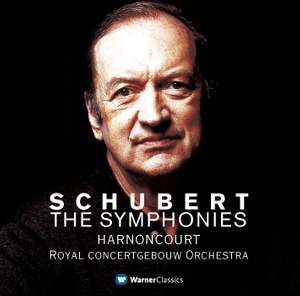
| |  | Schubert - The Symphonies
Review of Harnoncourt/Royal Concertgebouw Schubert Symphonies CDs in Classic CD:
“The playing bristles with the energy and optimism of a youthful composer aware of the symphonic heritage (Haydn, Mozart and Beethoven are regularly alluded to in passing), but already speaking in a clear, individual language of his own. [The Royal Concertgebouw Orchestra’s] playing throughout the cycle is extraordinarily sensitive to Harnoncourt’s direction. … Dramatic performances of the two ‘mature’ symphonies … set the seal on what is undoubtedly the Schubert symphony cycle of the 1990s.” “They look beyond the printed page...and gift all listeners with illuminating interpretations.” Gramophone Magazine, July 2012 | | | In stock - usually despatched within 1 working day. |
|
|
| |  | Schubert: Symphonies Nos. 1-9 (Complete)
“incandescent atmosphere and magisterial playing” Classic FM Magazine, August 2011 “These are marvellous performances: vibrant, clear, characterful and effortlessly well played. The recordings, too, still seem new-minted, even the Ninth, the first of the symphonies to be recorded. The Berliners' art is the art that disguises art. Böhm never feels the need to do anything clever but just quietly sees to it that this superb orchestra plays at its best. Böhm's way with the two late symphonies is, in fact, highly sophisticated. The Unfinished begins in what seems to be a leisurely fashion but his performance of the first movement catches Schubert's mix of lyricism and high drama with extraordinary acuity. Conversely, the second movement seems swift but brings the work full circle with an equally extraordinary sense of calm and catharsis in the final pages. The celebrated 1963 Ninth out-Furtwänglers Furtwängler in the myriad means it uses within a single grand design to capture the symphony's sense of danger and derring-do in addition to its lyricism, nobility, and earthy Austrian charm. In the early symphonies, Böhm's approach is simpler-seeming and more direct. Rhythms are so finely propelled, the pulse so effortlessly sustained, the music always lands on its feet. The zest comes from the stylish Berlin string- playing; melodically, it's the woodwinds (every one a Lieder singer) who catch the beauty of Schubert's melodies and the skirl of the attendant descants. You won't find yourself tiring of Böhm's approach; he doesn't give in to irritating idiosyncrasies (à la Harnoncourt), but ensures that the Schubertian stream is always clear to the eye and sweet to the taste.” Gramophone Classical Music Guide, 2010 | | | In stock - usually despatched within 1 working day. |
|
|
| |  | Schubert - The Complete Symphonies
| | | In stock - usually despatched within 1 working day. |
|
|
| |  | Schubert: Symphonies Nos. 1-9 (Complete)
Live recordings | | | In stock - usually despatched within 1 working day. |
|
|
| |  | Schubert: Symphonies Nos. 1-9 (Complete)
“They look beyond the printed page...and gift all listeners with illuminating interpretations” Gramophone Magazine, July 2012 | | (Sorry, download not available in your country) | |
|
|
| |  | Schubert: Symphonies Nos. 1-9 (Complete)
| | | (Sorry, download not available in your country) | Usually despatched in 8 - 10 working days. |
|
|
| |
|