Chopin: Polonaise No. 9 in B flat major, Op. 71 No. 2

This page lists all recordings of Polonaise No. 9 in B flat major, Op. 71 No. 2, by Frédéric François Chopin (1810-49) on CD & download (MP3 & FLAC). Generally, more recent releases are listed first, but with priority given to those that are in stock.

Prices shown exclude VAT. (UK tax is not payable for deliveries to United States.)
See Terms & Conditions for p&p rates.

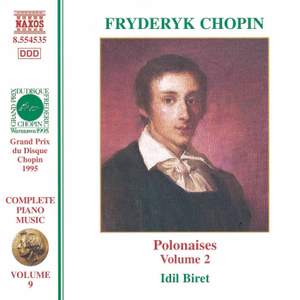
Chopin: Polonaises

Chopin: Polonaises


Chopin:

Polonaise No. 7 in A flat major, Op. 61 'Polonaise-fantaisie'

Polonaise No. 1 in C sharp minor, Op. 26 No. 1

Polonaise No. 2 in E flat minor, Op. 26 No. 2

Polonaise No. 3 in A major, Op. 40 No. 1 'Military'

Polonaise No. 4 in C minor, Op. 40, No. 2

Polonaise No. 5 in F sharp minor, Op. 44

Polonaise No. 6 in A flat major, Op. 53 'Héroïque'

Polonaise No. 8 in D minor, Op. 71 No. 1

Polonaise No. 9 in B flat major, Op. 71 No. 2

Polonaise No. 10 in F minor, Op. 71 No. 3

Andante spianato & Grande Polonaise, Op. 22


Polonaise: almost always, as soon as the word is uttered, it conjures up the name of Frédéric Chopin. And what could be more natural with a creative genius who was constantly attracted to the genre? His first work, published in Warsaw, was entitled ‘Polonaise for pianoforte dedicated to her Excellency the Countess Victoire Skarbek by Friderik Chopin, aged eight years’; and right up to the concluding Polonaise-Fantaisie, Op.61, fourteen other similar compositions had punctuated the all-too-brief career of the Polish maestro. Before Chopin, a number of musicians had devoted themselves to the polonaise since its appearance in the sixteenth century under the name of ‘Polish Dance’, before assuming that simply of ‘Polonaise’ (‘Polish’) in the following century. Gradually this dance in triple time had extended its influence to the whole of Europe. Undoubtedly some admirable polonaises had been written, but at the expense of the original essence of a proud, manly and noble dance. To Frédéric Chopin fell the honour of reviving that initial virility – of recreating the polonaise.

Franz Liszt had not been mistaken when, shortly after the premature death of his friend, he wrote: ‘His Polonaises... are among his most inspired creations; in no way do they remind us of those over-ornate, pretty-pretty pieces à la Pompadour... Their vigorous rhythm sets us quivering; it rouses us from our usual torpid indifference. The noblest sentiments of the Poland of old come to life in them. A sense of firm determination allied to gravity is what strikes us from the start. For the most part soldierly in spirit, they express gallantry and valour on a note of simplicity which typifies these qualities in a warrior nation. They exude a calm and thoughtful strength, and we feel we are back with those Poles of earlier days depicted in their chronicles.’

There could be no better commentary to introduce the Polonaise in A flat Op.53 (1843), one of Chopin’s most celebrated achievements whose usual nickname, the ‘Heroic’, sums up manly determination and fervour and a distinctly narrative character which has led some to detect in it an underlying programme. The ‘Military’ Polonaise in A major, Op.40 No.1 (1838), again paints a portrait of a valiant and combative people, an image which owes much to a rising melodic pattern and a verticality of composition issuing from vast and powerful chords. In complete contrast, the Polonaise in C minor, Op.40 No.2 (1839), is notable for its mood of distress. Is this not the bitterness and despondency of defeat at the close of day, seemingly born of the bass notes underlying the sombre chords from the right hand?

Four years before these two works of perfection Chopin had completed the two Polonaises Op.26. Created by a composer only twenty-five years old, they underline just how early in his career he had acquired a quite inimitable idiom. What vigour, indeed, in the first of these, in C sharp minor, which, if it does not make a clean break with the somewhat ornate manner of the polonaises of his even earlier youth (cf. Opus 71), already demonstrates an impressive authority. As for the second, the drama prefigured in the pianissimo of its opening bars is subsequently developed with an imagination expressed in sound which is astonishingly modern. The Polonaise in F sharp minor, Op.44 (1841) remains undoubtedly one of Chopin’s most enigmatic and disconcerting pieces. Its originality lies in its association of the polonaise with Chopin’s other favourite dance, the mazurka, and this association generates a strange atmosphere which Liszt, again, has wonderfully defined: ‘It is like the recounting of a dream in the first glimmering of a grey and misty winter dawn, a dream that follows a long, sleepless night, a dream-poem intermingling impression and reality which have no connection with one another, but which curiously coalesce.’

Published posthumously by Julien Fontana in 1871, the three Polonaises Op.71 – in D minor, B flat and F minor respectively – were written before their composer had finally left Poland. They are therefore the work of an adolescent who dazzled the aristocrats of Warsaw with his extraordinary talents. If here we are still far removed from the dramatic impact of the works which were to follow, we cannot fail to respond to the freshness and pianistic inventiveness of three compositions of great promise, made evident in a distinctive sense for contrast (No.1) or full-flavoured popular appeal (No.2).

As the orchestra plays an extremely limited and secondary role the Andante spianato et grande polonaise brillante in E flat can be performed without detriment on the solo piano. This work, so rich in lyricism and sparkle, was written between 1830 and 1834 and crowns that period of stylistic brilliance begun before his departure from Poland. Imbued with all the insouciance of a young composer intent on winning over his public, this work derives its impact from the contrast between the peaceful atmosphere and half-toned cantabile of the Andante, and the triumphant high spirits of the polonaise which follows.

With the Polonaise-Fantaisie in A flat, Op.61 (1846), Chopin made his last incursion into the world of the polonaise. The listener must not be put off by the evident multiformity of a masterpiece which is remarkable for the variety and complexity of the feelings and moods it expresses. The Polonaise-Fantaisie belongs among those works one gradually gets to grips with, constantly improving one’s appreciation of the inexhaustible wealth of poetry and the compositional audacities which, as with the fourth Ballade, place it among its author’s most visionary achievements.

Virgin Premium - 0293162

(CD)

$11.00

In stock - usually despatched within 1 working day.

The Welte-Mignon Mystery Volume 13

The Welte-Mignon Mystery Volume 13


Chopin:

Nocturne No. 8 in D flat major, Op. 27 No. 2

Polonaise No. 9 in B flat major, Op. 71 No. 2

Heller, S:

Prelude, Op. 81 No. 3 in G major

Prelude, Op. 81 No. 10 in C sharp minor

Leschetitzky:

Barcarolle, Op. 39 No. 1

La Source, Op. 36 No. 4

Arabesque en forme d’Etude, Op. 45 No. 1

L'Aveu, Op. 31 No. 1

Mazurka, Op. 24 No. 2 in E flat major

Canzonetta Toscana all'antica, Op. 39 No. 3

Impromptu 'Les deux Alouettes', Op. 2 No. 1

Mozart:

Fantasia in C minor, K475


Theodor Leschetizky (piano)

TACET’s much praised recording technique enables these recordings of 1906 to be heard for the first time linked to a modern Steinway.

Tacet - The Welte Mignon Mystery - TACET177

(CD)

$17.00

In stock - usually despatched within 1 working day.

Chopin - 11 Polonaises

Chopin - 11 Polonaises


Chopin:

Polonaise No. 1 in C sharp minor, Op. 26 No. 1

Polonaise No. 2 in E flat minor, Op. 26 No. 2

Polonaise No. 3 in A major, Op. 40 No. 1 'Military'

Polonaise No. 4 in C minor, Op. 40, No. 2

Polonaise No. 5 in F sharp minor, Op. 44

Polonaise No. 6 in A flat major, Op. 53 'Héroïque'

Polonaise No. 7 in A flat major, Op. 61 'Polonaise-fantaisie'

Andante spianato & Grande Polonaise, Op. 22

Polonaise No. 8 in D minor, Op. 71 No. 1

Polonaise No. 9 in B flat major, Op. 71 No. 2

Polonaise No. 10 in F minor, Op. 71 No. 3

Fantasia in F minor, Op. 49

Tarantella in A flat major, Op. 43

Barcarolle in F sharp major, Op. 60

Trois Nouvelles Études

Rondo in C major for two pianos, Op. 73

with Pierre Barbizet


The French pianist Samson François (1924–1970) recorded three complete Chopin sequences: the ballades, which brought him his first great success on record, the nocturnes and the polonaises. François learned his Chopin from Alfred Cortot, from whom he inherited a visionary style which suits the polonaises particularly well. (By an irony, Cortot himself played these works relatively rarely and recorded almost none of them.)

It was Chopin that François chose for his first recordings, which he made at the end of the 1940s on the Brunswick label. He recorded the polonaises twice: first in mono in 1958; then the present stereo version, made in the Salle Wagam in 1968 and 1969. There is no fundamental change of conception. If the mono recording benefits from the natural acoustic of the Salle de la Mutualité and at times offers something more rapt, it also affords less bel canto in the right hand too: the effect is more battling than dancing,so to speak.

Above all, these polonaises achieve a dramatic tension that sets them apart from other contemporary versions on disc: neither Rubinstein, supremely elegant as always, nor Stefan Askenaze, who cherishes the dance element, approach these works with such intensity.

The couplings are a handful of late works recorded at the end of sessions devoted to the nocturnes: the Trois Nouvelles Etudes, the Tarentelle, the Fantaisie in F minor and the F sharp Barcarolle share the same overcast outlook, and to that extent are a perfect foil to the often exuberant polonaises.

François played all the Chopin that was published in his day: even the C major Rondo for two pianos of 1828, reworked for four hands from an earlier solo piece, and recorded here with the pianist’s lifelong friend Pierre Barbizet.

All tracks are newly transferred and remastered to ART standard at Abbey Road Studios.

Award: Diapason d’Or

“François is not always immaculate, but his playing has real character and flair. The tempos are often unusually brisk, although he never sounds harried or hustled. This is sovereign playing that emphasises Gallic grace.” BBC Music Magazine, March 2009 ****

EMI Great Recordings of the Century - 2126952

(CD - 2 discs)

$16.25

In stock - usually despatched within 1 working day.

Evgeni Bozhanov: Highlights from the 16th International Fryderyk Chopin Competition Warsaw October 2010

Evgeni Bozhanov: Highlights from the 16th International Fryderyk Chopin Competition Warsaw October 2010


Chopin:

Nocturne No. 17 in B major, Op. 62 No. 1

Etude Op. 10 No. 11 in E flat major

Étude Op. 10 No. 5 in G flat major 'Black Key'

Ballade No. 3 in A flat major, Op. 47

Barcarolle in F sharp major, Op. 60

Rondo a la Mazurka, Op. 5

Impromptu No. 3 in G flat major, Op. 51

Polonaise No. 9 in B flat major, Op. 71 No. 2

Waltz No. 5 in A flat major, Op. 42

Mazurkas Op. 59 Nos. 1-3

Polonaise No. 7 in A flat major, Op. 61 'Polonaise-fantaisie'

Piano Sonata No. 3 in B minor, Op. 58

Mazurka No. 21 in C sharp minor, Op. 30 No. 4

Mazurka No. 32 in C sharp minor, Op. 50 No. 3

Mazurka No. 29 in A flat major, Op. 41 No. 4

Piano Concerto No. 1 in E minor, Op. 11

Warsaw Philharmonic Orchestra, Antoni Wit


Evgeni Bozhanov (piano)

Evgeni Bozhanov is a distinguished Bulgarian pianist carried by the temperament of great virtuosity from the late 19th and the early 20th century. He is the winner of the 2nd Prize in the prestigious Queen Elisabeth International Music Competition of Belgium [Belgium, 2010] and has won awards in numerous piano competitions since 1996, including 4th prize in the 16th International Fryderyk Chopin Piano Competition in Warsaw [2010].

This CD gives the listener the opportunity to savour the artistry of Bozhanov’s piano playing, as it illustrates well his interesting and individual approach to Frederic Chopin’s works.

Frederick Chopin Institute - NIFCCD608-609

(CD - 2 discs)

$34.00

Usually despatched in 2 - 3 working days.

Chopin: Selected Works

Chopin: Selected Works


Chopin:

Barcarolle in F sharp major, Op. 60

Polonaise No. 9 in B flat major, Op. 71 No. 2

Impromptu No. 3 in G flat major, Op. 51

Waltz No. 8 in A flat major, Op. 64 No. 3

Waltz No. 5 in A flat major, Op. 42

Ballade No. 3 in A flat major, Op. 47

Piano Sonata No. 3 in B minor, Op. 58


Evgeni Bozhanov (piano)

Recorded in the mythical Salle de Musique at La-Chaux-de-Fonds in Switzerland, this is the first solo recital of Evgeni Bozhanov (°1984), the Bulgarian pianist who has been shaking the piano world for over a year. At the major international competitions in which he has taken part since 2009, always reaching the finals, nobody remained indifferent – neither jury members nor public – to this exceptionally gifted pianist, seated in a low position and drawing unbelievable sounds from his piano.

Whether in Warsaw (Chopin 2010), Fort Worth (Van Cliburn 2009) or Brussels (Queen Elisabeth 2010), he produced a resolutely personal sound, notably in Chopin. Thanks to his Second Prize at the prestigious Queen Elisabeth Music Competition, awarded on 1st June 2010, Evgeni Bozhanov was given the opportunity to leave a trace of his so original art with Fuga Libera, in coproduction with the bank BNP Paribas Fortis, who chose him as their laureate for 2010-11 for a private concerts series.

Close your eyes, listen and discover!

Fuga Libera - FUG579

(CD)

$17.00

(also available to download from $10.50)

Usually despatched in 4 - 5 working days. (Available now to download.)

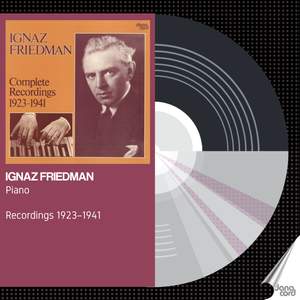
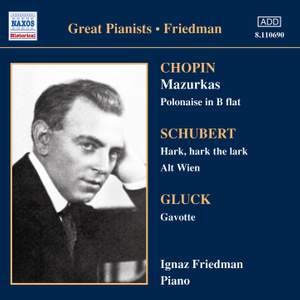
The Great Pianists Volume 14 - Ignace Friedman

The Great Pianists Volume 14 - Ignace Friedman


Bach, J S:

Toccata & Fugue in D minor, BWV565

Chopin:

Waltz No. 1 in E flat major 'Grande Valse Brillante', Op. 18

Impromptu No. 1 in A flat major, Op. 29

Waltz No. 6 in D flat major, Op. 64 No. 1 'Minute Waltz'

Polonaise No. 9 in B flat major, Op. 71 No. 2

Friedman, I:

Elle danse, Op. 10 No. 5

Old English Minuet (Shield)

Viennese Dance No. 1 (after Eduard Gärtner)

Viennese Dance No. 2 (after Eduard Gärtner)

Viennese Dance No. 3 (after Eduard Gärtner)

Viennese Dance No. 4 (after Eduard Gärtner)

Liszt:

Grande Étude de Paganini, S. 141 No. 3 'La Campanella'

Hungarian Rhapsody, S244 No. 14 in F minor

Moszkowski:

Serenata in D major, Op. 15 No. 1

Rubinstein:

Romance in E flat major, Op. 44 No. 1 'The Night'

Schumann:

Fantasiestücke, Op. 12 No. 1 'Des Abends'

Warum, Op. 12, No. 3

Wagner:

Die Walkure: Magic Fire Music


Ignace Friedman (piano)

The Masters of the Piano Roll continues with Volume 14 in this series of recordings of the great pianists of the 20th Century.

These piano rolls are nearly 100 years old and come from a collection owned by Denis Condon who is one of the world’s most respected authorities on the piano roll and has some 18,000 in his collection

These recordings were made in 1992 and recorded on a brand new Yamaha Concert Grand under Denis’s supervision – they are not historical recordings.

Dal Segno - The Great Pianists - DSPRCD054

(CD)

$10.50

Usually despatched in 8 - 10 working days.

Chopin: Waltzes & Polonaises

Chopin: Waltzes & Polonaises


Chopin:

Waltz No. 1 in E flat major 'Grande Valse Brillante', Op. 18

Waltz No. 2 in A flat major 'Grande Valse Brillante', Op. 34 No. 1

Waltz No. 3 in A minor 'Grande Valse Brillante', Op. 34 No. 2

Waltz No. 4 in F major 'Grande Valse Brillante', Op. 34 No. 3

Waltz No. 5 in A flat major, Op. 42

Waltz No. 6 in D flat major, Op. 64 No. 1 'Minute Waltz'

Waltz No. 7 in C sharp minor, Op. 64 No. 2

Waltz No. 8 in A flat major, Op. 64 No. 3

Waltz No. 9 in A flat major, Op. 69 No. 1 'Farewell Waltz'

Waltz No. 10 in B minor, Op. 69 No. 2

Waltz No. 11 in G flat major, Op. 70 No. 1

Waltz No. 12 in F minor, Op. 70 No. 2

Waltz No. 13 in D flat major, Op. 70 No. 3

Waltz No. 14 in E minor, Op. post., KKIVa:15, B 56

Waltz No. 15 in E major, Op. post., KKIVa:12, B 44

Waltz No. 16 in A flat major, Op. post., KKIVa:13, B 21

Waltz No. 18 in E flat major 'Sostenuto', Op. post., KKIVb:10, B 133

Waltz No. 19 in A minor, Op. post., KKIVb:11, B 150

Polonaise No. 11 in G minor B1/KKIIa:1

Polonaise No. 13 in A flat major B5/KKIVa:2

Polonaise No. 11 in B flat minor, BI 13 'Adieu'

Polonaise No. 9 in B flat major, Op. 71 No. 2


Marek Drewnowski (piano)

Drewnowski started playing the piano as a young child. In 1975 he recorded piano sonatas by Scarlatti and Leonard Bernstein was so impressed by his performances that he invited him to the Tanglewood Music Festival. These days he is professor of piano at the Schola Cantorum in Paris and the Academy of Music in Łódź, Poland. Here he performs on a Pleyel 1848 fortepiano.

Frederick Chopin Institute - The Real Chopin - NIFCCD019

(CD)

$17.00

Usually despatched in 2 - 3 working days.

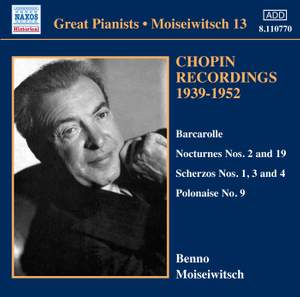
Great Pianists - Moiseiwitsch 13

Great Pianists - Moiseiwitsch 13

Chopin Recordings Volume 3 (1939-1952)


Chopin:

Barcarolle in F sharp major, Op. 60

Polonaise No. 9 in B flat major, Op. 71 No. 2

Nocturne No. 2 in E flat major, Op. 9 No. 2

Nocturne No. 19 in E minor, Op. 72 No. 1

Scherzo No. 1 in B minor, Op. 20

Scherzo No. 3 in C sharp minor, Op. 39

Scherzo No. 4 in E major, Op. 54

Mendelssohn:

A Midsummer Night's Dream: Scherzo

arr. Rachmaninov. Appendix


Producer and Audio restoration engineer: Ward Marston

“Supple pianism and poetic sensibility characterise Moiseiwitsch's Chopin” BBC Music Magazine, September 2010 ****

“Benno Moiseiwitsch always ranked among the world's most delectable pianists. And here...he shows himself as gloriously free, mischievous and mercurial. He can be curt, skittish or rhapsodic, seemingly at will...these performances are rarely less than personal and beguiling.” Gramophone Magazine, September 2010

20% off Naxos

Naxos Historical Great Pianists - 8110770

(CD)

Normally: $8.25

Special: $6.60

Usually despatched in 2 - 3 working days.

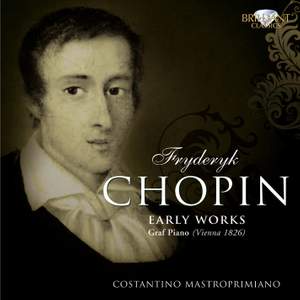
Chopin - Early Works

Chopin - Early Works


Chopin:

Rondo in C minor Op. 1

Rondo a la Mazurka, Op. 5

Polonaise No. 8 in D minor, Op. 71 No. 1

Polonaise No. 10 in F minor, Op. 71 No. 3

Polonaise No. 9 in B flat major, Op. 71 No. 2

Variations in A - Souvenír de paganini

also includes:

Polonaise in A Flat Major (dedicated to Zywny) (1821)

Mazurka in G major (1825-26) 01:05

Mazurka in B Flat Major, (1825-26) 01:33

Polonaise in B Flat Minor (1826) 06:19

Polonaise in G Flat Major (1829) 08:19

“Casta Diva” from V. Bellini's “Norma” (transcription for P. Viardot)


Constantiono Mastroprimiano (piano)

The young Chopin, a child prodigy if ever there was one, soon found his surroundings in his native Warsaw too narrow, and visited the cultural capital Vienna during the years 1829-1831. Here he met the local piano manufacturer Conrad Graf and was seduced by his instruments, with their light action and delicate, pliant sound. His triumphal concerts in Vienna were played on Graf’s pianos, and the young Fryderick was presented one as a gift by Graf himself.

This disc presents works of Chopin written in his Vienna period, and here they are played on exactly such an instrument, as is still preserved in the Italian Palazzo Contucci in Montepulciano.

The extensive booklet supplies historical background, pictures, illustrations and photos.

Costantino Mastroprimiano already recorded extensively for Brilliant Classics: the complete keyboard music of Clementi, highly praised by international critics.

Brilliant Classics - up to 30% off

Brilliant Classics - 94066

(CD)

Normally: $7.25

Special: $6.16

Usually despatched in 4 - 5 working days.

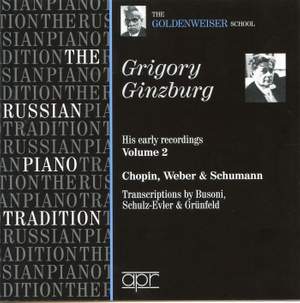
Grigory Ginzburg - His Early Recordings Volume 2

Grigory Ginzburg - His Early Recordings Volume 2

The Goldenweiser School


Concert Arabesques on ‘The Blue Danube’

Strauss–Schulz-Evler, recorded in Moscow in 1950 (from 78 LP: 00506/7)

Frühlingsstimmen, Op. 410

Strauss–Grünfeld, recorded in Moscow c1948 (from 78 LP: 00318/9)

Busoni:

Toccata and Fugue in D minor (after Bach BWV 565)

recorded in Moscow c1953 (from LP: D 4634/5)

Chopin:

Impromptus Nos. 1-4

recorded in Moscow c1948/9 (78 LP: 004700/1)

Polonaise No. 9 in B flat major, Op. 71 No. 2

recorded in Moscow c1950 (from 78 LP: 001282/3)

Polonaise No. 6 in A flat major, Op. 53 'Héroïque'

recorded in Moscow in 1950 (78: 019006/7)

Schumann:

Paganini Études Op. 3: No. 2 in E major

recorded in Moscow c1948 (78: 27348/9)

Paganini Études Op. 3: No. 4 in B flat major

recorded in Moscow c1948 (78: 27348/9)

Abegg Variations, Op. 1

recorded in Moscow in 1952 (from LP: D 4634/5)

Weber:

Rondo Brillante in E flat major (La Gaité), J.252 (Op. 62)

recorded in Moscow in 1951 (78: 20523/4)


Grigory Ginzburg (piano)

Grigory Ginzburg (1904-1961) was perhaps the most astounding virtuoso to emerge in Soviet Russia and it is a tragedy that he was never allowed to travel to the west after the mid 1930’s. He focussed his repertoire very much on the 19th century Romantic period and, above all, in Liszt, and his prolific recordings include many of Liszt’s virtuosic opera paraphrases that had fallen into neglect. This CD is the second of two devoted to his earliest 78rpm recordings mainly dating from around 1950. These discs are extremely rare and many of the performances included will be unknown to even the most ardent collectors. Of particular interest to pianophiles will be his supremely elegant Strauss transcriptions and the Schumann arrangements of Paganini Caprices.

“Ginzburg was among the greatest of all Soviet virtuosos. His multi-faceted pianism is everywhere evident here” BBC Music Magazine, July 2010 ***

“...you are made aware of a pianist who wore his character or originality lightly rather than heavily, a pianist of thoughts and dreams rather than superannuated virtuosity. He weaves his way with imperturbable ease through every decadent intricacy.” Gramophone Magazine, July 2010

APR - The Russian Piano Tradition - APR5672

(CD)

$11.50

Usually despatched in 2 - 3 working days.

Page: 

 1   2 

 Next >>

Copyright © 2002-13 Presto Classical Limited, all rights reserved.