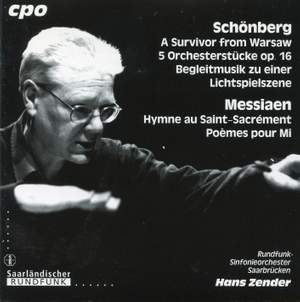
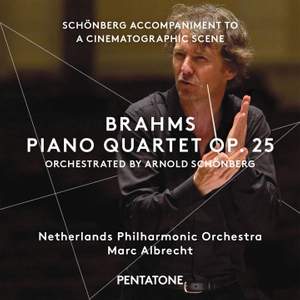
Prices shown exclude VAT. (UK tax is not payable for deliveries to United States.) See Terms & Conditions for p&p rates. | |  | Schoenberg: Orchestral WorksRecorded in concert 30th October - 7th November 2009
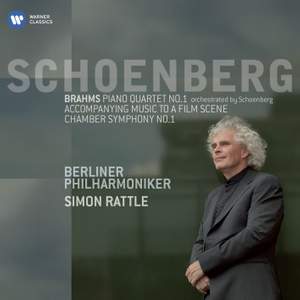
Following the release of the complete Brahms symphonies ("Altogether a marvellous achievement." The Daily Telegraph), Sir Simon Rattle and the Berliner Philharmoniker have performed and recorded a programme of orchestral works by Arnold Schoenberg, who was a great admirer of Brahms. In these three contrasting works, the spirits of Modernism, Romanticism and Classicism are invoked by Arnold Schoenberg – a revolutionary whose aesthetic roots lay firmly in tradition. Sir Simon Rattle, who first established his international reputation with masterpieces of the 20th century, explores these musical cross-currents with the Berliner Philharmoniker, long supreme in Austro-German repertoire. The repertoire, recorded in concert at Berlin’s Philharmonie in late October/early November 2009, consists of Schoenberg’s orchestration of Brahms’s Piano Quartet in G minor, Begleitungsmusik zu einer Lichtspielszene (Accompanying Music to a Film) and the full orchestra version of the Chamber Symphony No. 1. In these three contrasting works, the spirits of Modernism, Romanticism and Classicism are invoked by Arnold Schoenberg – a revolutionary whose aesthetic roots lay firmly in tradition. Sir Simon Rattle, who first established his international reputation with masterpieces of the 20th century, explores these musical cross-currents with the Berliner Philharmoniker, long supreme in Austro-German repertoire. Immediately after the recent performances/recordings, Sir Simon and the Orchestra set off on a coast-to-coast U.S. tour performing the Brahms symphonies and this Schoenberg programme at New York’s Carnegie Hall and in San Francisco, Los Angeles, Boston, Chicago and Ann Arbor. Schoenberg said that he had arranged Brahms’s Piano Quartet in G minor, Op. 25 for orchestra in 1937 for several reasons: “1) I like this piece; 2) It is seldom played; 3) It is always played badly, because the better the pianist, the louder he plays and you hear nothing from the strings. I wanted once to hear everything, and this I achieved.” He also stated that he intended to write his orchestration strictly in the style of Brahms, going no further than Brahms would have gone “if he had lived today.” Mark Swed, in The Los Angeles Times, said of the LA performance, “When [Schoenberg] made the version in 1937, he had recently moved from Berlin to Los Angeles and was clearly entranced by the resplendent light of his new home. He garbs the quartet in garish instrumental colors … Rattle emphasized everything in the most polystylistic way possible. A horn solo in the solo movement had a raw jazzy quality; a clarinet solo in the Gypsy-inspired last movement was klezmer-like. A xylophone clattered, a bass drum thumped. But within this ruckus was also ravishing ensemble playing and, from Rattle, the inspiration not only for great characterization but also for momentum.” Allan Kozinn in The NY Times wrote of the Carnegie Hall performance, “It can be hard to banish the original sound and texture from your inner ear, however convincing the new interpretation may sound. But it can be worth the effort, as Mr. Rattle and his musicians demonstrated in a vital, shapely account that found levels of drama in Schoenberg’s magnification that a performance of the chamber version could not possibly equal.” Simon Rattle previously recorded this work with the City of Birmingham Symphony Orchestra in 1985. “Accompaniment to a Film Scene...sounds less nightmarish, and a lot more beautiful than in any previous version. In general, Rattle's Schoenberg is more the voluptuous late Romantic than the bogeyman of popular legend.” BBC Music Magazine, October 2011 **** “you can tell at once that this is the Berlin Phil, so smooth and seductive are their dulcet tones. This is high sonic luxury, with Rattle coaxing on the hushed plush strings, the silken clarinets, the gold-leaf sound of the trumpets.” Classic FM Magazine, October 2011 ***** “The BPO woodwind and strings, with horn priming the canvas, are absolute ringers [for Brahms], but a deeper truth emerges from Rattle's delight in (or celebration of) moments where Schoenberg's orchestration goes a bit Mike Yarwood...The omnivorous virtuoso shout of the final moments [of the Chamber Symphony] spills beyond the usual orchestral threshold, the BPO demonstrating why they're the BPO.” Gramophone Magazine, October 2011 “The Berliners’ playing is absolute perfection.” MusicWeb International, July 2012 “[The Chamber Symphony] is a contradiction in terms with the Berliners’ massed and sleek strings, but the performance moves Schoenberg closer to Brahms, to which the former would certainly not have objected. For those out there who remain afraid of Schoenberg, this disc is an ideal entry point.” Sunday Times, 28th August 2011 “[Accompaniment to a Film Scene is] superbly played by the Berlin Phil, with Rattle encapsulating perfectly its concentrated drama.” The Guardian, 25th August 2011 **** “[The Brahms] is full of dash and gusto, especially during the concluding Rondo alla Zingarese. Elsewhere, the "Accompaniment to a Cinematographic Scene" offers a peek at the complex musical dramaturgy furnished by dissonant developments of the composer's later career.” The Independent, 5th August 2011 *** “The accompanying pieces demonstrate the Berliners' litheness, while Schoenberg's bizarre orchestration of Brahms moves from academic exercise to cartoonish fantasy in four movements.” The Independent on Sunday, 12th September 2011 “The sound is amazingly clear, and the virtuosity of the players, especially in the mad Hungarian dance of the finale [of the Piano Quartet], is astounding...[the Chamber Symphony is] performed with both heart-stopping urgency and radiant beauty.” The Telegraph, 25th August 2011 ***** “Schoenberg’s version offers ingenious fun, and Rattle’s Berlin players, recorded two years ago in live concerts, dispatch it with loving swagger.” The Times, 19th August 2011 *** | | | In stock - usually despatched within 1 working day. |
|
|
| |  | Schoenberg - String Trio, Op. 45
Schoenberg: | String Trio, Op. 45 Rolf Schulte (violin), Richard O’Neill (viola) & Fred Sherry (cello) Four Pieces for Mixed Chorus, Op. 27 Simon Joly Chorale & Members of the London Sinfonietta Three Satires for Mixed Chorus, Op. 28 Simon Joly Chorale & Members of the London Sinfonietta Septet (Suite) in E flat major, Op. 29 Rolf Schulte (violin), Fred Sherry (cello), Christopher Oldfather (piano), Charles Neidich and Alan R. Kay (clarinets), Michael Lowenstern (bass clarinet) & Toby Appel (viola) Accompaniment to a Cinematographic Scene, Op. 34 London Symphony Orchestra |
Craft has twice won the Grand Prix du Disque, as well as the Edison Prize for his landmark recordings of Schoenberg, Webern and Varèse, and countless other awards. Craft’s consummate artistry and unique insight continue to bear fruit with this volume featuring diverse works spanning more than twenty years of Schoenberg’s controversial and highly influential career. “Robert Craft was put on this earth to produce clear blueprints of Schoenberg and Stravinsky scores.” Gramophone “An intriguing assortment...Insightful performances” BBC Music Magazine, May 2010 **** “The performance has the right idea in not attempting to gloss over the discontinuities [of the String Trio]...[these players] give a good sense of the way angry expression dissolves into wistful lyricism at the end...Schoenberg's voice...is heard to powerful effect.” Gramophone Magazine, June 2010 “The latest in Craft’s Schoenberg series for Naxos is a bizarre but bracing sequence. First comes the late, great String Trio, a profoundly concentrated but expressively liberated single span...and afterwards the Septet-Suite, one of his most dazzling essays, played with fierce gusto.” Sunday Times, 11th April 2010 *** “the late, febrile String Trio of 1947 [is] played with wiry intensity by Rolf Schulte, Richard O'Neill and Fred Sherry” The Guardian, 18th March 2010 *** | | | (also available to download from $6.00) | Usually despatched in 2 - 3 working days. (Available now to download.) |
|
|
| |  | Pierre Boulez
Booklet Notes:Tracklisting in English, French, German. This first DVD release of Boulez' most famous interpretations is a must-have! His ground breaking Debussy interpretations Nocturnes: Fêtes Jeux - Poème dansé and Images freed Debussy from cliché. Stravinsky's Rite of Spring (1913) and Schoenberg's Accompaniment to a Cinematographic Scene (1930) confirmed Boulez as the authority on 20th century music. A composer himself, Boulez conducts with precision and a deep understanding of the sound worlds of the composers: he "thinks music". Includes film footage of Boulez' conducting Images and working on Fêtes Jeux. "Pierre Boulez is arguably the most influential, and controversial, figure in the world of music today. Boulez is known as the young Turk of post-war avant-garde composition who has steadily transformed himself into one of the most authoritative interpreters of standard 19th and 20th-century music." The Guardian “These concerts, spanning 30 years, show Boulez's consistency in achieving precision, colour and clarity. The Debussy and Schoenberg performances are classics, the Stravinsky too civilised.” BBC Music Magazine, January 2009 **** | | | Usually despatched in 2 - 3 working days. |
|
|
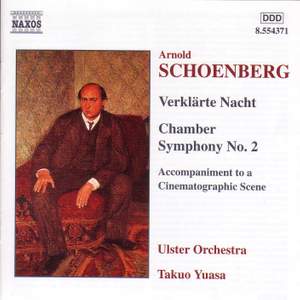
| |  | Schoenberg: Verklärte Nacht
“As an example of Naxos's daring these days, for only its second disc of Schoenberg, it has headed for the Second Chamber Symphony - a work begun in 1906 but not completed after 1939 - rather than the familiar First. Like the Gurrelieder, which was part-orchestrated after Schoenberg's style had moved on from his late-Romantic phase, so the Second Chamber Symphony bears the mark of those missing 33 years in its combination of chromaticism and more acerbic dynamism. The Ulster Orchestra gives a vibrant performance of the work.” BBC Music Magazine, October 2000 | | | (also available to download from $6.00) | Usually despatched in 2 - 3 working days. (Available now to download.) |
|
|
| |  | Giuseppe Sinopoli conducts Berg, Schoenberg & Webern
Berg: | Violin Concerto 'To the Memory of an Angel' (1935) Reiko Watanabe (violin) Chamber Concerto for Piano and Violin with 13 Wind Instruments Reiko Watanabe (violin) & Andrea Lucchesini (piano) Lyric Suite - for soprano and string quartet Alessandra Marc (soprano) 3 Wozzeck-Fragments Alessandra Marc (soprano) Lulu-Suite (Five Symphonic Pieces) for soprano and orchestra Alessandra Marc (soprano) Sieben frühe Lieder Orchestral version 1928 Juliane Banse (soprano) 5 Orchesterlieder nach Ansichtskartentexten von Peter Altenberg, Op. 4 Alessandra Marc (soprano) Der Wein Doborah Voigt (soprano) Drei Orchesterstücke, Op. 6 | Schoenberg: | Pierrot lunaire, Op. 21 Luisa Castellani (voice) & Andrea Lucchesini (piano) Erwartung, Op. 17 live recording Alessandra Marc (soprano) 6 Lieder for soprano and orchestra, Op. 8 Alessandra Marc (soprano) Accompaniment to a Cinematographic Scene, Op. 34 A Survivor from Warsaw, Op. 46 John Tomlinson (narrator) Chamber Symphony No. 1 in E major, Op. 9 Gurrelieder live from the Semper Opera, Dresden Deborah Voight, Jennifer Larmore, Bernd Weikl & Kenneth Riegel | Webern: | Im sommerwind (Idyl for large orchestra) (1904) Idyll after a poem by Bruno Wille Passacaglia for Orchestra, Op. 1 Six Pieces for Orchestra Op. 6 arr. For reduced orchestra 1928 Five Pieces for Orchestra Op. 10 Symphony, Op. 21 Concerto for Nine Instruments Op. 24 Variations for Orchestra, Op. 30 |
This set shows the so-called bogey-men of the Second Viennese School, from their hyper Romantic height, through Expressionism and onto the more entertaining aspects of Serialism, as entertainers of a great order. The Nineteenth-Century heritage of Schubert, Brahms and Wagner are never far from Schoenberg, Berg and Webern in these 8 CDs, which concentrate on the earlier, more approachable (and often finest) products of three distinct composers, rather than any school. The performers reflect the composers' Romantic leanings here; Sinopoli bringing in artists at the height of their early careers: Deborah Voigt, Alessandra Marc and Juliane Banse. The ever-approachable Berg is seen at his kindest and Webern, a figure who looked as far back as he did forward is as finely tuned in Im Sommerwind as in the Op.21 Symphony – a simply and fascinating journey. Schoenberg is in full splendour, too. Sounding more like Mahler's heir than a prophet of total change. “In his highly compelling live recording, Sinopoli conducts a most sensuous reading of Gurrelieder, bringing out all it’s romantic voluptuousness… anyone who has ever thought of Schoenberg as cold should certainly hear this, magnetic from first to last…" Penguin Guide *** “It would be hard to imagine more romantic readings of Berg’s principal orchestral works than those under Giuseppe Sinopoli. The atonal arguments of Berg have never been presented more sinuously, cocooning the ear, helped by sumptuous playing and recording” Penguin Guide *** | | | In stock - usually despatched within 1 working day. |
|
|
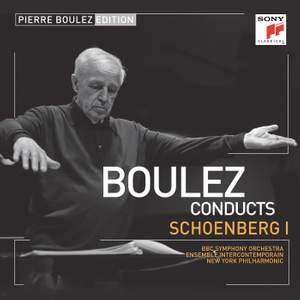
| |  | Pierre Boulez conducts Schoenberg
Schoenberg: | Septet (Suite) in E flat major, Op. 29 Verklärte Nacht, Op. 4 3 Pieces for Chamber Orchestra Serenade, Op. 24 5 orchestral pieces, Op. 16 Ode to Napoleon Buonaparte, Op. 41 Variations for Orchestra, Op. 31 Verklärte Nacht, Op. 4 (version for string orchestra) Erwartung, Op. 17 Pierrot lunaire, Op. 21 Lied der Waldtaube (from Gurrelieder) Friede auf Erden, Op. 13 Kol Nidre, for Rabbi-Narrator, Mixed Chorus and Orchestra, Op. 39 Folksong Arrangements (4) Kanons (2) Four Pieces for Mixed Chorus, Op. 27 Three Satires for Mixed Chorus, Op. 28 Stücke (6), Op. 35 Dreimal tausend jahre, Op. 50a De Profundis (Psalm 130), Op. 50b for mixed choir a cappella Moderner Psalm für Sprecher, Chor und Orchester, Op. 50c A Survivor from Warsaw, Op. 46 Gurrelieder Four Orchestral Songs, Op. 22 Die Jakobsleiter Chamber Symphony No. 1 in E major, Op. 9 Accompaniment to a Cinematographic Scene, Op. 34 Moses und Aron Chamber Symphony No. 2, Op. 38b |
| 
| | | In stock - usually despatched within 1 working day. |
|
|
| |
|