Debussy: Préludes - Book 2: No. 12, Feux d’artifice

This page lists all recordings of Préludes - Book 2: No. 12, Feux d’artifice, by Claude Achille Debussy (1862-1918) on CD, DVD & download (MP3 & FLAC). Generally, more recent releases are listed first, but with priority given to those that are in stock.

Recommendations

Disc of the Month
October 2005
Rosette

All recordings

Prices shown exclude VAT. (UK tax is not payable for deliveries to United States.)
See Terms & Conditions for p&p rates.

Sviatoslav Richter

Sviatoslav Richter

Royal Festival Hall, 11 June 1967


Chopin:

Barcarolle in F sharp major, Op. 60

Debussy:

Préludes - Book 2: No. 4, Les fées sont d’exquises danseuses

Préludes - Book 2: No. 10, Canope

Préludes - Book 2: No. 11, Tièrces alternées

Préludes - Book 2: No. 12, Feux d’artifice

Haydn:

Piano Sonata No. 62 in E flat major, Hob.XVI:52

Schumann:

Novelette, Op. 21 No. 4 in D major

Novelette, Op. 21 No. 8 in F sharp minor

Weber:

Piano Sonata No. 3 in D minor, Op.49


Sviatoslav Richter (1915–1997) is acknowledged today as one of the greatest pianists of the 20th century along with his great Russian contemporaries, David Oistrakh, Emil Gilels and Mstislav Rostropovich.

This rare broadcast recording makes its first appearance on CD.

The June 1967 recital at the Royal Festival Hall very much reflects the pianist’s personal taste, containing the rarely played Haydn and Weber Sonatas together with the Schumann Novelettes with the more popular additions of Chopin and Debussy.

He declared, ‘my principle is to play only works that I really love and not just those that are currently accepted’.

Of all the Haydn Sonatas that Richter played, No.62 featured more frequently in his programmes as did the Weber Sonata No.3, which he regarded in a notebook entry in 1990 as a ‘highly original work and I like it a lot’.

The two Schumann Novelettes were often played in the 1960s though Richter did not perform No.8 for the following two decades. With the Chopin and Debussy, Richter is on familiar territory, which he invests with his characteristic imagination and spontaneity.

Superb Ambient Mastering recreates the atmosphere in the Royal Festival Hall perfectly.

ica classics Legacy - ICAC5004

(CD)

$15.00

(also available to download from $10.50)

In stock - usually despatched within 1 working day.

Debussy: 16 Préludes

Debussy: 16 Préludes


Debussy:

Préludes - Book 1: No. 1, Danseuses de Delphes

Préludes - Book 2: No. 3, La Puerta del Vino

Préludes - Book 1: No. 6, Des pas sur le neige

Préludes - Book 1: No. 11, La Danse de Puck

Préludes - Book 1: No. 9, La serenade interrompue

Préludes - Book 1: No. 3, Le vent dans la plaine

Préludes - Book 2: No. 5, Bruyères

Préludes - Book 2: No. 6, General Lavine - eccentric

Préludes - Book 2: No. 10, Canope

Préludes - Book 1: No. 7, Ce qu’a vu le vent de l’ouest

Préludes - Book 1: No. 8, La fille aux cheveux de lin

Préludes - Book 1: No. 12, Minstrels

Préludes - Book 1: No. 10, La cathédrale engloutie

Préludes - Book 2: No. 8, Ondine

Préludes - Book 2: No. 7, La terrasse des audiences au clair de lune

Préludes - Book 2: No. 12, Feux d’artifice


Jorge Bolet (piano)

Debussy's twenty-four Preludes, like Chopin's, are surprisingly self-sufficient. Divided into two books, published in 1910 and 1913, the Preludes are an intimate record of Debussy's inner and imaginative life. Their titles were after-thoughts rather than direct inspirations, largely because Debussy's delicate and complex response to natural phenomena or human idiosyncrasy could hardly be contained or expressed by a simple caption or heading.

The Cuban-American pianist Jorge Bolet isn't readily associated with the music of Debussy, but his selection of sixteen of the composer's Preludes yield performances of refinement and fluidity. Lines are clearly delineated and the myriad of impressions within a single piece are nothing short of kaleidoscopic.

Australian Eloquence - 4801131

(CD)

$10.25

In stock - usually despatched within 1 working day.

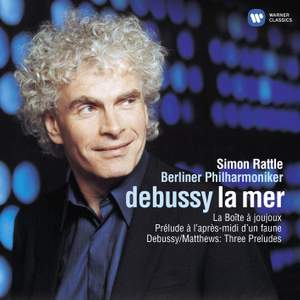
Debussy: La Mer, etc.

Debussy:

La Mer

La Boîte à joujoux

Prélude à l'après-midi d'un faune

Préludes - Book 1: No. 7, Ce qu’a vu le vent de l’ouest

Préludes - Book 2: No. 2, Feuilles mortes

Préludes - Book 2: No. 12, Feux d’artifice

(piano preludes transcribed for orchestra by Colin Matthews)


“…Rattle and the Berlin Philharmonic, resplendently recorded, capture the languorous sensuality of L'après-midi supremely well, with the flautist Emmanuel Pahud phrasing in huge spans, and with the most refined rubati. La mer is less tempestuous than it can be... but I find it more convincing and more evocative than when it is turned into a concerto for orchestra. Once again every last touch of colour emerges in this beautifully natural recording.” BBC Music Magazine, September 2005 ****

“Karajan and the Berlin Philharmonic's perfumed, pictorial 1964 recordings of Debussy's Prélude à L'après-midi d'unfaune and La mer (see above) have come to be revered – and rightly so, as they possess a remarkable frisson. Rattle's interpretations, recorded live, are markedly less urgent; with nary a noise from the audience, one might even mistake them for studio recordings. Yet these new accounts, too, have the ability to engross and sometimes even astonish. Note, for example, the sinuous swoop of the flutes and clarinets at the beginning of 'Jeux de vagues' in La mer, or the shimmering rustle of strings at 1'00" in the Prélude – both almost tactile sensations.
Of course, one counts on Rattle to elucidate detail, and here the clarification of the music's intricately layered textures is revelatory. Karajan appears more intent on blending colours, creating a kind of sonic kaleidoscope that, coupled with a strong narrative thrust, can make Debussy sound a little like Rimsky-Korsakov. Subtlety may be part of the issue. Karajan, for example, heightens dynamic contrast whereas Rattle grades the dynamics as per Debussy's instructions (he's one of the few conductors who seems to have noticed that there's but one fortissimo in the Prélude).
The makeweights are especially valuable.
There aren't that many recordings of La boîte àjoujoux in the catalogue and this zestful, gracefully droll performance is among the best. As in the Prélude and La mer, the conductor's supple tempo manipulations convey a real feeling of spontaneity. Colin Matthews's scoring of three piano Préludes evokes Debussy's sound world with preternatural accuracy.
The turbulence of 'Ce qu'a vu le vent d'Ouest' and sparkle of 'Feux d'artifice' are most impressive, though 'Feuilles mortes', with its hauntingly desolate atmosphere, is perhaps finer still.
In short, a dazzling disc.”
Gramophone Classical Music Guide, 2010

“the clarification of the music’s intricately layered textures is revelatory… In short, a dazzling disc” Gramophone Magazine

GGramophone Magazine

Disc of the Month - October 2005

Penguin Guide

Rosette Winner

EMI - 5580452

(CD)

$13.00

In stock - usually despatched within 1 working day.

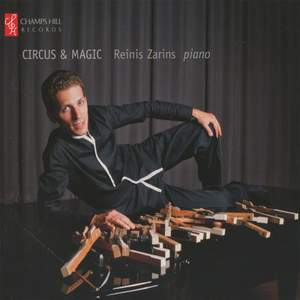
Reinis Zarins: Circus & Magic

Reinis Zarins: Circus & Magic


Bloch, E:

Circus Pieces (4)

Debussy:

Masques

Préludes - Book 2: No. 12, Feux d’artifice

Ligeti:

Étude No. 10 'Der Zauberlehrling'

Prokofiev:

Cinderella - Three Pieces for Piano, Op. 95

Stravinsky:

Three Movements from Petrushka


Reinis Zarins (piano)

London‐based pianist Reinis Zarins makes his debut recording for Champs Hill Records with ‘Circus and Magic’. Born in Riga in 1985, he is a prize‐winner in eleven international piano competitions and performs regularly with leading orchestras in Latvia for broadcast on national radio and TV, and has been recognized with national awards. He has performed at the Lucerne Festival, Bath Musicfest and the Norfolk & Norwich Festival.

Ernest Bloch, essentially a romantic composer torn between his natural instincts and modernist trends, produced his character sketches The Four Circus Pieces for private performance but was eventually persuaded to publish them. One is dedicated to “the sad and ever‐comprehending Charlie Chaplin” whom Bloch admired. He sent the music to Chaplin, himself a skillful composer, but received no reply.

Included on this album are three pieces by Debussy, including his firework display in Feux d’Artifice, a fantastic display of inventive piano‐writing, and Masques , inspired by the Commedia dell'arte as painted by Watteau - a blend of joy and pathos. Marguerite Long, who studied with Debussy, wrote: “I hear Masques - a tragedy for piano one might call it - as a sort of transparency of Debussy's character … He was torn with poignant feelings which he preferred to mask with irony”.

Three Pieces from Prokofiev’s ballet music for Cinderella follow: Intermezzo creates wonderful imagery of the Waltz guests danced to at the ball; Gavotte - played during a scene in which Cinderella takes a broom as her dancing partner; and Slow Waltz, the penultimate number in the full ballet, which is played as the Prince and Cinderella dance together in an enchanted garden. Even when divorced from their orchestral colour, these pieces still possess a strong tactile feeling and a sense of wonderment.

Ligeti's eighteen Études have become modern classics. Étude No.10 (Der Zauberlehrling) dates from 1994 and is named after the celebrated Goethe poem which inspired Dukas to write his symphonic poem/scherzo The Sorcerer's Apprentice.

This recital disc concludes with Three Pieces from Petrushka by Stravinsky arranged in 1921 from the 1911 original, and dedicated to Arthur Rubinstein. Danse Russe is taken from the music in Tableau One to which Petrushka and the other puppets dance after being brought to life, and is followed by In Petrushka’s Room. The Shrovetide Fair, with its evocation of a teeming crowd, completes the set. With these pieces, Stravinsky stated his intention of writing something essentially pianistic ‐ in no way an imitation of the sound of the orchestral score.

“the Ligeti is a delight, beginning with needle-sharp precision and culminating in Mediterranean warmth. Zarins's Prokofiev is nicely idiomatic, and his performance of Petrushka is one of the most charming accounts of this work I have ever heard.” BBC Music Magazine, April 2013 ***

Champs Hill Records - CHRCD048

(CD)

$14.50

Usually despatched in 2 - 3 working days.

Debussy: 16 Préludes

Debussy: 16 Préludes


Debussy:

Préludes - Book 1: No. 1, Danseuses de Delphes

Préludes - Book 1: No. 3, Le vent dans la plaine

Préludes - Book 1: No. 6, Des pas sur le neige

Préludes - Book 1: No. 7, Ce qu’a vu le vent de l’ouest

Préludes - Book 1: No. 8, La fille aux cheveux de lin

Préludes - Book 1: No. 9, La serenade interrompue

Préludes - Book 1: No. 11, La Danse de Puck

Préludes - Book 1: No. 10, La cathédrale engloutie

Préludes - Book 1: No. 12, Minstrels

Préludes - Book 2: No. 3, La Puerta del Vino

Préludes - Book 2: No. 5, Bruyères

Préludes - Book 2: No. 6, General Lavine - eccentric

Préludes - Book 2: No. 7, La terrasse des audiences au clair de lune

Préludes - Book 2: No. 8, Ondine

Préludes - Book 2: No. 10, Canope

Préludes - Book 2: No. 12, Feux d’artifice


Jorge Bolet (piano)

Jorge Bolet made this superbly languid and delicate recording of 16 Préludes by Debussy less than two years before his untimely death in 1990 at the age of 75. The Cuban-born pianist's reputation was largely founded on his mercurial, blockbusting performances and recordings of Rachmaninov and Liszt, but this disc shows a true pianist’s lightness of touch, as well as some superbly sensitive engineering and technical preparation of his beloved Baldwin SD-10 instrument, chosen by Bolet in preference to the far more popular Steinways.

Bolet's own personal fastidiousness – he always recorded in a jacket and tie – is reflected, and in perhaps unexpected and certainly fascinating ways, in this personal selection from the two books of twelve Préludes, and the ordering of them. He may have been a reluctant, and and indeed until the last couple of decades of his life, infrequent visitor to the studio – he once remarked that he would rather give hundreds of concerts than make one recording – but this wariness does not translate itself into metronomical stiffness but rather reflect a refined version of the spontaneity that manifested itself more naturally in his concert playing.

‘Bolet’s performances, with their inimitable beauty of line and shimmering sonority (very much the product of an unobtrusive but subtle virtuoso pedal technique), their poetic freedom within a basic pulse, were like some serene and final distillation of all he had learnt and known, the massive and legendary virtuosity of earlier days directed into an everincreasing concern with more durable musical truths.’ Gramophone, 1991

“Bolet's deep and velvety touch brings out a more profound mysticism in Debussy's multifaceted visions.” BBC Music Magazine, February 2011 ***

“He basically alternates tranquil and lively, but slow and dreamy pieces such as Des pas sur la neige or La Fille aux cheveux de lin seem to loom largest — dreamy not meaning ethereal, but a spaciousness and weightiness of sonority new to Debussy, and of which Bolet is the suavest exponent.” Sunday Times, 7th November 2010 ***

Newton Classics - 8802026

(CD)

$11.50

Usually despatched in 2 - 3 working days.

Debussy/Matthews - Preludes

Debussy/Matthews - Preludes


Debussy:

Jeux - Poème dansé

Préludes - Book 1: No. 1, Danseuses de Delphes

Préludes - Book 1: No. 9, La serenade interrompue

Préludes - Book 1: No. 6, Des pas sur le neige

Préludes - Book 2: No. 4, Les fées sont d’exquises danseuses

Préludes - Book 1: No. 2, Voiles

Préludes - Book 2: No. 9, Hommage á S.Pickwick Esq.

Préludes - Book 2: No. 7, La terrasse des audiences au clair de lune

Préludes - Book 2: No. 5, Bruyères

Préludes - Book 2: No. 8, Ondine

Préludes - Book 1: No. 5, Les collines d'Anacapri

Préludes - Book 2: No. 12, Feux d’artifice

Préludes - Book 1: No. 10, La cathédrale engloutie

Matthews, C:

Postlude: Monsieur Croche

(Debussy preludes arranged for orchestra by Colin Matthews)


"Matthews has been heralded for the success with which he has taken the inspiration of the piano masterpieces and skillfully created orchestral works of great variety, beauty and drama. “…these pieces are more than orchestrations, they are recreations achieved by entering into the mind and thought of the original composer. Beautiful performances.” Sunday Telegraph 2007

“Matthews's exquisite treatment of this supremely pianistic music goes far beyond mere orchestration. While some of his arrangements are relatively straightforward - Danseuses de Delphes, which opens the first book and with which this sequence also opens, for instance, is a relatively strict translation of the original into orchestral terms - pieces such as Bruyères and Feux d'Artifice are virtually recomposed, though they never trespass beyond Debussy's own musical world. The whole set is a remarkable achievement, and Elder and his orchestra play these pieces with great care and sensitivity. Yet by comparison their account of Jeux seems rather lumbering, applying colour with a broad brush to what should be needle-point detail. The disc remains a treat, though.” The Guardian, 20th February 2009 ****

“…Jeux… has an underlying eroticism. The diaphanous atmospheric detail from the strings and subtle wind colouring in Debussy's poème dansé require great delicacy of feeling and sensuous caressing from the violins in the movements of restrained ecstasy, which are exquisitely realised here. The transparent acoustic of the Bridgewater Hall and the balancing skill of producer Andrew Keener add to the allure of this miraculous score, with the violent climax superbly graduated and the closing pages returning spontaneously to the opening mood. Altogether this is a fascinating and rewarding disc...” Gramophone Magazine, June 2009

“Matthews’s creative finesse is remarkable: the pieces aren’t simply dressed in orchestral clothes, rather sensitively re-imagined for an expanded palette of refined colours by a gifted contemporary composer.” The Times, 17th July 2010 ****

“The diaphonous atmospheric detail from the strings and subtle wind colouring in Jeux, Debussy's poème dansé, require great delicacy of feeling and sensuous caressing from the violins in the moments of restrained ecstasy, which are exquisitely realised here. The transparent acoustic of the Bridgewater Hall and the balancing skill of producer Andrew Keener add to the allure of this miraculous score, with the violent climax superbly graduated and the closing pages returning spontaneously to the opening mood.
The programme is completed by 12 more of Colin Matthews's highly imaginative orchestrations of Debussy's piano Préludes, and these, to my ears, have even more distinction than the first group, which came in harness with Mark Elder's compelling Hallé account of La mer (see above). The shimmering textures Matthews creates from the 'Danseuses de Delphes', 'Des pas sur la neige' and 'Les fées sont d'exquises' are even more translucently exotic, balanced by the luxuriance of 'Bruyères'. If not quite matching Stokowski's famous over-the-top transcription, 'La cathédrale engloutie' produces a splendidly expansive, watery spectacle, tolling bell included, which is sonorously moving. However, 'S Pickwick Esq', with its side drum and mock-solemn national anthem snippet on the brass, feels rather too heavily pompous, not witty enough, and 'Feux d'artifice', too, is a bit of a damp squib – it sounds much more effective in its barer piano original. Moreover, Colin Matthews's own Monsieur Croche makes an exuberantly brilliant postlude, even if its helter-skelter progress obviously includes very few crochets. Altogether this is a fascinating and rewarding disc and is well worth aquiring to make a pair, alongside its illustrious companion.”
Gramophone Classical Music Guide, 2010

Hallé - CDHLL7518

(CD)

$15.75

Usually despatched in 4 - 5 working days.

The Essential Van Cliburn

The Essential Van Cliburn


Beethoven:

Piano Concerto No. 5 in E flat major, Op. 73 'Emperor' - Rondo (Allegro)

Brahms:

Piano Concerto No. 2 in B flat major, Op. 83, 2nd movement

Fritz Reiner

Rhapsody in G minor, Op. 79 No. 2

Chopin:

Polonaise No. 6 in A flat major, Op. 53 'Héroïque'

Nocturne No. 17 in B major, Op. 62 No. 1

Fantasia in F minor, Op. 49

Debussy:

Clair de Lune (from Suite Bergamasque)

Préludes - Book 2: No. 12, Feux d’artifice

Liszt:

Liebestraum, S541 No. 3 (Nocturne in A flat major)

Un Sospiro from 3 Concert Studies, S144 No. 3

Widmung S566 after Schumann (Liebeslied)

Mephisto Waltz No. 1

Rachmaninov:

Piano Concerto No. 2 in C minor, Op. 18: 2 - Adagio sostenuto

Fritz Reiner

Piano Concerto No. 3 in D minor, Op. 30: 3rd movement

Kirill Kondrashin

Étude-Tableau, Op. 39 No. 5 in E flat minor

Prelude Op. 3 No. 2 in C sharp minor

Tchaikovsky:

Piano Concerto No. 1 in B flat minor Op. 23 : Allegro non troppo e molto maestoso - Allergo con spirito

Kirill Kondrashin


Van Cliburn (piano)

A national hero when he was only 23 years old, pianist Van Cliburn has been one of classical music’s few true household names ever since his triumph at the 1958 Tchaikovsky Competition in Moscow – the first American ever to win there, a Cold War – thawing phenomenon that led to a frenzied ticker-tape parade for Cliburn in New York. He was one of the first million-selling classical artists in the LP era, and his catalogue of critically hailed, best selling recordings for RCA Red Seal includes many of the most popular concertos and solo piano works of the Romantic era.

Sony Essential Classics - 88697095852

(CD - 2 discs)

$19.25

Usually despatched in 3 - 4 working days.

Devoted to Debussy

Devoted to Debussy


Debussy:

Clair de Lune (from Suite Bergamasque)

Préludes - Book 2: No. 12, Feux d’artifice

Préludes - Book 1: No. 6, Des pas sur le neige

Préludes - Book 2: No. 3, La Puerta del Vino

Pour les sonorites opposees

Estampes (3) (Complete)

Berceuse héroïque

Morceau de concours

Ballade

Pour le piano

Pièce sans titre

Élégie, L138


Roberta Rust (piano)

Centaur - CRC2867

Download only from $10.50

Available now to download.

Piano Works played by Caroline Fischer

Piano Works played by Caroline Fischer


Chopin:

Étude Op. 10 No. 1 in C major

Debussy:

Préludes - Book 2: No. 4, Les fées sont d’exquises danseuses

Préludes - Book 2: No. 6, General Lavine - eccentric

Préludes - Book 2: No. 12, Feux d’artifice

Liszt:

Grande Étude de Paganini, S. 141 No. 3 'La Campanella'

Réminiscences de "Don Juan" (after Mozart), S. 418

Hungarian Rhapsody, S244 No. 13 in A minor

Mozart:

Piano Sonata No. 8 in A minor, K310

Scarlatti, D:

Keyboard Sonata K141 in D minor

Shchedrin:

Basso ostinato


Caroline Fischer (piano)

Genuin - GEN86068

Download only from $10.50

Available now to download.

Hommage a Ricardo Vines

Hommage a Ricardo Vines


Albéniz:

Piezas Características, Op. 92: Torre Bermeja

Almeria (from Iberia, book 2)

Triana (from Iberia, book 2)

Cadiz (from Suite Española, Op. 47)

Sevilla (from Suite Española, Op. 47)

Debussy:

Suite Bergamasque

Préludes - Book 2: No. 5, Bruyères

Préludes - Book 2: No. 6, General Lavine - eccentric

Préludes - Book 1: No. 2, Voiles

Préludes - Book 2: No. 12, Feux d’artifice

Falla:

Cuatro piezas españolas

Fantasía Bética

Ravel:

Sonatine

Alborada del gracioso (Miroirs No. 4)


Juan Miguel Murani (piano)

Zigzag - ZZT0211012

(CD - 2 discs)

$20.00

Usually despatched in 4 - 5 working days.

Page: 

 1   2 

 Next >>

Copyright © 2002-13 Presto Classical Limited, all rights reserved.