Chopin: Mazurka No. 11 in E minor, Op. 17 No. 2

This page lists all recordings of Mazurka No. 11 in E minor, Op. 17 No. 2, by Frédéric François Chopin (1810-49) on CD & download (MP3 & FLAC). Generally, more recent releases are listed first, but with priority given to those that are in stock.

Recommendations

Instrumental Choice
April 2010
Editor's Choice
April 2011

All recordings

Prices shown exclude VAT. (UK tax is not payable for deliveries to United States.)
See Terms & Conditions for p&p rates.

Chopin: Mazurkas

Chopin: Mazurkas


Chopin:

Mazurka No. 3 in E major, Op. 6 No. 3

Mazurka No. 5 in B flat major, Op. 7 No. 1

Mazurka No. 11 in E minor, Op. 17 No. 2

Mazurka No. 13 in A minor, Op. 17 No. 4

Mazurka No. 15 in C major, Op. 24 No. 2

Mazurka No. 17 in B flat minor, Op. 24 No. 4

Mazurka No. 33 in B major, Op. 56 No. 1

Mazurka No. 41 in C sharp minor, Op. 63 No. 3

Mazurka No. 47 in A minor, Op. 68 No. 2

Mazurka No. 49 in F minor, Op. 68 No. 4

Scherzo No. 1 in B minor, Op. 20

Nocturne No. 13 in C minor, Op. 48 No. 1

Polonaise No. 7 in A flat major, Op. 61 'Polonaise-fantaisie'


Cédric Tiberghien offers us a panorama of Chopin’s output, with three of the composer’s key works framed by a selection of mazurkas.

“I devised a recital programme for the 150th anniversary of Chopin’s death in 1999. The idea was to offer a panoramic survey of his output featuring several representative ‘large’ pieces, with the mazurkas providing a sort of chronological thread between them. So ten years later it was a natural process to narrow the focus down to three key pieces from different periods of Chopin’s life, surrounded by a generous selection of mazurkas… One of the very first Chopin pieces I discovered was on a record telling the story of the composer’s life: the Mazurka op.68 no.2, which illustrates the nostalgia for his homeland, the melancholy so often present in his music. I think the mazurkas show the most intimate side of Chopin’s personality, with their mixture of improvisation, evocation, and the ephemeral. These short pieces were a way for him to stay in touch with the roots of his country; he has nothing to prove, he submits to no rule except that of his inner music. I find it fascinating to see how varied Chopin’s inspiration is despite the common basis of all the mazurkas. As I explored the fifty-one pieces in the collection, I rediscovered masterpieces I thought I knew already, while others that were new to me have now become essential parts of my life. Chopin wrote mazurkas throughout his adult career, from 1830 to 1849. The first ones (opp.6 and 7) emphasise the popular element, while the later examples (op.59, op.68 no.4) show an unprecedented harmonic refinement that betrays his contact with French culture. The Scherzo has always struck me with its violence, which grips you right from the first chord and never lets up until the magnificent ‘Christmas carol’ which is transcendent in its simplicity. The Nocturne illustrates how important melody was for Chopin. He insisted that all his pupils should practise singing so that they would sense the phrasing, the direction of the lines, the moments of tension and relaxation. The Polonaise-Fantaisie is a very special work. It’s at the very opposite pole from the mazurkas, if only in its dimensions; and it achieves a mysterious balance between its improvisatory aspect and the strength of its architecture, between extreme complexity and a feeling of intimacy. The opening chords warn the listener: ‘Prepare for an extraordinary journey.’ If I were allowed to keep only one work by Chopin, it would be this Polonaise-Fantaisie in A flat – a key which was very dear to him, incidentally. For me it’s the perfect expression of his personality.” Cédric Tiberghien

“When Tiberghien next plays in London, be there.” Geoff Brown, The Times

Concert reviews: Chopin Mazurkas

“The case for the innovatory nature of Chopin's mazurkas, penetrating the deepest of emotions often with the sparsest of musical gestures, was formidably made.” Tim Ashley, The Guardian, 26 January 2010

“This is very close to what we know about Chopin's own playing...How well Tiberghien caught the gentle, musing melancholy of the opening, and how the silence before the ensuing storm seemed to press on our eardrums!” The Daily Telegraph

“Tiberghien seems to have the poise and poetry of Chopin in his blood. He makes the piano sing...This is an imaginative disc of shifting moods that are readily within Tiberghien’s expressive orbit and which he interprets with sublime inspiration.” The Telegraph, 8th October 2010 *****

“Tiberghien says that if he was allowed to keep only one Chopin work, it would be the Polonaise-Fantasie, and he plays this once-neglected piece as if he treasures it: there's a sense of mystery in the way the dances are hinted at impressionistically.” BBC Music Magazine, December 2010 ****

“Perhaps the C minor Nocturne, Op. 48 No. 1, adds up to this recital's best-realised interpretation, with its measured and sustained opening section and assiduous build into a shattering climax. Harmonia Mundi provides Tiberghien with attractively robust engineering.” Gramophone Magazine, November 2010

Harmonia Mundi - HMC902073

(CD)

$17.50

In stock - usually despatched within 1 working day.

Chopin - Journal Intime

Chopin - Journal Intime


Chopin:

Mazurka No. 41 in C sharp minor, Op. 63 No. 3

Ballade No. 1 in G minor, Op. 23

Mazurka No. 11 in E minor, Op. 17 No. 2

Mazurka No. 47 in A minor, Op. 68 No. 2

Fantasia in F minor, Op. 49

Nocturne No. 20 in C sharp minor, Op. post.

Mazurka No. 6 in A minor, Op. 7 No. 2

Ballade No. 2 in F major, Op. 38

Mazurka No. 13 in A minor, Op. 17 No. 4

Largo, Prelude Op. 28 No. 4

Écossaises (3), Op. 72 No. 3

Contredanse in G flat major, KKAnh.Ia/4

Impromptu No. 4 in C sharp minor, Op. 66 'Fantaisie-Impromptu'

Nocturne No. 2 in E flat major, Op. 9 No. 2


Already established as one of today’s most individual and thoughtful pianists, Alexandre Tharaud makes his debut on Virgin Classics with this collection of pieces by Chopin, ‘Journal intime’ (Private diary). Each of the chosen pieces – mazurkas, nocturnes, ballades, the famous Fantaisie-impromptu and a number of other, lesser-known works – has a special importance or association for Tharaud, who cites the pianism of Vlado Perlemuter and Sergey Rachmaninov as a particular influence in the music of Chopin.

Many of these pieces have been in Tharaud’s repertoire since his student days: “I let time work for me. It is extraordinarily enriching to study a work when you are young and then revisit it in the course of your life. It becomes part of you.”

Tharaud, born in Paris in 1968, takes a discerning approach to repertoire, highlighting and often juxtaposing composers such as Bach, Rameau, Couperin, Chabrier, Satie, Ravel, Poulenc and Thierry Pécou (b.1965). His catalogue of recordings for Harmonia Mundi has contributed substantially to his reputation:

“Alexandre Tharaud [is] a young aristocrat of the keyboard. Cool, supple and elegant, all his performances are in the best French tradition; a fine union of sense and sensibility ... each phrase bringing a renewed sense of delight … the inwardness and grace one associates with true artists ... All these performances suggest a fastidious musical intelligence with an immaculate technique, the music's character and fragrance made light yet pervasive ... these scrupulously modern and sensitive performances are among the finest available." Gramophone

"Alexandre Tharaud plays Chopin with superlative technique. (...) He has recorded a breathtaking disc … This is intelligent playing that matches its clarity with perception and sensitivity, and variety of touch with sonic beauty. Tharaud is unfailingly responsive to melodic nuance and seems to relish every new twist of the texture. But there is also immense power when the dark energy beneath is unleashed. His concept plumbs the depths of Chopin's musical psyche with humility … a brilliant and original performance." BBC Music Magazine

“Alexandre Tharaud has dedicated his reading of Chopin’s Préludes to the memory of Vlado Perlemuter, and it is as unhistrionic and clearly articulated as the versions left by the late pianist … Tharaud is immediately persuasive with his uncontrived musicality. The more serene pages unfold gracefully … [but] shadows often assert their menacing presence: the pianist has spoken of the darkness he finds in the cycle, and it makes itself felt, though with no suggestion of artificiality or overstatement.” Diapason

" … New discs of Chopin's waltzes are invariably compared to Dinu Lipatti's ethereal 1950 recording, which still inspires cult-like devotion. But even die-hard Lipatti fans will be impressed with the powerfully evocative musicianship of the superb young French pianist Alexandre Tharaud. Languid, wistful and dignified, his spontaneous and imaginative interpretations reinforce the enchanting, otherworldly quality of Chopin's miniatures …” Time Out, New York

“His vision [of the Chopin waltzes] is completely personal – sensitive, but unaffected, sovereign in its pianism and always mobile, winged, in search of a multiplicity of voices and views.” ClassicToday

“Alexandre Tharaud plays Chopin’s waltzes with the naturalness that comes when one’s wishes have been fulfilled … a wish to play, to speak, to sing, to be carried like a child on the momentum of the waltzes and to take private pleasure in these little things from a time when everything seemed simpler … Chopin’s nostalgia is not just a Romantic cliché … there is a sense that music is taking the place of narrative, the better to tell the story of a lost land … Alexandre Tharaud surpasses every expectation … making this an indispensable disc.” Arte

Tharaud takes a quietly unconventional approach to performance and to study. For instance, he gives concerts with the score to hand – he finds this liberating rather than restrictive, since he does not have to worry about possible lapses of memory – and he does not have his own piano, preferring to practise on friends’ instruments. ”It is by digging, by chipping away [at the score] that I find the answers, that I reach the colours I am searching for. Then, when it comes to the concert, the particularities of the instrument become secondary to some degree, since I am so used to engaging in a dialogue with any type of piano.” Tharaud also feels that this approach maintains the freshness of his relationship with the piano: “It is rather like being part of a long-established couple: there comes a time where you need to be able to leave a little space, to manage the desire so that you can appreciate it all the more.”

Alexandre Tharaud’s personal text

Why this private diary…

My life has been mapped out by Chopin; more than any other composer, he has accompanied me at every stage. Some of his works take me back ineluctably to a particular event or meeting, and I wanted to put them all together in a single programme, like an album of personal memories.

What was your first encounter with this music?

When I was four I was not allowed to touch the family record-player, but I would ask my parents to put on the LPs of Samson François and Tamás Vásáry – so my first Chopin had dash and dazzle. I also took in the coarse, hammered-out Chopin of Mireille, the old lady pianist who played for my mother’s dancing-classes, to which I went every week. I adored Mireille – she introduced me to a fair number of composers – but I really have to say she massacred Chopin, to the extent of adding a beat to his waltzes, making them waltzes in 4/4 time. I was lulled to sleep by the Écossaises and the Op. 9 Nocturne played by her quirky fingers.

How did you first come to play Chopin?

Right from my first years on the piano, Carmen Taccon-Devenat, a teacher of genius, readily understood that I “needed” Chopin to give me pleasure. Straight away she introduced me to that little gem the Contredanse, which has so seldom been recorded, then to some mazurkas, waltzes and études. Some years later came the Fantaisie-Impromptu, a showy piece but not beyond a child’s hands, which I played all the time, to whoever would listen. She was by my side at each of these discoveries, a twinkle in the corner of her eye, her hand on my arm to stop me from racing away. For her, Chopin had to speak: “Tone above all!” We put words or syllables to each note. I have never forgotten what she taught me.

And at the conservatoire?

The piano was the secret garden of my adolescence, and it was through Chopin that I gave myself up to it. The second Ballade is indissolubly linked with my entry into the Conservatoire National. On the day of the audition, Carmen Taccon-Devenat and I were in panic, my hands trembling in hers as I waited my turn outside the room. We had spent a month at her house in the country, working intensively to prepare ourselves for this moment.

At the Conservatoire the Fantaisie was my party-piece. I dreamt of the first Ballade, and I would have given anything to play it, but it was consistently denied me. The years passed and I ended up being convinced we were not made for one another. I was twenty before I got my hands on it. And then I pounced on it!

What about the other pieces in this album?

These pieces remind me of certain rather private moments in my life, of people I have loved or friends I have lost. Once, at the funeral of a close friend, I heard a terrific funeral march on the organ; much later, I was amazed to learn that it was from the Largo in C minor, a practically unknown piece, written originally for piano. The Mazurkas, Op.17 No.4, Op.7 No.2 and Op. 63 No.3, and the Nocturne in C sharp minor, Op. posth., take me back to Warsaw, Montreal, Munich and Senigallia…

How did the recording go?

Cécile Lenoir and I chose a Steinway piano with a clear tone, and a warm, ample recording which gave a sense of the hall, to approximate as closely as possible to a concert ambience. We opted for a generous, natural reverberation.

In the course of recording, the personal memories to which each of these pieces is linked came to the forefront, blending together and completely suffusing me. In a way, they became the real performers of this “Private Diary”…

“He clearly has qualms about the emotional involvement he brings to Chopin's miniatures, executing an evocative transformation from languid self-absorption to high drama in the 'Ballade no. 1 op. 23', and navigating the turbulent, oceanic depths of the 'Fantaisie op. 49'.” The Independent, 19th February 2010 ****

“He plays the music with palpable affection and sensitivity, gilded with a panache and passion in the more tempestuous moments...Tharaud’s feel for tonal colouring and his eloquence of expression are a perfect match for this inspiring, kaleidoscopic music.” The Telegraph, 26th February 2010 *****

“this sequence of carefully chosen pieces makes for a satisfying listen. Tharaud lifts the music across the bar-lines with deft rubato, his sound clear, shining and sensuous; altogether breathtakingly beautiful.” The Observer, 7th March 2010

“memorably refined and stylish performances...Here, as so often with Tharaud, there is an aristocratic balance of sense and sensibility, though his brilliant fury in the Second Ballade's Presto storm is breathtaking” Gramophone Magazine, April 2010

“Tharaud's playing is never less than elegant.” The Independent on Sunday, 7th March 2010

“We can almost take for granted Tharaud's virtuosity, his sensitivity of touch and his satisfying mixture of imagination, intuition and good sense. But he is extraordinary in one very special area: for him quietness speaks more than loudness...there is as much music in the silences as in the notes...It's breathtaking.” BBC Music Magazine, April 2010 *****

BBC Music Magazine

Instrumental Choice - April 2010

Virgin - 4578452

(CD)

$12.25

In stock - usually despatched within 1 working day.

Chopin: 24 Preludes, Waltzes, Mazurkas & Nocturnes

Chopin: 24 Preludes, Waltzes, Mazurkas & Nocturnes


Chopin:

Preludes (24), Op. 28

Mazurka No. 10 in B flat major, Op. 17 No. 1

Mazurka No. 11 in E minor, Op. 17 No. 2

Mazurka No. 13 in A minor, Op. 17 No. 4

Nocturne No. 7 in C sharp minor, Op. 27 No. 1

Nocturne No. 8 in D flat major, Op. 27 No. 2

Waltz No. 12 in F minor, Op. 70 No. 2

Waltz No. 13 in D flat major, Op. 70 No. 3


Christina Bjørkøe (b.1970) began learning the piano at the age of five from her mother. In 1978 she became a pupil of Therese Koppel, who taught her until 1990, then she studied with Seymour Lipkin at the Juilliard School in New York and with Anne Øland at the Royal Danish Academy of Music in Copenhagen, where she made her debut as a soloist in 1997. She has been awarded several prestigious prizes and grants, among them Victor Borges Musikpris in 1994, Victor Schiølers Legat in 1999, and Merete og Helge Finsens Hæderpris for 1999.

Christina Bjørkøe is associate professor at the Carl Nielsen Academy of Music Odense. She has made various acclaimed recordings of piano music from her homeland for CPO and Dacapo, including the works of Knudåge Riisager, Carl Nielsen, Herman D Koppel and Niels Viggo Bentzon.

Now she turns to music as well-loved and familiar as it is elusive, the Preludes of Chopin. They were conceived and composed amid the rain and emotional turmoil (far different from its modern reputation as a sun-seeker’s paradise) of Majorca, whence he had decamped with his mistress George Sand and her two children in search of a climate that would ameliorate his health, debilitated as he was by the onset of tuberculosis.

It was not to be. However, the Preludes form a deeply disciplined exercise in poetic sensibility, covering all the major and minor keys like Bach before him in The Well-Tempered Clavier. Each prelude is a poem, a complete, self-contained musical statement.

Released or re-released in last 6 months

United Classics - t2CD2012057

(CD)

$11.25

Usually despatched in 2 - 3 working days.

Chopin: Piano Works Vol. 3

Chopin: Piano Works Vol. 3


Chopin:

Mazurka No. 11 in E minor, Op. 17 No. 2

Mazurka No. 12 in A flat major, Op.17 No.3

Mazurka No. 13 in A minor, Op. 17 No. 4

Mazurka No. 15 in C major, Op. 24 No. 2

Mazurka No. 17 in B flat minor, Op. 24 No. 4

Mazurka No. 20 in D flat major, Op. 30 No. 3

Polonaise No. 3 in A major, Op. 40 No. 1 'Military'

Nocturne No. 14 in F sharp minor, Op. 48 No. 2

Scherzo No. 1 in B minor, Op. 20

Impromptu No. 2 in F sharp major, Op. 36

Étude Op. 10 No. 5 in G flat major 'Black Key'

Waltz No. 5 in A flat major, Op. 42

Waltz No. 6 in D flat major, Op. 64 No. 1 'Minute Waltz'

Andante spianato & Grande Polonaise, Op. 22


Boris Bloch (piano)

Chopin‘s oeuvre is extraordinarily manifold. It contains the whole spectrum of feelings that can stir the human soul: from the most subtle and profoundly personal emotions in the nocturnes and mazurkas to those grandiose feelings reflecting the epic of a whole nation in the polonaises and sonatas. Listening to his music is for us like experiencing a miracle. For a born Chopin interpreter is not someone who plays a lot of Chopin, but someone who finds that special “Chopin quality” in his own soul which enables him to discover in his interpretation of Chopin what no-one has discovered before him, but what is in harmony with Chopin’s world, Chopin’s poetry. Pianist Boris Bloch has a very familiar relationship to Chopin: “Today Chopin represents for me that ivory tower where I seek refuge in these troubled times in which we live.”

ARS Produktion - ARS38503

(CD)

$18.50

(also available to download from $10.50)

Usually despatched in 4 - 5 working days. (Available now to download.)

Chopin: Resonances

Chopin: Resonances


Balakirev:

Nocturne No. 2 in B minor

Chopin:

Impromptu No. 4 in C sharp minor, Op. 66 'Fantaisie-Impromptu'

Prelude Op. 28 No. 14 in E flat minor

Étude Op. 25 No. 1 in A flat major 'Aeolian Harp'

Berceuse in D flat major, Op. 57

Mazurka No. 6 in A minor, Op. 7 No. 2

Mazurka No. 34 in C major, Op. 56 No. 2

Mazurka No. 11 in E minor, Op. 17 No. 2

Crumb:

Dream Images

Debussy:

Études pour piano No. 11 - Pour les arpeges composes

Evans, B:

The Peace Piece

Paderewski:

Nocturne in B flat Op. 16 No. 4

Scriabin:

Étude Op. 8 No. 12 in D sharp minor

Szymanowski:

Mazurka, Op. 50 No. 2


Kevin Kenner (piano)

“The placement of the various works on this album was intended to create a seamless flow of musical ideas, a kind of tonal stream of consciousness which transcends composer, time and place. This is my personal tribute to the genius of Chopin – a composer whose unique musical sonorities have resonated across the globe over the last 200 years, inspiring and giving life to the works of countless composers” Kevin Kenner

“all the performances...are of unwavering mastery and musicianship, with towering but never forced strength and a rubato and nuance both personal and telling. [Kenner] is exceptionally glittering and stylish in Chopin's Fantasie-Impromptu...This is a record to fascinate even the most blasé listener.” Gramophone Magazine, April 2011

GGramophone Magazine

Editor's Choice - April 2011

Dux - DUX0782

(CD)

$18.50

Usually despatched in 4 - 5 working days.

Chopin: The Mazurka Diary

Chopin: The Mazurka Diary


Chopin:

Mazurka No. 1 in F sharp minor, Op. 6 No. 1

Mazurka No. 2 in C sharp minor, Op. 6 No. 2

Mazurka No. 4 in E flat minor, Op. 6 No. 4

Mazurka No. 5 in B flat major, Op. 7 No. 1

Mazurka No. 6 in A minor, Op. 7 No. 2

Mazurka No. 9 in C major, Op. 7 No. 5

Mazurka No. 11 in E minor, Op. 17 No. 2

Mazurka No. 13 in A minor, Op. 17 No. 4

Mazurka No. 14 in G minor, Op. 24 No. 1

Mazurka No. 15 in C major, Op. 24 No. 2

Mazurka No. 18 in C minor, Op. 30 No. 1

Mazurka No. 19 in B minor, Op. 30 No. 2

Mazurka No. 20 in D flat major, Op. 30 No. 3

Mazurka No. 21 in C sharp minor, Op. 30 No. 4

Mazurka No. 25 in B minor, Op. 33 No. 4

Mazurka No. 27 in E minor, Op. 41 No. 2

Mazurka No. 32 in C sharp minor, Op. 50 No. 3

Mazurka No. 34 in C major, Op. 56 No. 2

Mazurka No. 36 in A minor, Op. 59 No. 1

Mazurka No. 37 in A flat major, Op. 59 No. 2

Mazurka No. 38 in F sharp minor, Op. 59 No. 3

Mazurka No. 40 in F minor, Op. 63 No. 2

Mazurka No. 43 in G minor, Op. 67 No. 2

Mazurka No. 44 in C major, Op. 67 No. 3

Mazurka No. 45 in A minor, Op. 67 No. 4

Mazurka No. 46 in C major, Op. 68 No. 1

Mazurka No. 47 in A minor, Op. 68 No. 2

Mazurka No. 48 in F major, Op. 68 No. 3

Mazurka No. 49 in F minor, Op. 68 No. 4


Anna Gourari (piano)

Frédéric Chopin was a devoted champion of the Mazurka. Anna Gourari has selected a programme of works illustrating his life, as if in a musical diary. She lends these triple-time pieces an irresistibly attractive pulse, painting an exquisitely defined and colourful image. In short, Anna Gouari’s performance is stunning.

Berlin Classics - 0016662BC

(CD)

$17.00

Usually despatched in 4 - 5 working days.

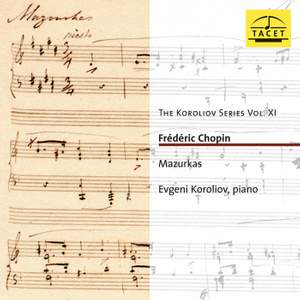
Chopin: Mazurkas

Chopin: Mazurkas

Koroliov Series Volume 11


Chopin:

Mazurka No. 1 in F sharp minor, Op. 6 No. 1

Mazurka No. 14 in G minor, Op. 24 No. 1

Mazurka No. 5 in B flat major, Op. 7 No. 1

Mazurka No. 11 in E minor, Op. 17 No. 2

Mazurka No. 15 in C major, Op. 24 No. 2

Mazurka No. 13 in A minor, Op. 17 No. 4

Mazurka No. 17 in B flat minor, Op. 24 No. 4

Mazurka No. 41 in C sharp minor, Op. 63 No. 3

Mazurka No. 8 in A flat minor, Op. 7 No. 4

Mazurka No. 21 in C sharp minor, Op. 30 No. 4

Mazurka No. 19 in B minor, Op. 30 No. 2

Mazurka No. 34 in C major, Op. 56 No. 2

Mazurka No. 35 in C minor, Op. 56 No. 3

Mazurka No. 45 in A minor, Op. 67 No. 4

Mazurka No. 18 in C minor, Op. 30 No. 1

Mazurka No. 40 in F minor, Op. 63 No. 2

Mazurka No. 29 in A flat major, Op. 41 No. 4

Mazurka No. 32 in C sharp minor, Op. 50 No. 3

Mazurka No. 39 in B major, Op. 63 No. 1

Mazurka No. 27 in E minor, Op. 41 No. 2

Mazurka No. 47 in A minor, Op. 68 No. 2

Mazurka No. 46 in C major, Op. 68 No. 1

Mazurka No. 22 in G sharp minor, Op. 33 No. 1

Mazurka No. 51 in A minor 'Émile Gaillard'

Mazurka No. 49 in F minor, Op. 68 No. 4


Evgeni Koriolov (piano)

Koriolov was born in Moscow in 1949. As a student, he won numerous prizes at international competitions and after graduating was invited to teach at the Tchaikovsky Conservatoire. He later became a professor in Hamburg. His previous recordings on Tacet have all been very well received.

Tacet - The Koroliov Series - TACET183

(CD)

$17.00

Usually despatched in 2 - 3 working days.

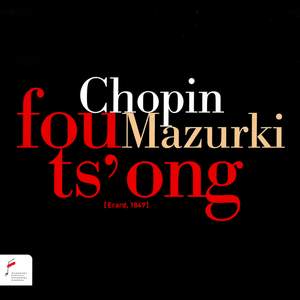
Chopin: Mazurkas

Chopin: Mazurkas


Chopin:

Mazurka No. 32 in C sharp minor, Op. 50 No. 3

Mazurka No. 22 in G sharp minor, Op. 33 No. 1

Mazurka No. 16 in A flat major, Op. 24 No. 3

Mazurka No. 35 in C minor, Op. 56 No. 3

Mazurka No. 40 in F minor, Op. 63 No. 2

Mazurka No. 12 in A flat major, Op.17 No.3

Mazurka No. 17 in B flat minor, Op. 24 No. 4

Mazurka No. 18 in C minor, Op. 30 No. 1

Mazurka No. 31 in A flat major, Op. 50 No. 2

Mazurka No. 14 in G minor, Op. 24 No. 1

Mazurka No. 30 in G major, Op. 50 No. 1

Mazurka No. 25 in B minor, Op. 33 No. 4

Mazurka No. 19 in B minor, Op. 30 No. 2

Mazurka No. 11 in E minor, Op. 17 No. 2

Mazurka No. 27 in E minor, Op. 41 No. 2

Mazurka No. 36 in A minor, Op. 59 No. 1

Mazurka No. 6 in A minor, Op. 7 No. 2

Mazurka No. 49 in F minor, Op. 68 No. 4


Fou Ts’ong (piano)

Fou Ts’ong is one of the greatest Chopin interpreters alive today, a prize-winner at the Fifth International Chopin Piano Competition in Warsaw in 1955, at which he also received the Polish Radio Prize for the best performance of mazurkas, eighteen of which he interprets on an original ‘Chopinian’ instrument on this disc. They date from different periods in the composer’s oeuvre.

Frederick Chopin Institute - The Real Chopin - NIFCCD001

(CD)

$17.00

Usually despatched in 2 - 3 working days.

Chopin: Tristesse

Chopin: Tristesse

and other Masterpieces for Piano


Chopin:

Étude Op. 10 No. 3 in E major 'Tristesse'

Prelude Op. 28 No. 4 in E minor

Étude Op. 25 No. 6 in G sharp minor

Piano Sonata No. 2 in B flat minor, Op. 35 'Marche funèbre': 3rd movement (Funeral March)

Prelude Op. 28 No. 16 in B flat minor

Prelude Op. 28 No. 24 in D minor

Mazurka No. 47 in A minor, Op. 68 No. 2

Polonaise No. 3 in A major, Op. 40 No. 1 'Military'

Mazurka No. 45 in A minor, Op. 67 No. 4

Mazurka No. 13 in A minor, Op. 17 No. 4

Mazurka No. 11 in E minor, Op. 17 No. 2

Polonaise No. 4 in C minor, Op. 40, No. 2

Nocturne No. 5 in F sharp major, Op. 15 No. 2

Étude Op. 25 No. 11 in A minor 'Winter Wind'

Prelude Op. 28 No. 8 in F sharp minor

Prelude Op. 28 No. 6 in B minor

Prelude Op. 28 No. 17 in A flat major

Prelude Op. 28 No. 20 in C minor

Étude Op. 25 No. 12 in C minor


Idil Biret, Janusz Olejniczak, Rafael Orozco & Grigory Sokolov (piano)

Chopin grew up in Poland, before living as an exile in France. In his piano music he expressed an infinite palette of feelings and emotions, and used his legendary virtuosity to create musical poetry. In his works, which include Nocturnes and Mazurkas, we find gentleness and melancholy, expressiveness and passion.

Chopin grew up in Poland, before living as an exile in France. In his piano music he expressed an infinite palette of feelings and emotions, and used his legendary virtuosity to create musical poetry. In his works, which include Nocturnes and Mazurkas, we find gentleness and melancholy, expressiveness and passion

Naive Classical Moments - V5105

(CD)

$9.00

(also available to download from $10.50)

Usually despatched in 3 - 4 working days. (Available now to download.)

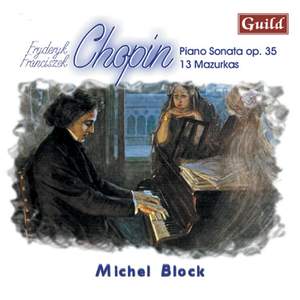
Chopin: Mazurkas Op. 35 & Marche Funèbre

Chopin: Mazurkas Op. 35 & Marche Funèbre


Chopin:

Mazurka No. 24 in C major, Op. 33 No. 3

Mazurka No. 50 in A minor 'Notre Temps'

Mazurka No. 48 in F major, Op. 68 No. 3

Mazurka No. 11 in E minor, Op. 17 No. 2

Mazurka No. 12 in A flat major, Op.17 No.3

Mazurka No. 13 in A minor, Op. 17 No. 4

Mazurka No. 29 in A flat major, Op. 41 No. 4

Mazurka No. 49 in F minor, Op. 68 No. 4

Mazurka No. 22 in G sharp minor, Op. 33 No. 1

Mazurka No. 45 in A minor, Op. 67 No. 4

Mazurka No. 40 in F minor, Op. 63 No. 2

Mazurka No. 41 in C sharp minor, Op. 63 No. 3

Mazurka No. 30 in G major, Op. 50 No. 1

Piano Sonata No. 2 in B flat minor, Op. 35 'Marche funèbre'


Michel Block (piano)

Guild - GMCD7186

(CD)

$18.00

Usually despatched in 8 - 10 working days.

Copyright © 2002-13 Presto Classical Limited, all rights reserved.