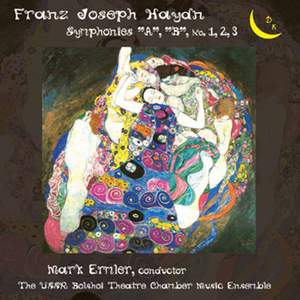
All recordingsPrices shown exclude VAT. (UK tax is not payable for deliveries to United States.) See Terms & Conditions for p&p rates. | |  | Haydn: Symphonies A, B, Nos. 1, 2 & 3
USSR Bolshoi Theatre Chamber Music Ensemble, Mark Ermler | | | In stock - usually despatched within 1 working day. |
|
|
| |  | Haydn - Symphonies Volume 29
“very musical and very alive.” (Music Web) | | | (also available to download from $5.75) | Usually despatched in 2 - 3 working days. (Available now to download.) |
|
|
| |  | Haydn - Symphonies Nos. 1-5
Immensely inventive works that, had there not been another hundred to follow, every music-lover would know and which would be widely performed and recorded. Early Music Review | | | Usually despatched in 2 - 3 working days. |
|
|
| |  | Haydn Early Symphonies
Cantilena, Adrian Shepherd | | | (also available to download from $12.50) | Usually despatched in 2 - 3 working days. (Available now to download.) |
|
|
| |  | Haydn Symphonies Volume 1, Nos. 1-20
| | | In stock - usually despatched within 1 working day. |
|
|
| |  | Haydn: Complete Symphonies - MP3 EditionThe Esterházy Recordings
To celebrate the bicentennial of Haydn's death Nimbus have released an ultra value MP3 set containing the complete symphonies. This new is released in MP3 format at 320 kbps, the highest possible bit rate for MP3 format. Customers will be able to transfer the files directly to their ipod or MP3 player or to play the discs on their computer, most DVD players and the latest generation of in car players. PLEASE NOTE THAT THIS SET WILL ONLY PLAY ON MP3-ENABLED CD PLAYERS AND ON COMPUTERS/IPODS. “Fischer's body of strings is appreciably smaller [than Dorati's], and his violin and cello soloists sweeter toned, surer in their intonation and more imaginative in their phrasing. In the slow movements the greater refinement of Fischer's soloists and his rather lighter touch are invariably more persuasive” Gramophone Magazine “The sound is at once warmly atmospheric and intimate, with high contrasts of dynamic and texture. Continuing to use modern, not period instruments, but with limited string vibrato and Viennese oboes and horns standing out distinctively, these are recordings to challenge the long-time supremacy of Dorati's pioneering Decca set.” Penguin Guide | | | Usually despatched in 4 - 5 working days. |
|
|
| |  |
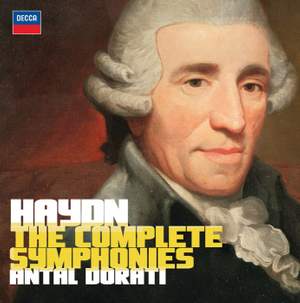
“Dorati's famous integral recording of all 104 of the published Symphonies now returns in a Decca bargain box containing 33 CDs. It still holds its place in the catalogue as the only complete set to contain everything Haydn wrote in this medium, including the Symphonies 'A' and 'B', omitted from the original numbering scheme because at one time they were not thought to be symphonies at all. The survey also encompasses additional alternative movements for certain works (notably Nos 53 and 103) and alternative complete versions of the Philosopher Symphony and No 63, which are fascinating. The remastering confirms the excellence of the vintage Decca sound. No more needs to be said, except that the one minus point in these very convincing modern-instrument performances is Dorati's insistence on measured, often rustic tempos for the minuets. For those who can run to the complete series this is self-recommending – a source of inexhaustible pleasure.” Gramophone Classical Music Guide, 2010 “Dorati was ahead of his time as a Haydn interpreter when, in the early 1970s, he made this pioneering integral recording of the symphonies. Superbly transferred to CD in full, bright, immediate sound, the performances are a consistent delight.” Penguin Guide, 2011 edition | | | In stock - usually despatched within 1 working day. |
|
|
| |  |
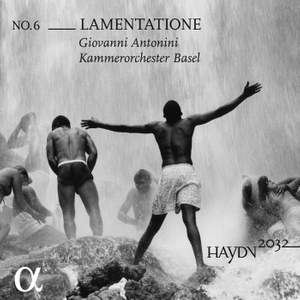
“It was little short of tragic that the very last box of symphonies in Adám Fischer's Haydn series for Nimbus, Nos 21 to 39 plus the Symphonies A and B, appeared just as the demise of that label was announced in January 2002. The final box was the finest of the series, but all too few copies reached the shops, making this 33-disc box covering all the symphonies very welcome indeed, even if over the 14 years that it took to complete the project, the quality and style varied. That final box of 20 symphonies was a superb culmination to the project. Not only are they a fascinating sequence of works written in the 1760s when the young Haydn was busy experimenting, the performances are outstanding. They were recorded as recently as 2000 and Haydn Orchestral 551 2001, and far more than the earliest recordings in the series, they take full note of period practice while staying faithful to modern instruments. More than ever one registers the individual virtuosity of the various soloists in the orchestra, often challenged to the limit by fast speeds. So a movement like the variation finale of No 31, the Hornsignal, features a sequence of brilliant soloists such as Haydn might have been writing for in his Esterházy orchestra – violin, cello, horn and so on, even double bass. It's a performance full of panache, with the four horns braying out superbly. Other striking symphonies in the group include No 22 in E flat, The Philosopher, with its extraordinary parts for two cors anglais. Also the Alleluia Symphony, No 30 in C, with trumpets and drums dramatically added to the usual published scoring – brought in later, according to HC Robbins Landon, by Haydn as an option. The minor-key works in this last batch, such as the Lamentatione, No 26 in D minor, and best of all, No 39 in G minor, are fine examples of Haydn's Sturm und Drang manner, with Fischer heightening dynamic contrasts to good effect. No 39 brings an example of Fischer's mastery when he enhances the tension of the nervy opening and exaggerates the pauses; he's far more effective in that movement than Dorati . While with those symphonies recorded at the beginning of the project, from 1987 to 1990, comparisons with the Dorati series have the merits of each balanced fairly evenly, the advantage certainly tips in favour of Fischer as the project developed. For the London Symphonies, Nos 93 to 104, the first to be recorded, the Nimbus engineers – working in the very hall at the Esterházy Palace which Haydn used – produce rather washy sound, whereas the works recorded later benefit from a sharper focus. In those early recordings, too, the slow movements tend to be taken at the sort of broad speeds of tradition, with warmly expressive phrasing. At that point, no doubt, Fischer was just beginning to woo his select band of Austrian and Hungarian musicians away from their usual Romantic manners. In his notes Fischer makes a point of describing the unfolding development of the project over 14 years. He becomes increasingly aware of historically informed style, notably in faster speeds for both slow movements and minuets (which increasingly acquire a scherzo-like flavour), giving him a clear advantage over Dorati. Also the string playing comes closer to that found in period orchestras, with lighter phrasing and less marked use of vibrato. That development is noticeable as early as the recordings made in 1994-5, when most of the Sturm und Drang symphonies were covered – broadly those in the late 40s and early 50s in the regular Breitkopf numbering. Finales in particular, taken fast, have all the bite and wildness one could want, with pinpoint attack. The very earliest symphonies in numerical order, Nos 1 to 20, were recorded early in the project between 1989 and 1991, with results that are more variable. The finale of No 12, for example, marked Presto, is taken surprisingly slowly, almost like a minuet. No 13, very adventurously for that early period, uses four horns, yet because of the reverberant acoustic they don't ring out as prominently as those used in works like the Hornsignal, recorded later. Even in these early symphonies, recorded near the beginning of the project, the trios in Minuets have solo strings, and regularly the vigour and thrust of Allegros is exhilarating, with rhythms lifted and admirably crisp ensemble. This is a set guaranteed to encourage collectors to delve into works which from first to last convey the joy in creation that's the unfailing mark of this ever-welcoming master. If you have an MP3 player or listen via your computer Nimbus offer the entire cycle on eight discs of MP3 files, easily downloaded for use with your iPod.” Gramophone Classical Music Guide, 2010 | | | Usually despatched in 4 - 5 working days. |
|
|
| |  | The Complete Haydn Symphonies
Sinfonia Finlandia Jyväskylä, Northern Chamber Orchestra, Cologne Chamber Orchestra, Toronto Chamber Orchestra, Nicolaus Esterhazy Sinfonia, Swedish Chamber Orchestra & Capella Istropolitana, Patrick Gallois, Nicholas Ward, Helmut Mühler-Brühl, Kevin Mallon, Bela Drahos & Barry Wordsworth One of the most extraordinary bequests in the history of music, Haydn’s symphonies established his reputation as the greatest composer of his time. This comprehensive boxed set – including not only Nos 1–104 but also No. 105 (Sinfonia concertante) and the less familiar No. 107 (‘Symphony A’) and No. 108 (‘Symphony B’) – celebrates both a highly commended symphonic series and a supremely imaginative composer who changed the course of classical music. | | Naxos - 8503400 (CD - 34 discs) Normally: $136.50 Special: $109.20 |
| | Usually despatched in 2 - 3 working days. |
|
|
| |  |
This 37-disc box set is the only brand new and fully digital recording of the complete symphonies of Haydn. Performed by the Stuttgarter Kammerorchester (Stuttgart Chamber Orchestra) and conducted by Dennis Russell Davies, the recordings were done live in connection with concerts of the whole cycle. The series received fantastic reviews by the press, and The Stuttgart Chamber Orchestra was awarded the European Chamber Music Prize in 2008. Available at a fantastic price, the set is released to tie in with the 200th anniversary of the composer’s death in 2009. Packaged in individual cardboard wallets with a sturdy outer box, this limited edition set includes a booklet with texts in both English and German. “The Trauer Symphony (No 44) receives a truly exciting performance, demonstrating also that Davies is ever alert to a sudden dynamic shift or a surprise accent. …works such as the sublime No 42 and the outdoor finale of the almost entirely neglected No 71 demonstrate the pedigree of these fine wind-players. By the time they reach the "Paris" Symphonies and their successors (Nos 88-90 especially) they're in a true purple patch in performances that can hold their own against many on record.” Gramophone Magazine, January 2010 “This complete edition by the Stuttgarter Kammerorchester under the baton of Dennis Russell Davies is of equivalent standard to Haydn's achievement, a remarkable body of work in which it's possible to get happily lost for days.” The Independent, 18th December 2009 ***** “A lovely bumper bundle...The first set recorded in digital sound, its clarity suits the players’ bounce and bite.” The Times, 12th December 2009 **** | | | In stock - usually despatched within 1 working day. |
|
|
| |
|