This page lists all recordings of Sulla tomba che rinserra (from Lucia di Lammermoor) (Act One duet - Lucia and Edgardo), by Gaetano Donizetti (1797-1848) on CD. Generally, more recent releases are listed first, but with priority given to those that are in stock. |
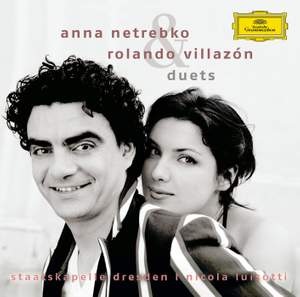
Prices shown exclude VAT. (UK tax is not payable for deliveries to United States.) See Terms & Conditions for p&p rates. | |  | Anna Netrebko & Rolando Villazón - Duets
Limited edition special edition also available - click here “Netrebko and Villazón have toured with a recital programme in which most of these duets have been included, interspersed with a few solos and orchestral pieces. In London they sang to much cheering but against a general feeling that Villazón's warm tone and eager personality contrasted with Netrebko's rather chilly star– grooming, while the purity of her tone was a little less appealing than it might have been because she sang so much more loudly than she need have done. As recorded, the voices match well in terms of volume, and Netrebko's brightness seems reduced in wattage sufficiently to distribute the lighting more evenly. It's still not the voice of a Mimì (not warm enough) or a Lucia (not vulnerable) but the voice–character becomes better suited after these two, which as it happens are the opening numbers, though in the London recital there was no Donizetti and the Puccini was used for the finale. It was then spoiled, as it is now, by the offstage notes at the end being sung in octaves and fortissimo instead of in harmony and pianissimo as marked. Also Mimì's 'Io t'amo' is marked con abbandono but not molto ritardando. Such changes vulgarise a finely calculated score which needs no additional underlining. There is, however, lovely singing by Villazón, who in the Lucia duet phrases his verse of 'Verrano a te' with a breadth matched by the grace of his beautifully lightened tone. The French excerpts go well, the Manon being particularly well characterised. Netrebko is her best self in the Tchaikovsky duet. The voices are well recorded; the Dresden violins caught in rather harsh exposure of the overtones, which are not the things we most want to hear.” Gramophone Classical Music Guide, 2010 | | | In stock - usually despatched within 1 working day. |
|
|
| |  | Edita Gruberova: Vienna State Opera 1977-2010
Bellini: | La dama d'Arturo... Oh, vieni al tempio (from I Puritani) Deh! Con te li prendi ... Mira,o Norma (from Norma) | Donizetti: | Quel guardo il cavaliere (from Don Pasquale) sung in German as 'O jene Glut in Blicken ... Auch ich versteh' die feine Kunst ' Quando di luce rosea (from Maria Stuarda) Regnava nel silenzio...Quando rapito in estasi (from Lucia di Lammermoor) Sulla tomba che rinserra (from Lucia di Lammermoor) Ah! tardai troppo...O luce di quest'anima (from Linda di Chamounix) Com' e bello! (from Lucrezia Borgia) Scellerato!...Va! La morte sul capo ti pende (from Robert Devereux) Pronta son; purch'io non manchi (from Don Pasquale) sung in German as 'Ich bin bereit' | Massenet: | Allons! Il le faut pour lui-même!... Adieu, notre petite table (from Manon) Suis-je gentille ainsi? ... Je marche sur tous les chemins ... Obéissons quand leur voix appelle (from Manon) Ces murs silencieux...Toi! Vous!...Oui, c'est moi (from Manon) | Mozart: | Fuggi, crudele, fuggi! (from Don Giovanni) Vanne, t'affretta… Ah se il crudel periglio (from Lucio Silla) Martern aller Arten (from Die Entführung aus dem Serail) | Strauss, J, II: | Mein Herr Marquis (from Die Fledermaus) | Strauss, R: | Grossmächtige Prinzessin (from Ariadne auf Naxos) | Verdi: | Un dì felice, eterea (from La traviata) Sempre libera (from La Traviata) |
If opera enthusiasts had to choose a singer as the quintessential coloratura soprano, the name of Edita Gruberova would be bound to come up. To the delight of her audiences, she has spent the last four decades exploring every corner of the coloratura repertory. The fact that throughout this period she has retained her timbre, flexibility and an upper range extending above top C is due to two factors: her sovereign technique and her intelligent choice of repertoire. After making her professional début with a provincial company in her native Slovakia, Gruberova joined the Vienna State Opera, which remains her artistic home to this day. This new compilation of high points from Orfeo's Wiener Staatsoper Live series showcases her earliest decisive successes in the sort of lighter coloratura roles often sung by soubrettes: Norina in 'Don Pasquale' and above all Zerbinetta in 'Ariadne auf Naxos', a role to which she returned for 35 years. Lucia stayed for 30 years, allowing her to cast a powerful spell on audiences not only in Vienna but all over the world. Starting with Lucia and with three of Mozart’s soprano roles, Donna Anna, Konstanze and Giunia in the rarely heard 'Lucio Silla', she began to develop in the direction of dramatic coloratura roles, a development that finally enabled her to tackle Bellini’s 'Norma'. Between these two extremes, Edita Gruberova’s career contains many other milestones that may all be enjoyed in this portrait from Vienna. Roles represented here include the titular heroine of Verdi’s 'La traviata' (with Alfredo Kraus as one of her many world-class partners), the flighty Manon in Massenet’s opera of the same name – one of only a handful of excursions into the French repertory – and her irresistible Adele in Johann Strauss’ operetta, 'Die Fledermaus'. Central to the second half of Edita Gruberova’s 40-year reign at the Vienna State Opera are leading roles in bel canto operas, operas which without her be even more of a rarity: Elvira in 'I Puritani' and four of Donizetti’s dramatic coloratura roles, Elisabetta in 'Roberto Devereux' plus Maria Stuarda, Linda di Chamounix and, most recently, Lucrezia Borgia. “an excellent portrait of the artist” International Record Review, October 2012 | | | Usually despatched in 3 - 4 working days. |
|
|
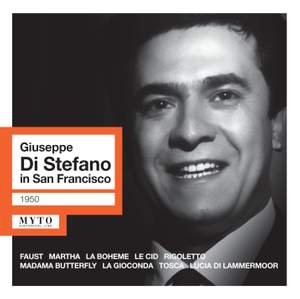
| |  | Giuseppe di Stefano in San Francisco
Giuseppe de Stefano was renowned as the true successor of Gigli and was known as the “Golden Voice”. This collection of recordings made in San Francisco in 1950 includes excerpts from Gounod’s Faust, Verdi’s Rigoletto and Puccini’s La Boheme. In the excerpt from Madame Butterfly, di Stefano is joined by Renata Tebaldi. | | | Usually despatched in 2 - 3 working days. |
|
|
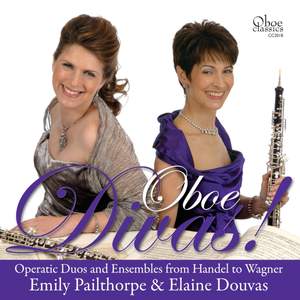
| |  | Oboe Divas!Operatic Duos and Ensembles from Handel to Wagner
Emily Pailthorpe (the youngest winner of the Gillet International oboe competition) joins Elaine Douvas (Principle Oboe of the Met Opera Orch.) to give an oboist’s-eye-view of opera. | | | Usually despatched in 4 - 5 working days. |
|
|
| |  | The Art of Erna Spoorenberg in Opera
Erna Spoorenberg (soprano) | | | Usually despatched in 2 - 3 working days. |
|
|
| |  | The Pavarotti Collection Vol. 2
Adam: | O Holy Night | Barber, S: | Agnus Dei | Beethoven: | In questa tomba oscura, WoO.133 | Bellini: | E serbato a questo acciaro (from I Capuleti e i Montecchi) Ola ! Chi sei? (from I Capuleti e i Montecchi) Cavaliere Vaga luna che inargenti Dolente immagine di Fille mia Vieni, fra queste braccia! (from I Puritani) Son salvo, alfin son salvo...A una fonte afflitto (from I Puritani) Malinconia, ninfa gentile Son salvo, alfin son salvo...A una fonte afflitto (from I Puritani) Credeasi misera, da me tradita (from I Puritani) Bella Nice che d'amore Ma rendi pur contento Dolente immagine di Fille mia Vanne, o rosa fortunata Bella Nice che d'amore | Berchem: | O Jesu Christe | Bixio: | La mia canzone al vento Mamma | Bizet: | Agnus Dei | Buzzi-Peccia: | Lolita | Capua: | O sole mio | Crescenzo: | Rondine al nido | Curtis, E: | Torna a Surriento Non ti scordar di me | Denza: | Occhi di fata | Donizetti: | Tombe degl'avi miei … Fra poco a me ricovero...Tu che a Dio spiegasti l'ali (from Lucia di Lammermoor) Ah! mes amis, quel jour de fête! (from La Fille du Régiment) Pour me rapprocher de Marie (from La Fille du régiment) Fra poco a me ricovero...Tu che a Dio spiegasti l'ali (from Lucia di Lammermoor) Una parola…Chiedi all'aura (from L'elisir d'amore) Quanto è bella, quanto è cara! (from L'Elisir d'amore) Qui di sposa eterna...Ah! Verrano a te sull'aure (from Lucia di Lammermoor) Che voi m'amate (from La Figlia del Reggimento) Me voglio fa'na casa Il barcaiolo 'Voga, voga, il vento tace' Sulla tomba che rinserra (from Lucia di Lammermoor) Una furtiva lagrima (from L'elisir d'amore) | Flotow: | Ach, so fromm (from Martha) | Franck, C: | Panis Angelicus | Giordani, G: | Caro mio ben | Giordano, U: | Amor ti vieta (from Fedora) | Gluck: | Che faro' senza Euridice? (from Orfeo ed Euridice) | Gruber, F: | Stille Nacht | Handel: | Messiah: Hallelujah Chorus | Lazzaro, E: | Chitarra romana | Legrenzi: | Che fiero costume | Leoncavallo: | Vesti la giubba (from I Pagliacci) | Liszt: | Sonetto 104 del Petrarca 'Pace non trovo', S270 No. 1 | Mascagni: | Serenata | Massenet: | Instant charmant … En fermant les yeux (from Manon) Pourquoi me reveiller (from Werther) A Parigi n'andrem (Manon) | Mozart: | No, la morte io non pavento (from Idomeneo) Dalla sua pace (from Don Giovanni) Padre, mio caro padre (from Idomeneo) Un'aura amorosa del nostro tesoro (from Così fan tutte) Spiegarti non poss'io, K489 Non ho colpa (from Idomeneo) Ah, qual gelido orror...Il padre adorato (from Idomeneo) | Pergolesi: | Tre giorni son che Nina | Puccini: | Recondita armonia (from Tosca) O Mimi, tu piu non torni (from La Bohème) Dunque è proprio finita! (from La Bohème) O soave fanciulla (from La Bohème) Non sono in vena (from La Bohème) Che gelida manina (from La Bohème) Nessun dorma (from Turandot) Donna non vidi mai (from Manon Lescaut) | Respighi: | Nevicata, P. 65 Nebbie Pioggia | Rossini: | Soirées musicales: La Danza La promessa Stabat Mater: Cujus animam gementem | Schubert: | Ave Maria, D839 Mille Cherubini in coro | Sibella: | La Girometta | Stradella: | Pieta, Signore | Tosti: | Luna d'estate Ideale A vucchella L'ultima canzone Non t'amo più! Aprile Marechiare Malià Chanson de l’Adieu | Verdi: | De' miei bollenti spiriti (from La traviata) Bella figlia dell'amore (from Rigoletto) Un dì felice, eterea (from La traviata) Libiamo, ne' lieti calici (from La Traviata) Parigi, o cara (from La Traviata) Ma se m'è forza perderti (from Un ballo in maschera) Ah sì ben mio (from Il trovatore) La donna è mobile (from Rigoletto) Ah! L'Ultima Preghiera (from Luisa Miller) Ah Inseperabile Di quella pira (from Il trovatore) È il sol dell'anima (from Rigoletto) O madra mia ... Come poteva un angelo (from I Lombardi) Un dì felice, eterea (from La traviata) Partite? Crudele! Questa o quella (from Rigoletto) Amelia a d'ess'ancor (from Luisa Miller) La mia letizia infondere (from I Lombardi) Ella mi fu rapita! (from Rigoletto) Oh! fede negar potessi (from Luisa Miller) Kyrie eleison (from Requiem) O mio rimorso (from La Traviata) | Wade: | O come, all ye faithful | Yon: | Gesu bambino |
Featuring 100 historic recordings on 12 CDs (including beloved arias such as Nessun Dorma), the set also includes excerpts from oratorios and art songs. As a bonus, Pavarotti’s magnificent 1989 live performance in Barcelona is captured on DVD with terrific sound and picture. | | | Usually despatched in 2 - 3 working days. |
|
|
| |
|