Prices shown exclude VAT. (UK tax is not payable for deliveries to United States.) See Terms & Conditions for p&p rates. | |  | Wagner: Orchestral Excerpts Volume 3
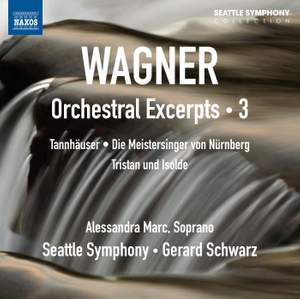
Themes of love and passion dominate these orchestral excerpts from Wagner’s music dramas. The legend of Tannhäuser contrasts the sensual allure of Venus with the ideals of courtly love and religious devotion. Die Meistersinger von Nürnberg pits an inspired but rash young singer against the traditions of the old masters in a song competition, with a beautiful girl as the prize. Tristan und Isolde, based on one of the world’s great love stories, is considered Wagner’s most revolutionary work, seamlessly blending themes of love and death into a shattering apotheosis. Gerard Schwarz’s other selections of Wagner excerpts can be found on 8572767 and 8572768. “Marc is an excellent singer, thankfully free of the gusty tone production which afflicts too many Wagnerian sopranos today. She sings with expressiveness, delicacy and a real feeling for the text” MusicWeb International, October 2012 | | | (also available to download from $6.00) | In stock - usually despatched within 1 working day. |
|
|
| |  | Wagner - Orchestral Music
| | | In stock - usually despatched within 1 working day. |
|
|
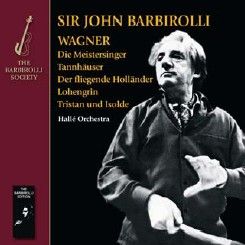
| |  | Wagner: Opera Overtures & PreludesRecorded Free Trade Hall, Manchester, 16-17 September 1959 and April 1959 STEREO
These stereo recordings date from sessions on 16 and 17 September 1959 for Pye. (The Tannhäuser Overture was recorded at an earlier session in April 1959). The Meistersinger Overture and Act 3 Suite was popular with Barbirolli, having recorded it for HMV in 1944 and other Wagner works he recorded included the Lohengrin Preludes (HMV 1946, now released on SJB1004), the Rienzi Overture (HMV 1944). A unique opportunity to hear an all-Wagner concert from Barbirolli comes in a ‘live’ broadcast with the New York Philharmonic in November 1938 which includes the Siegfried Idyll, which he never recorded commercially (Barbirolli Society SJB1035). Whatever qualms Wagner himself might have had about performing extracts from his operas in the concert hall, he was, as a professional musician, able to suppress them. They brought in revenue, of course, but this was not the main consideration; more important was that his work should be known and understood. He therefore sanctioned, even encouraged, the performance of excerpts from his operas, either with vocalists or, as in the present recording, in purely orchestral form. | | | Usually despatched in 4 - 5 working days. |
|
|
| |  | Reiner conducts Wagner
| | | Usually despatched in 3 - 4 working days. |
|
|
| |  | Barbirolli in New YorkRecording of a concert in Carnegie Hall, New York on 20 November 1938
Although John Barbirolli made several commercial recordings during his seven years as conductor of the Philharmonic- Symphony Orchestra of New York (as the New York Philharmonic was then formally known), the Barbirolli Society offers us a unique oportunity with this issue of an off-the-air recording of a Wagner concert, performed in Carnegie Hall in November 1938. It comes as a valuable reminder of an important period of his career, one moreover which has come to be regarded, superficially and misleadingly, as a failure. The orchestra was immediately won over by Barbirolli’s personality and remained devoted to him. If these tough players – once known as ‘Murder Incorporated’ – had not liked him and respected his musicianship, it would have been impossible for the manager Arthur Judson, within five days of JB’s first concert, to have begun to mention a permanent appointment. On 7 December 1936, after five weeks’ work with the orchestra, the board offered him a three-year contract and this was renewed in 1940 for a further two years, by which time the war was a complicating factor. JB himself was overwhelmed and wrote to his future wife Evelyn Rothwell on 11 December 1936: ‘The orchestra played tonight as something I have dreamed of. . . The emotion of the orchestra at my appointment is something too touching for words. I can’t believe I am worthy of all this.’ The orchestra’s first horn player spoke of ‘the joy’ of making music with Barbirolli. | | | Usually despatched in 4 - 5 working days. |
|
|
| |  | Wagner: Orchestral Music from Operas
| |
|
| |  | Wagner & Strauss
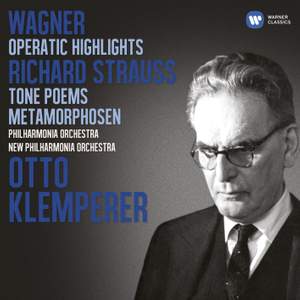
This collection sees Otto Klemperer lead the Philharmonia and New Philharmonia orchestras in compelling performances of works by Wagner and Richard Strauss. The set features highlights from each of Wagner’s most acclaimed operas, as well as Strauss’s Don Juan and a 1962 account of Tod und Verklärung that was hailed as one of Klemperer’s finest late recordings. Ambivalent is the word which best describes Klemperer’s feelings about Germany’s two great musical Richards, Wagner and Strauss. During his early years as an opera conductor in Germany, Klemperer conducted a modicum of Strauss and a good deal of Wagner, though from the outset it was clear that he was never going to be an unthinking fan of either. The music of both composers did, nonetheless, cast its spell. Recording Act 1 of Wagner’s Die Walküre in London in 1969 was, he said, like meeting a woman he had loved 40 years ago and discovering that she was much as she had always been. He went on: ‘I find the music thrilling. Thrilling! One can say this or that about Wagner, but no one else could have written that music. No one! It’s as stupid to underestimate Wagner as it is to overestimate him. He doesn’t need either’. Klemperer’s attitude to the operas of Richard Strauss was no less mixed. He thrilled to Salome, which even as an old man he considered to be one of the twentieth century’s most original scores, revered Elektra, and took great delight in Ariadne auf Naxos. On the other hand, he found too much ‘sugar-water’ in Der Rosenkavalier and was baffled by Die Frau ohne Schatten of which he conducted a handful of performances in Cologne in 1919. The Strauss work which had first impressed Klemperer – he was 15 at the time – was Tod und Verklärung. What struck the young enthusiast was the quality of the orchestration and the remorselessness of the build-up of the thematic material, qualities Klemperer would later bring to his own reading of a work which does indeed advance implacably towards its sought-for goal: the soul’s transfiguration as memories of childhood visions and unattained artistic ideals grandly mingle. Knowing the man as he did, Klemperer experienced few difficulties in coming to terms with Strauss’s equivocations during the Nazi era. As the Second World War drew towards its close Strauss began working on Metamorphosen, a threnody for 23 solo strings born of the trauma of wartime cultural loss: the Goethe house destroyed, Dresden, Munich, Weimar all in ruins. ‘Basically quite nice’ was Klemperer’s laconic comment on the piece, yet no one was more eager to conduct it, an ambition he realised in Budapest in March 1948. Klemperer’s coupling of Metamorphosen with Tod und Verklärung on an LP first released in 1962 was widely welcomed as one of the finest of all his late recordings. | 
| | | In stock - usually despatched within 1 working day. |
|
|
| |  | Sunday Evenings with Pierre Monteux
Alfano: | Aria from Resurrection | Beethoven: | Consecration of the House Overture, Op. 124 Symphony No. 5 in C minor, Op. 67 The Creatures of Prometheus Overture, Op. 43: Adagio Egmont Overture, Op. 84 Fidelio Overture Op. 72c Leonore Overture No. 3, Op. 72b Piano Concerto No. 3 in C minor, Op. 37 - 1st movt (transc Alkan) Solomon | Berlioz: | Le carnaval romain Overture, Op. 9 Trojans Prelude L'Enfance du Christ, Op. 25 - excerpts La Damnation de Faust, Op. 24 (excerpts) Roméo et Juliette, Op. 17 (excerpts) Le Corsaire Overture, Op. 21 | Borodin: | Prince Igor: Polovtsian March | Brahms: | Waltzes (16), Op. 39, extracts (arr. Hertz) Symphony No. 1 in C minor, Op. 68 (extract) Tragic Overture, Op. 81 Double Concerto for Violin & Cello in A minor, Op. 102: I. Allegro Naoum & Boris Blinder | Chadwick: | Symphonic Sketches: Jubilee | Dukas: | The Sorcerer's Apprentice | Falla: | The Three Cornered Hat - suites Nos. 1 & 2 | Franck, C: | Prélude, Choral et Fugue, M21 (arr. Pierné) Rédemption Symphonic Interlude (excerpt) Psyche Suite (extracts) Symphony in D minor | Glazunov: | Scènes de ballet, Op. 52 | Gluck: | Iphigénie en Aulide Overture | Gretry: | Céphale et Procris - Suite | Haydn: | Symphony No. 8 in G major 'Le Soir' | Liszt: | Les Préludes, symphonic poem No. 3, S97 Hungarian Rhapsody, S244 No. 2 in C sharp minor | Massenet: | Phèdre: Overture | Mendelssohn: | Hebrides Overture, Op. 26 Symphony No. 4 in A major, Op. 90 'Italian' Ruy Blas Overture, Op. 95 | Messiaen: | L'Ascension (Quatre meditations pour l'orchestre) | Mozart: | Don Giovanni, K527: Overture Die Zauberflöte, K620: Overture Die Entführung aus dem Serail, K384: Overture Symphony No. 35 in D major, K385 'Haffner' Piano Concerto in A major (excerpt) W. Kapell (piano) Symphony No. 41 in C major, K551 'Jupiter' | Nicolai, C O: | Die lustigen Weiber von Windsor overture | Rachmaninov: | Symphony No. 2 in E minor, Op. 27 | Respighi: | Fountains of Rome | Rimsky Korsakov: | Christmas Eve Suite Russian Easter Festival Overture, Op. 36 Capriccio espagnol, Op. 34 | Rossini: | L'Italiana in Algeri Overture Guillaume Tell Overture | Schubert: | Fantasie in C major, D760 'Wanderer' Lili Kraus | Schumann: | Symphony No. 4 in D minor, Op. 120 | Sibelius: | Valse Triste, Op. 44 No. 1 Pohjola's Daughter, Op. 49 | Sousa: | The Stars and Stripes Forever | Strauss, R: | Don Juan, Op. 20 Tod und Verklärung, Op. 24 Till Eulenspiegels lustige Streiche, Op. 28 Der Rosenkavalier - Suite | Tchaikovsky: | Romeo & Juliet - Fantasy Overture Piano Concerto No. 1 in B flat minor Op. 23 : Allegro non troppo e molto maestoso - Allergo con spirito Cherkassky | Thomas, Ambroise: | Mignon Overture | Wagner: | Rienzi Overture Tannhäuser: Overture Die Meistersinger von Nürnberg: Overture Die Meistersinger von Nürnberg: Dance of the Apprentices Die Meistersinger von Nürnberg: Entry of the Masters Tristan und Isolde: Prelude & Liebestod Leb wohl...Loge, hör! 'Wotan's Farewell & Magic Fire Music' (from Die Walküre) Siegfried: Waldweben Götterdämmerung: Siegfried's Rhine Journey | Walton: | Façade - Ballet Suite | Weber: | Euryanthe Overture |
CDs 1-10 previously issued on Music & Arts set CD978 (deleted); CDs 11-13 previously unissued, contains nearly 4 hours of new material | | | (also available to download from $60.25) | Usually despatched in 2 - 3 working days. (Available now to download.) |
|
|
| |  | Leopold Stokowski: The Stereo Collection 1954-1975
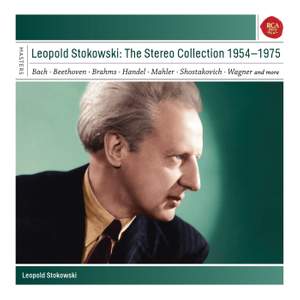
Bach, J S: | Cantata BWV147 'Herz und Mund und Tat und Leben': Jesu, bleibet meine Freude New Symphony Orchestra of London, Norman Luboff Choir Sheep May Safely Graze, from Cantata BWV208 orch. Stokowski New Symphony Orchestra of London, Norman Luboff Choir Partita for solo violin No. 2 in D minor, BWV1004: Chaconne arr. Stokowski London Symphony Orchestra Partita for solo violin No. 3 in E major, BWV1006: Preludio arr. Stokowski London Symphony Orchestra Ein feste Burg ist unser Gott arr. Stokowski London Symphony Orchestra Orchestral Suite No. 3 in D major, BWV1068: Air ('Air on a G String') arr. Stokowski London Symphony Orchestra Fugue in G minor, BWV578 'Little' arr. Stokowski London Symphony Orchestra Adagio in F major, Sinfonia from Cantata No.156, Ich steh mit einem Fuss im Grabe (BWV156) arr. Stokowski London Symphony Orchestra Chorale Prelude BWV645 'Wachet auf, ruft uns die Stimme' arr. Stokowski London Symphony Orchestra Komm süsser Tod, BWV478 arr. Stokowski London Symphony Orchestra Toccata & Fugue in D minor, BWV565 London Symphony Orchestra Toccata & Fugue in D minor, BWV565 arr. Stokowski (rehearsal) London Symphony Orchestra | Beethoven: | Symphony No. 3 in E flat major, Op. 55 'Eroica' London Symphony Orchestra Coriolan Overture, Op. 62 London Symphony Orchestra Die Ehre Gottes aus der Natur ('Die Himmel rühmen des Ewigen Ehre'), Op. 48 No. 4 New Symphony Orchestra of London, Norman Luboff Choir | Brahms: | Academic Festival Overture, Op. 80 New Philharmonia Orchestra Symphony No. 4 in E minor, Op. 98 New Philharmonia Orchestra | Canteloube: | Songs of the Auvergne (selection) Anna Moffo (soprano) American Symphony Orchestra | Dvorak: | Symphony No. 9 in E minor, Op. 95 'From the New World' New Philharmonia Orchestra | Enescu: | Romanian Rhapsody in A major, Op. 11 No. 1 RCA Victor Symphony Orchestra | Gluck: | Orfeo ed Euridice: Les Champs-Elysées arranged as 'O, Saviour hear me' by Norman Luboff & Walter Stott New Symphony Orchestra of London, Norman Luboff Choir | Handel: | Ombra mai fu (from Serse) New Symphony Orchestra of London, Norman Luboff Choir Water Music Suite No. 1 in F major, HWV348: excerpts RCA Victor Orchestra Music for the Royal Fireworks, HWV351 RCA Victor Symphony Orchestra | Humperdinck: | Abendsegen 'Abends will ich schlafen gehn' (Hänsel und Gretel) New Symphony Orchestra of London, Norman Luboff Choir | Khachaturian: | Symphony No. 3 'Simfoniya-poema' Mary Sauer (organ) Chicago Symphony Orchestra | Liszt: | Hungarian Rhapsody, S244 No. 2 in C sharp minor arr. Muller-Berghaus RCA Victor Symphony Orchestra | Mahler: | Symphony No. 2 in C minor 'Resurrection' Margaret Price (soprano), Brigitte Fassbaender (mezzo) London Symphony Orchestra & Chorus | Menotti: | Sebastian: Ballet Suite Members of the NBC Symphony Orchestra | Prokofiev: | Romeo and Juliet, Op. 64 - excerpts Members of the NBC Symphony Orchestra | Rachmaninov: | Vocalise, Op. 34 No. 14 New Symphony Orchestra of London, Norman Luboff Choir Vocalise, Op. 34 No. 14 Anna Moffo (soprano) American Symphony Orchestra | Rimsky Korsakov: | Scheherazade, Op. 35 Erich Gruenberg (violin) Royal Philharmonic Orchestra Russian Easter Festival Overture, Op. 36 Chicago Symphony Orchestra | Shostakovich: | The Golden Age (complete) Chicago Symphony Orchestra Symphony No. 6 in B minor, Op. 54 Chicago Symphony Orchestra | Smetana: | The Bartered Bride Overture RCA Victor Symphony Orchestra Má Vlast: Vltava RCA Victor Symphony Orchestra | Tchaikovsky: | Liturgy of St John Chrysostom, Op. 41: Our Father New Symphony Orchestra of London, Norman Luboff Choir Symphony No. 6 in B minor, Op. 74 'Pathétique' London Symphony Orchestra | trad.: | Deep River New Symphony Orchestra of London, Norman Luboff Choir Praise God from whom all blessings flow New Symphony Orchestra of London, Norman Luboff Choir | Villa-Lobos: | Bachianas Brasileiras No. 5: Aria and Dança (Martelo) Anna Moffo (soprano) American Symphony Orchestra | Wagner: | Die Walküre: Ride of the Valkyries Martina Arroyo, Carlotta Ordassy, Doris Yarick (sopranos), Betty Allen, Doris Okerson, Regina Sarfaty, Shirley Verrett (mezzos), Louise Parker (contralto) Symphony of the Air Tristan und Isolde: Prelude to Act 3 Herny Schuman (cor anglais) Symphony of the Air Das Rheingold: Entrance of the Gods into Valhalla Martina Arroyo, Carlotta Ordassy (sopranos), Louise Parker (contralto) Symphony of the Air Tannhäuser: Overture and Venusberg Music Symphony of the Air Rienzi Overture Royal Philharmonic Orchestra Die Walkure: Magic Fire Music Royal Philharmonic Orchestra Die Meistersinger von Nürnberg: Prelude to Act 3 Royal Philharmonic Orchestra Die Meistersinger von Nürnberg: Dance of the Apprentices Royal Philharmonic Orchestra Die Meistersinger von Nürnberg: Entry of the Masters Royal Philharmonic Orchestra Tristan und Isolde: Prelude & Liebestod Royal Philharmonic Orchestra Götterdämmerung: Siegfried's Rhine Journey and Funeral March London Symphony Orchestra Starke Scheite schichtet mir dort 'Brünnhilde's Immolation Scene' (from Götterdämmerung) (orchestral version) London Symphony Orchestra Begluckt darf nun dich 'Pilgrims' Chorus' (from Tannhauser) New Symphony Orchestra of London, Norman Luboff Choir Rienzi Overture (rehearsal & alternative ending) Royal Philharmonic Orchestra |
and rehearsal footage of Beethoven's Pastoral and Mahler's Resurrection Symphony
| | | In stock - usually despatched within 1 working day. |
|
|
| |
|