All recordingsPrices shown exclude VAT. (UK tax is not payable for deliveries to United States.) See Terms & Conditions for p&p rates. | |  | Jonas Kaufmann sings Mozart, Schubert, Beethoven & Wagner
Jonas Kaufmann is now established as the most successful and versatile tenor of his generation, attracting rave reviews for his live performances and recordings. Following the international success of Romantic Arias, Jonas Kaufmann returns with this album of outstanding arias from German opera; music of his homeland which he grew up hearing. The great opera conductor Claudio Abbado directs the Mahler Chamber Orchestra and Arnold Schoenberg Chor in his first ever vocal recital recording for Decca, and his first Decca recording for almost 40 years. The album cover shows Jonas Kaufmann as 'Wanderer' - inspired by the much-loved painting by German Romantic artist Caspar David Friedrich. Jonas Kaufmann's recording of Schubert's great German song cycle Die Schöne Müllerin with pianist Helmut Deutsch, will be released in 2010. This album will be packaged as a 'sister product' to this album of German arias. “This disc, which has the luxury of Claudio Abbado's magisterial, refined conducting, shows that Kaufmann is at least as fine a Mozart singer as a Wagner one… His outburst from Act II of Parsifal… is a thrilling foretaste of things to come… In Florestan's great aria from Fidelio we have a perfectly controlled expression of agony and exaltation. Everything here makes you crave to listen to this major artist in complete recordings, preferably, given his acting, on DVD.” BBC Music Magazine, November 2009 ***** “…Fidelio, is the centrepiece of this disc: it receives a powerful performance from both tenor (his opening "Gott" is heart-piercing) and conductor. Kaufmann ends where he began, with Wagner. …his beautiful phrasing and controlled singing in the "Winterstürme" shows why he has become the most sought-after tenor of his generation, and is a highlight of this exciting new release.” Gramophone Magazine, Awards Issue 2009 “No other compilation that has crossed my path comes within striking distance of this collection...The baritone-like richness to his singing in the Wagner extracts is especially compelling. That Kaufmann has Claudio Abbado and the superlative Mahler Chamber Orchestra to accompany him only makes the project even more special.” The Guardian, 27th November 2009 ***** “Aside from the smooth, warm masculinity...he has enormous versatility, helped by a voice that, whilst tenor, has the deep tone and resonance of a baritone...These qualities also make Kaufmann the perfect Wagnerian tenor, his voice soaring above Wagner’s lush orchestral textures, and dramatically upping the ante for the many heart-on-sleeve climaxes.” Charlotte Gardner, bbc.co.uk, 24th September 2009 “Kaufmann is slowly but surely demonstrating that he may be the next hot tip. A calling card to be treasured.” Classic FM Magazine, November 2009 **** | | | In stock - usually despatched within 1 working day. |
|
|
| |  | Hommage à Sevilla
Opera scenes directed by Jean-Pierre Ponnelle | | | In stock - usually despatched within 1 working day. |
|
|
| |  | Ian Storey Sings
Ian Storey (tenor) Sinfonia Musicisti, Howard Burrell Ian Storey is currently one of the most in-demand dramatic tenors in the Wagnerian repertoire. 21 years ago Ian Storey sang his first solo role, in Britten’s Rape of Lucretia under the baton of Howard Burrell. Ian’s first solo CD completes the circle, released on the newly formed Artist Recording Label (ARC) and once more under the baton of Howard Burrell. It was Daniel Barenboim who chose Ian to make his debut as Tristan at the opening of the season La Scala in December 2007, a role he has now sung not only at La Scala but also at both the Berlin Staatsoper and Deutsche Oper in Berlin, Zurich, Dusseldorf, Barcelona, Bilbao, Oslo and Genova. Barenboim has high praise for Storey: ‘It’s a wonderful thing for him, a wonderful thing for La Scala, a wonderful thing for the music world, because Tristans don’t grow on trees.’ “[Rienzi's prayer] demonstrates Storey's plangent, shaded tones and his heroic timbre, as well as the inherent unsteadiness that tends to surface in long-breathed lines. This is least apparent in his Italian roles, especially Calaf and Otello, where he sounds quite at home...this is a welcome signpost to a fine if not perfect tenor, who is well worth hearing.” BBC Music Magazine, June 2013 **** | 
| | | Usually despatched in 4 - 5 working days. |
|
|
| |  | Edition Gewandhausorchester Leipzig Vol.2
Beethoven: | Gott! Welch Dunkel hier! (from Fidelio) August Seider (Florestan) Paul Schmitz Euch werde lohn in bessern Welten (from Fidelio) Margarete Bäumer (Leonore), August Seider (Florestan), Willi Schwenkreis (Rocco) Paul Schmitz Heil sei dem Tag! (from Fidelio) Margarete Bäumer (Leonore), August Seider (Florestan), Willi Schwenkreis (Rocco), Rosel Schaffrian (Marzelline), Paul Reinecke (Jaquino), Theodor Horand (Don Fernando) Paul Schmitz | Mozart: | Sola, sola in bujo loco (from Don Giovanni) sung in German Margarete Bäumer (Donna Anna), Rita Meinl-Weiser (Donna Elvira), Lotte Schürhoff (Zerlina), Heinz Daum (Don Ottavio), Joseph Olberts (Leporello), Gottlieb Zeithammer (Masetto) Paul Schmitz Come scoglio (from Così fan tutte) sung in German Rita Meinl-Weiser (Fiordiligi) Paul Schmitz | Verdi: | Ella giammai m'amò (from Don Carlo) sung in German Friedrich Dalberg (Philip) Paul Schmitz Presso alla mia persona (from Don Carlo) sung in German Theodor Horand (Rodrigo), Friedrich Dalberg (Philip) Paul Schmitz O Carlo, ascolta (from Don Carlo) sung in German Theodor Horand (Rodrigo) Paul Schmitz Io morro (from Don Carlo) sung in German Theodor Horand (Rodrigo) Paul Schmitz | Wagner: | In fernem Land (from Lohengrin) August Seider (Lohengrin) Paul Schmitz Tannhäuser: Overture Paul Schmitz Soll ich lauschen?...Lass mich sterben! (from Tristan und Isolde) Margarete Bäumer (Isolde), August Seider (Tristan); with Willi Schwenkreis (baritone - Kurwenal), Walter Streckfuss (bass - Melot), Freidrich Dalberg (bass - König Marke) Paul Schmitz | Weber: | Der Freischütz Overture Gustav Brecher Nein! länger trag' ich nicht die Qualen…Durch die Wälder (from Der Freischütz) August Seider (Max) Paul Schmitz |
2CD + Book This beautifully packaged 2 CD set is packaged into a book which documents the history of the beautiful Gewandhaus in Leipzig. The book contains photographs of the venue, the performers, programmes from concerts etc, which together form a wonderful history of this iconic venue and orchestra. | 
| | | Usually despatched in 2 - 3 working days. |
|
|
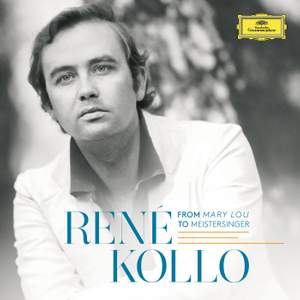
| |  | René Kollo: The Opera Singer
Albert, E: | Hast du's gehört? Ich krieg' ein Weib (from Tiefland) Schu her, das ist ein Taler (from Tiefland) | Beethoven: | Gott! Welch Dunkel hier! (from Fidelio) | Bizet: | La fleur que tu m'avais jetée (from Carmen) | Flotow: | Ach, so fromm (from Martha) | Giordano, U: | Come un bel dì di maggio (from Andrea Chénier) Vicino a te (from Andrea Chénier) | Kienzl: | Der Evangelimann: Selig sind die Verfolgung leiden | Lortzing: | Lied: Vater, Mutter, Schestern, Bruder (from Undine) | Mascagni: | Mamma, quel vino (from Cavalleria Rusticana) | Meyerbeer: | Pays merveilleux... Ô paradis (from L'Africaine) | Puccini: | Addio, fiorito asil (from Madama Butterfly) Nessun dorma (from Turandot) | Schultze, N: | Ach, ich hab in meinem Herzen (from Schwarzer Peter) | Verdi: | Niun mi tema (from Otello) Celeste Aida (from Aida) Ah sì ben mio (from Il trovatore) | Wagner: | In fernem Land (from Lohengrin) | Weber: | Nein! länger trag' ich nicht die Qualen…Durch die Wälder (from Der Freischütz) |
The “heroic” tenor René Kollo was born in Berlin in 1937. He arrived at Bayreuth, the Wagner sanctum, in 1969 and, for almost a decade and a half, he would be numbered among its greatest stars. An extensive catalogue of recordings, including many award-winning recordings, shows that Kollo was the most active German tenor of his generation. This wide range of repertoire as well as his frequent television appearances have greatly contributed to his popularity over the years. | | | (also available to download from $21.25) | Usually despatched in 4 - 5 working days. (Available now to download.) |
|
|
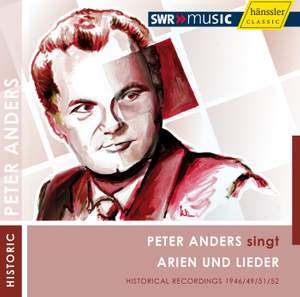
| |  | Peter Anders sings Arias and Lieder - The SWR Recordings (1946-1952)
Beethoven: | Gott! Welch Dunkel hier! (from Fidelio) An die ferne Geliebte (To the distant beloved), Op. 98 | Bizet: | La fleur que tu m'avais jetée (from Carmen) Parle-moi de ma mère (from Carmen) | Kienzl: | Der Evangelimann: Selig sind die Verfolgung leiden | Puccini: | Bimba dagli occhi pieni di malia (from Madama Butterfly) Sono andati? Fingevo di dormire (from La Bohème) | Schubert: | Wohin? (No. 2 from Die schöne Müllerin, D795) Nacht und Träume, D827 Liebesbotschaft, D957 No.1 Ganymed, D544 (Goethe) Lied eines Schiffers an die Dioskuren D360 (Mayrhofer) Der Musensohn, D764 (Goethe) Frühlingsglaube, D686 | Schumann: | Schöne Fremde (No. 6 from Liederkreis, Op. 39) Zum Schluß, Op. 25 No. 26 Intermezzo (No. 2 from Liederkreis, Op. 39) Frühlingsfahrt, Op. 45 No. 2 Die beiden Grenadiere, Op. 49 No. 1 | Smetana: | So find ich dich (from Die verkaufte Braut) | Strauss, J, II: | Als flotter Geist (from Der Zigeunerbaron) Wer uns getraut? (from Der Zigeunerbaron) | Tchaikovsky: | They said: You fool, do not go, Op. 25, No. 6 None but the lonely heart, Op. 6 No. 6 Oh! Chante Encore!, Op.16 No.4 Qu'importe op.16 No.5 A tear trembles, Op. 6 No. 4 Sred' shumnogo bala (Amid the din of the ball), Op. 38 No. 3 Otchevo? (Why?), Op. 6 No. 5 | Verdi: | Giá nella notte densa (from Otello) | Wagner: | In fernem Land (from Lohengrin) | Weber: | Nein! länger trag' ich nicht die Qualen…Durch die Wälder (from Der Freischütz) |
Peter Anders (tenor), Heinz Mende (piano), Hubert Giesen (piano) Sinfonieorchester Baden-Baden und Freiburg, Otto Ackermann, Paul Burkhard This is a specially priced 2CD portrait of the great German tenor, Peter Anders. These recordings were made at the height of his career and have never been released before. Included are works by Wagner, Strauss, Beethoven, Schumann and Tchaikovsky. All tracks sung in German | | | (also available to download from $21.25) | Usually despatched in 2 - 3 working days. (Available now to download.) |
|
|
| |  | Anton Dermota: Vienna State Opera Recordings 1944-81
Beethoven: | Jetzt Schätzchen, jetzt sind wir allein (from Fidelio) Recorded 5th August 1950 Elisabeth Schwarzkopf (Marzelline) Wilhelm Furtwängler Gott! Welch Dunkel hier! (from Fidelio) Recorded 5th November 1955 Karl Böhm | Mozart: | Dies Bildnis ist bezaubernd schön (from Die Zauberflöte) Recorded 14th September 1950 Karl Böhm Mich schreckt kein Tod (from Die Zauberflöte) Recorded 11th - 14th November 1944 Irmgard Seefried, Josef Witt, Paul Schöffler Dalla sua pace (from Don Giovanni) Sung in German as 'Nur ihrem Frieden' Sola, sola in bujo loco (from Don Giovanni) Sung in German as 'Einsam hier an dunkler Stätte'; recorded 6th November 1955 Sena Jurinac (Elvira), Lisa Della Casa (Anna), Irmgard Seefried (Zerlina), Erich Kunz (Leporello), Walter Berry (Masetto) Il mio tesoro intanto (from Don Giovanni) Sung in German as 'Folget der Heißgeliebten'; recorded 14th September 1950 Wiener Philharmoniker, Karl Böhm La mia Dorabella capace non e' (from Così fan tutte) Erich Kunz (Guglielmo), Paul Schöffler (Don Alfonso) Fra gli amplessi (from Così fan tutte) Recorded 8th August 1956 Irmgard Seefried (Fiordiligi) Karl Böhm Die Weisheitslehre….. führt mich der Ton zu ihr from Die Zauberflöte Recorded 21st January 1981 Hans Helm (Sprecher) Thomas Sanderling | Pfitzner: | Allein, in dunkler Tiefe (from Palestrina) Recorded 12th May 1970 Rita Streich (Engel), Hilde Rössel-Majdan (Lucrezia) | Shostakovich: | Katerina! Sinowi! (from Katerina Ismailowa) Recorded 10th May 1968 Inge Borkh (Katerina), Fritz Uhl (Sergei) Serge Baudo | Strauss, R: | Di rigori armato il seno (from Der Rosenkavalier) Recorded June 1954 Ludwig Weber (Ochs), Franz Bierbach (Notar) Wiener Philharmoniker, Erich Kleiber Arabella? Unmöglich! (from Arabella) Recorded June 1957 Lisa Della Casa (Arabella) Wiener Philharmoniker, Georg Solti Kein andres, das mir so im Herzen loht (from Capriccio) Recorded 15th May 1960 Lisa Della Casa (Countess), Paul Schöffler (La Roche), Walter Berry (Olivier) Karl Böhm | Tchaikovsky: | Mesdames! Ya na sebya vzyal smyelost (from Eugene Onegin) Sung in German as 'Mesdames, verzeih’n Sie meine Kühnheit'; recorded on 17th June 1955 Leonie Rysanek (Tatyana), George London (Onegin), Mira Kalin (Olga) Berislav Klobučar Kuda, Kuda 'Lensky's Aria' (from Eugene Onegin) Sung in German as 'Wohin? Wohin?' Duel scene (from Eugene Onegin) Sung in German as 'Da kommen sie'; recorded 26th January 1961 Dietrich Fischer-Dieskau (Onegin), Ljubomir Pantscheff (Zaretsky) Lovro von Matačić Voilà tsaritsa etot dyen (from Eugene Onegin) Sung in German as 'Voilà – die Königin des Tags'; recorded on 10th November 1973 Peter Schrottner | Wagner: | Gleich, Meister! Hier! (from Die Meistersinger von Nürnberg) Recorded September 1951 Paul Schöffler (Hans Sachs) Hans Knappertsbusch |
Where is the likes of Anton Dermota today? The Slovenian tenor was not just a member of the Vienna State Opera ensemble for over 50 years, he was also a master of the stage and concert hall, celebrated all over the world from Milan to Buenos Aires. This new release of his performances at the Vienna State Opera makes evident this versatility. His Tamino is given here both at the beginning and the end of our selection,from the immediate post-war years under Karl Böhm, plus an excerpt from the run of performances under Sanderling with which Demota made his farewell to the stage in 1981, at the age of 71! Nor can Dermota’s interpretations of Ferrando and Don Ottavio be omitted from this double CD. It is delightful to contrast the buffo roles and Dermota’s exploits as a tenore lirico spinto, such as Florestan. The tricky, brief roles in Richard Strauss’ operas, such as the Singer in Rosenkavalier and Matteo in Arabella, were ones he mastered superbly. They too are to be found here, as in the legendary Capriccio ensemble with Elisabeth Schwarzkopf as the Countess. Dermota appeared with various, equally splendid partners in Tchaikovsky’s Eugene Onegin – as Lenski he duelled before the radio microphone with George London and Dietrich Fischer-Dieskau, while as late as the 1970s he turned Monsieur Triquet’s burlesque into a subtle character study. | | | Usually despatched in 3 - 4 working days. |
|
|
| |  | Hans Hopf - Historical Recital
These recordings are from the Philips sessions of 1956 and German radio recordings of 1952 – 53. | | | Usually despatched in 2 - 3 working days. |
|
|
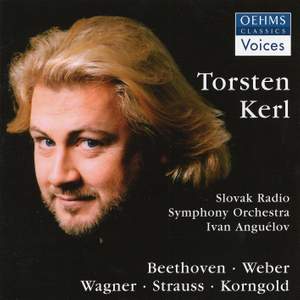
| |  | Torsten Kerl sings German Arias
Torsten Kerl (tenor) Slovac Radio Symphony Orchestra, Ivan Anguélov | | | (also available to download from $10.50) | Usually despatched in 2 - 3 working days. (Available now to download.) |
|
|
| |  | Opera Highlights
| | | Usually despatched in 3 - 4 working days. |
|
|
| |
|