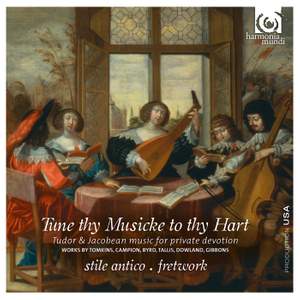
All recordingsPrices shown exclude VAT. (UK tax is not payable for deliveries to United States.) See Terms & Conditions for p&p rates. | |  | Tune thy Musicke to Thy HartTudor & Jacobean music for private devotion
Amner: | O ye little flock A stranger here | Browne, J: | Jesu, mercy, how may this be? | Byrd: | Why do I use my paper, inke and penne? | Campion: | Never weather-beaten sail | Croce: | From profound centre of my heart | Dowland: | I shame at mine unworthiness | Gibbons, O: | See, see, the Word is incarnate | Parsons, R: | In nomine a 4 No. 1 In nomine a 4 No. 2 | Ramsey, R: | How are the mighty fallen | Tallis: | Purge me, O Lord | Taverner: | In nomine a 4 | Tomkins: | O Praise the Lord, All Ye Heathen When David Heard |
Stile Antico (joined by Fretwork) explore long-neglected repertory: the wealth of Tudor and Jacobean sacred music written for domestic devotion, rather than for church worship. Culled from collections intended for use in private homes, these pieces by Tomkins, Campion, Byrd, Tallis, Dowland, Gibbons and others, offer a unique insight into the turbulent religious climate of the time and the thriving musical culture at its heart. Stile Antico is now established as one of the most original and exciting voices in its field. Much in demand in concert, the group performs regularly throughout Europe and North America. Their recordings are the best-sellers on the harmonia mundi label, winning awards including the Diapason d’or de l’année and the Preis der deutschen Schallplattenkritik, and have twice attracted GRAMMY nominations. Their release Song of Songs won the 2009 Gramophone Award for Early Music and reached the top of the US Classical Chart. Few ensembles can match the breadth of Fretwork’s repertoire, which ranges from the first printed collection published in 1501 in Venice to music commissioned by the group this year. In the 25 years since its debut, Fretwork’s pioneering work has taken its members all over the world. Their consistently high standards have brought music old and new to audiences hitherto unfamiliar with the inspiring sound-world of the viol. Fretwork’s acclaimed recordings of the classic English viol repertory – Purcell, Gibbons, Lawes, Byrd – have become the benchmark by which other performances are measured. Its arrangements of the music of J. S. Bach have garnered particular praise. Released in 2009, the harmonia mundi recording of Purcell’s Complete Fantazias won the Gramophone Award for Baroque Chamber Music. “We are, perhaps, in a wood-panelled Elizabethan hall, where in the early 17th century the family of a large house gather for their private prayer. Voices and viols mix in harmony, ranging from the familiar simplicity of Thomas Campion's "Never weather-beaten sail" to the elaborate verse anthem by Orlando Gibbons's "See, see the word is incarnate"...Another triumph” The Observer, 29th January 2012 “The beautifully blended voices of Stile Antico give this music with all the intensity that its emotional content merits. But then every work here fairly burns itself on the heart.” Sunday Times, 12th February 2012 “the performances are wonderfully fresh, revelling in the harmonic false relations and affectingly attentive to the import of the words.” The Telegraph, 18th February 2012 ***** “a varied treasure trove of seldom heard but extremely affecting music, nicely sung and spliced together with some darkly-glittering string In Nomines played by Fretwork...[They] easily persuade us that there is such a thing as beautiful simplicity.” BBC Music Magazine, April 2012 **** “Stile Antico's sleek tuning and supple attention to words, and the studio recording, intimate but not claustrophobic, do bring a carefully plotted span (over 120 years) of sacred styles into our listening rooms with rare success.” Gramophone Magazine, May 2012 “another winner from the 12-voice ensemble Stile Antico... The two pieces by Thomas Tomkins, O praise the Lord and When David heard, epitomise the expressive richness of the style. But the simplicity of Campion’s Never weather-beaten sail is also gorgeous, and there’s an unexpected rocking figure, John Browne’s much earlier Jesu, mercy, how may this be?, that becomes a real earworm. The contributions of the viol consort Fretwork are equally fine” Irish Times, 20th April 2012 ***** “The group's singing is, as ever, breathtakingly beautiful” Classical Music, 2nd June 2012 **** | | | In stock - usually despatched within 1 working day. |
|
|
| |  | The John Dowland CollectionWith new booklet article, Dowland timeline, and sung texts in English
Dowland: | Lachrimae Antiquae If my complaints could passions move Can she excuse my wrongs? (First Booke of Songes, 1597) Come away, come, sweet love My Lady Hudson's Allmande A Piece without title The Shoemaker's Wife Come again, sweet love doth now invite Come heavy sleep Mr Dowland's Midnight Sir John Smith, His Almain Semper Dowland Semper Dolens Lachrimae Gementes I saw my Lady weepe Flow my teares (Lacrimæ) Fine knacks for ladies Shall I sue? Lachrimae Tristes Me, me, and none but me Forlorn Hope Fancy (Fantasie No. 2) Weepe you no more, sad fountaines Lachrimae Coactae Go, nightly cares The Right Honourable Ferdinando The most sacred Queene Elizabeth her Galliard Tell me, true Love Lachrimae Amantis In darkness let me dwell A Fantasie My Lord Chamberlaine his Galliard Far from triumphing Court I shame at mine unworthiness Lachrimae Verae |
Whether gay or sad, simple or complex, John Dowland’s music has the power to move us four centuries after its composition. This wide-ranging anthology explores all aspects of the work of England’s greatest songwriter and lutenist, performed by leading exponents of his art today. “The collection might have sounded like a bit of a hotchpotch were it not for the fact that Dowland's celebrated Lachrimae pavans are woven through the sequence, giving the whole a sense of unity and shape. All in all, it makes a nostalgic and inspiring testimony to Dowland's versatility.” BBC Music Magazine, May 2007 **** | | | Usually despatched in 2 - 3 working days. |
|
|
| |
|