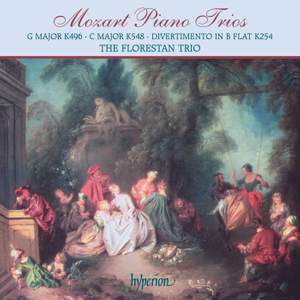
All recordingsPrices shown exclude VAT. (UK tax is not payable for deliveries to United States.) See Terms & Conditions for p&p rates. | |  | Mozart - Piano Trios Volume 2
“At the start of K548’s airy finale, Susan Tomes’ gracefully demure piano is swiftly countered by Anthony Marwood’s raffish forte riposte: and this sense of delighted, quick-witted dialogue between quasi-operatic protagonists runs through the whole movement, abetted by touches of sly, subtle
timing, from Marwood especially. No performance of this piece has ever made me smile as much … Talk of an outright winner is always dangerous. For my taste, though, the Florestan’s sparkling, inventive performances, on this disc and its companion, make them a top recommendation for the
complete Mozart trios, their claims enhanced by the warm, ideally balanced recording” Gramophone Magazine, June 2007 “The Florestan Trio get it exactly right, with Susan Tomes’ exquisite pianisim perfectly supported by violinist Anthony Marwood’s lithe, highly articulate playing and cellist Richard Lester’s finely judged asides. Another winner from this wonderful ensemble” Classic FM Magazine “These are certainly performances to be treasured, with the playing unfailingly stylish and full of imaginative touches … Their new recording can be unreservedly recommended” BBC Music Magazine “So much of Mozart's instrumental music is opera by other means. The Florestan understand this as well as any group, and better than most. At the start of K548's airy finale, Susan Tomes's gracefully demure piano is swiftly countered by Anthony Marwood's raffish forte riposte: and this sense of delighted, quick-witted dialogue between quasi-operatic protagonists runs through the whole movement, abetted by touches of sly, subtle timing, from Marwood especially. No performance of this piece brings such a smile to the face. The Florestan have the knack of bringing alive even apparently neutral figuration, of sensing the possibilities of interplay in what may look like a simple theme-plus-accompaniment texture. Piano and violin dominate in these works, especially in the breezy early Divertimento, K254. But Richard Lester's warm, nutty timbre contributes crucially to the music's colour, here and elsewhere, while he takes his chances when Mozart gives the cello an equal voice in the texture: say, in the first-movement development of K496, where the Florestan typically conjure a vivid operatic imbroglio. As usual, the Florestan choose flowing speeds in the slow movements, which may initially faze those who know the music from the revered Beaux Arts versions. In in the 6/8 Andante of K496 the Florestan show that a graceful dance lilt, even a hint of skittishness, need not preclude an eloquent response to Mozart's extraordinary remote modulations. Talk of an outright winner is always dangerous, butthe Florestan's sparkling, inventive performances make them a top recommendation for the complete Mozart trios, their claims enhanced by the warm, ideally balanced recording.” Gramophone Classical Music Guide, 2010 | | | In stock - usually despatched within 1 working day. |
|
|
| |  | Mozart - Piano Trios
| | | In stock - usually despatched within 1 working day. |
|
|
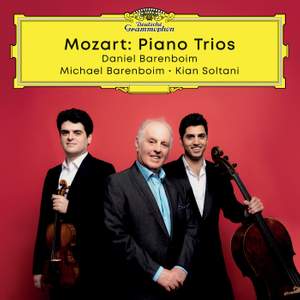
| |  | Mozart - Six Piano Trios
“The record companies fell over each other to bring out single discs or sets of piano trios during Mozart year. EMI offers a near-complete cycle, omitting the early Divertimento, K254, but including the wonderful Kegelstatt Trio for the (in 1786) unprecedented combination of clarinet, viola and piano. With Barenboim at the keyboard no Mozart performance is ever dull. And despite a recording that balances the violin too closely, sometimes giving a bright glare to Nikolaj Znaider's normally sweet tone, there is plenty to enjoy in these performances: the bold sweep of K496's opening Allegro, for instance, with Barenboim and Kyril Zlotnikov relishing Mozart's spirited dialogues between keyboard and the newly emancipated cello; the mingled grace and swagger of the outer movements in the underestimated K548, full of typically deft touches of shading and timing; or the popular-style finale of the final trio, K564, where Barenboim and his accomplices choose an ideal, relaxed allegretto and give a lusty kick to the rhythms in the rustic waltz. Appealing, too, is the mobile tempo and gentle flexibility of phrase in the not-so-slow movement of K542, perfectly poised between an ancienrégime gavotte and a Schubertian 'walking' andante. In contrast, the central movements of K502 and K548 are taken broadly, with moltoespressivo phrasing that some will find ideally soulful, others, including me, over-romanticised. The Andante first movement of the Kegelstatt is also dangerously slow and 'backward-leaning' but this proviso apart, the performance is warmly sung, with a notably rich, throaty viola.” Gramophone Classical Music Guide, 2010 “Barenboim's partners...are a natural and most musical team and their playing radiates an infectious pleasure in music-making.” Penguin Guide, 2011 edition | | | In stock - usually despatched within 1 working day. |
|
|
| |  | Mozart - Complete Piano Trios
| | | In stock - usually despatched within 1 working day. |
|
|
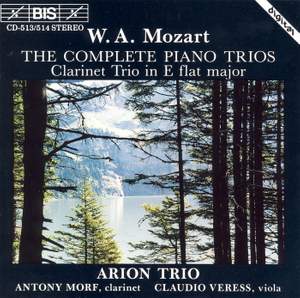
| |  | Mozart - The Complete Piano Trios & Clarinet Trio
| | | (Sorry, download not available in your country) | In stock - usually despatched within 1 working day. |
|
|
| |  | Mozart: Complete Piano Trios
The legendary recording is now back on the market in a splendid state of the Art re-mastering. The resultant sound is superb! A double CD. | 
| | | Usually despatched in 2 - 3 working days. |
|
|
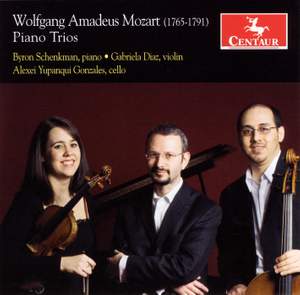
| |  | Mozart: Piano Trios
Byron Schenkman (piano), Alexei Gonzales (cello), Gabriela Diaz (violin) | |
|
| |  | Tchaikovsky, Shostakovich & Mozart - Piano Trios
The famous “Moscow Soloists’ Trio” Dmitry Bashkirov, Igor Bezrodny and Michael Homitser are brilliant musicians and strong personalities. Their every phrase is born spontaneously and freely as if it were an improvisation but does not break the unity of the ensemble. | | | Usually despatched in 2 - 3 working days. |
|
|
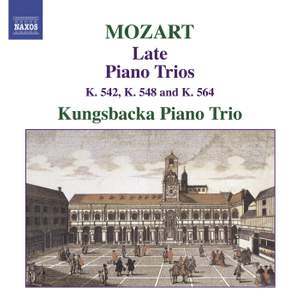
| |  | Mozart - Piano Trios Volume 2Late Piano Trios
Composed in 1788 at the peak of his creative powers, though at a time of both artistic success and looming personal crisis, Mozart’s last three piano trios are masterpieces whose prevailing character of congenial gaiety is heightened by poignant undercurrents of lyrical melancholy. The rarely heard Piano Trio K. 442 was completed by the composer’s friend, Maximilian Stadler. Volume 1 (8570518) also features the acclaimed young Kungsbacka Piano Trio, winners of the 3rd Melbourne International Chamber Music Competition and Associate Ensemble at London’s Guildhall School of Music & Drama. “Is there a better Trio ensemble in Western Europe?” The Strad on the Kungsbacka Piano Trio “Texture plays such an important part in Mozart's late trios and the Kungsbacka Trio clearly relish this aspect, notably in the buoyant finale of the G major Trio; the recording is a little on the hard side.” BBC Music Magazine, September 2009 **** “The Kungsbacka Piano Trio… are musicians of enlightened individual and collective probity who incorporate stylistic niceties into interpretations that are all the more authentic for being authentically felt, and absorbingly communicated.” Gramophone Magazine, May 2009 | | | (also available to download from $6.00) | Usually despatched in 2 - 3 working days. (Available now to download.) |
|
|
| |  | Mozart - Complete Piano Trios
Trio Stradivari (on period instruments) Isaac Stern himself stated, “The trio is one of the best chamber ensembles that I have heard in a long time; [they are] musicians on the highest level.” Yehudi Menuhin himself remarked that he had: “a great need from the bottom of my heart to point to their great and deserved success.” | | | (also available to download from $21.75) | Usually despatched in 2 - 3 working days. (Available now to download.) |
|
|
| |
|