Prices shown exclude VAT. (UK tax is not payable for deliveries to United States.) See Terms & Conditions for p&p rates. | |  | O Felice Morire (Firenze, 1600)
Joel Frederiksen (basso profondo) Ensemble Phoenix Munich "I have great pleasure in providing a few introductory words for this most engaging programme, as it recalls much delight I enjoyed when first I began to work with this area of repertoire about thirty years ago . . . This CD explores this particular area of virtuosity in a very engaging survey of highly ornamented yet deeply expressive music. From the suave complaint of Sigismondo D'India, Che farai Meliseo where the singer needs the agility of a nimble mountain goat, to [the virtuoso singer], Giovani Puliaschi's subterranean exploration, Locar sopra gl'abissi that resonates like some dark cavern, by way of the sublime 'crooning' of Caccini's Muove si dolce, the listener is in no doubt that in this repertoire at least, the empty bragging of Brancaccio is left far behind - and the comic bass buffoonery lies elsewhere and in the future.The quiet virtuosity of poetry is sublime, opening out into moments of profound declamation." Anthony Rooley Giulio Caccini and the early Italian Baroque singer-songwriters have fascinated and challenged Joel Frederiksen for the past 20 years. For the most part they are the inspiration and subject of this CD. Men like Caccini, but also Giovanni Kapsberger and Giovanni Puliaschi, were singer-player-composers who wrote in a revolutionary way for the bass voice and accompanied themselves on the lute. Joel has attempted to recreate this performance ideal by accompanying himself on the archlute (which combines attributes of the lute and harp) and immersing himself in repertoire which flowered between approximately 1580 and 1620. After moving to Munich, Joel Frederiksen established Ensemble Phoenix Munich in 2003 for the recording of his first solo CD Orpheus, I am, a CD of Renaissance and early Baroque music, from England, Italy and France.The ensemble is heir to his previous group, L'antica musica New York, 1989-2001. It presents a wide range of programmes from the Renaissance and Baroque, and from Early America c.1800-1900. | | | In stock - usually despatched within 1 working day. |
|
|
| |  | Italian Music of the 17th CenturyVocal works from the pre-Baroque Mannerist period in Italy
| | | In stock - usually despatched within 1 working day. |
|
|
| |  | Baroque OrientalWorks by Monteverdi, Ufki, Caccini & Çelebi
Valer Barna-Sabadus Pera Ensemble, Mehmet C. Yesicay A disc of medieval dance music with an oriental twist! This seemingly impossible combination produces an enchanting result, as in earlier centuries when the eastern Mediterranean with its trade routes enjoyed a cultural exchange which we can only dream of today. | | | Usually despatched in 4 - 5 working days. |
|
|
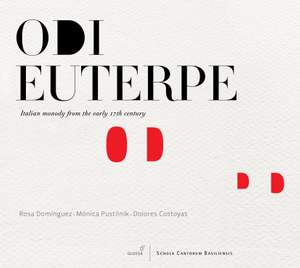
| |  | Odi EuterpeItalian monody in the early 17th century
Rosa Domínguez (mezzo), Mónica Pustilnik (archlute, Renaissance guitar & organ) & Dolores Costoyas (theorbo & Baroque guitar) LUXURY DIGIPACK 56pp booklet. Recorded in Santa Giulia in Caprona, Pisa, September 2008 Seldom ever have ‘new musics’ demonstrated the freshness and boldness as shown at the beginning of the 17th century. In 1602 Giulio Caccini proposed, in the essay prefacing his Le Nuove Musiche, a new relationship between music and text; this could be summed up in the term sprezzatura, according to which the text moves to a primary position of importance. In combination with the emergent basso continuo, Caccini thus sowed the seed for the startling development of vocal genres in subsequent centuries. This recording presents various facets of the new vocal art, beginning with works by Caccini himself, moving via stylish composers such as Girolamo Frescobaldi or the madrigalian miracles of Sigismondo d’India to exhilarating works by the poet-composer Benedetto Ferrari, active in Venice and Vienna in the middle of the 17th century. Rosa Domínguez interprets these works placing special emphasis on the text, prominently and enthusiastically stressing the ‘I’ of these poetic creations, generally the victim of amorous sufferings. The plentiful stanzas of these songs, dressed by an extremely flexible and imaginative basso continuo permit the telling of complete stories. By utilising a limited means of support (just the two plucked strings instruments), the full deployment of vocal expressivity is encouraged, bringing into existence as a result new musical spaces in the line of what was imagined by Caccini and his ‘nuove musiche’. “Rosa Dominguez has an attractively light and lyrical voice, warm in the middle register and bright in the upper one. Her phrasing is sensitive and improvised ornamentation in an appropriate style has been discreetly and thoughtfully added...Altogether a delightful advocate for some forgotten masterpieces.” Gramophone Magazine, April 2011 | | | (also available to download from $10.75) | Usually despatched in 3 - 4 working days. (Available now to download.) |
|
|
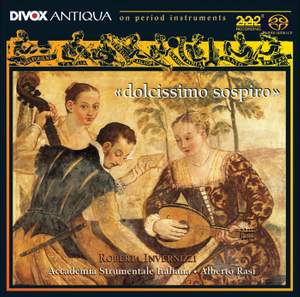
| |  | Caccini - Dolcissimo SospiroArie e Madrigali
Roberta Invernizzi is one of the most sought-after sopranos in the field of Early Music. | | | (also available to download from $10.75) | Usually despatched in 2 - 3 working days. (Available now to download.) |
|
|
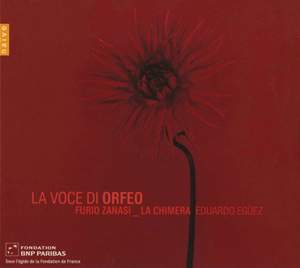
| |  | La Voce di Orfeo: A tribute to Francesco Rasi
Brunelli: | Non havea Febo ancora | Caccini, G: | Dolcissimo sospiro Dalla porta d'oriente | Despres: | Mille Regretz A nonimo “Porto celato il mio nobil pensiero”, Ms Torrefranca 250, f. 13-14 | Egüez: | Passamezzo Sinfonia | Ferrari, B: | Io son amante di un crin aurato | India: | Vorrei baciarti, o Filli Cara mia cetra Che vegg’io ohimè, Le musiche… a una et due v oci… libro IV Sovente allor | Monteverdi: | Air d'Orphee Rosa del ciel Solo di arpa dall’opera L’Orfeo Et è pur dunque vero | Rasi: | Fillia mia, Filli dolce È si lieto il mio core, madrigali di diversi autori In morte di Madonna Dove misero mai, madrigali di diversi autori Un guardo ohime ch’io moro, Madrigali di diversi autori… | Rinuccini: | Sfogava con le stelle | Tasso: | Madrigale “Amor l’ali m’impenna” |
Early music specialist, baritone Furio Zanasi and La Chimera pay tribute to the Italian singer, Francesco Rasi (1574-1621), one of the most fascinating musicians produced by the early Baroque era in Italy. The programme devised by La Chimera is organised in three sections, each of them representing one of the amatory conditions that Francesco Rasi regularly treated in the works he sang or composed. Francesco Rasi (1574-1621), poet, composer and singer, quickly established a reputation as an exceptional singer and a virtuoso exponent of the lute. His love of travelling saw him meet outstanding musicians including: Luca Marenzio, Jacapo Peri, Marco da Gagliano and Claudio Monteverdi. His splendid vocal talents in turn influenced these great composers, creating, for example, the title role in Monteverdi’s ‘Orfeo’. La Chimera was formed in 2001 as a viol ensemble by Sabina Colonna-Preti. Since meeting Eduardo Egüez and Quito Gato it has turned into a complete baroque ensemble. | | | (also available to download from $10.75) | Usually despatched in 3 - 4 working days. (Available now to download.) |
|
|
| |  | Caccini: Madrigali, Arie & Canzoni
Paolo Cherici, Tania d´Althann, Hans Ludwig Hirsch Accademia Claudio Monteverdi, Hans Ludwig Hirsch | | | Usually despatched in 4 - 5 working days. |
|
|
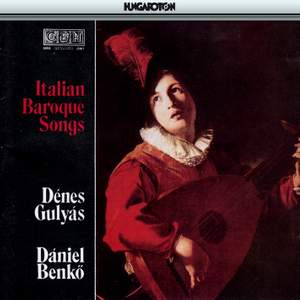
| |  | Italian Baroque Songs
Dénes Gulyás (tenor), Dániel Benkõ (lute, guitar, orpharion), László Czidra (recorder), Tibor Alpár (organ) Budapest Baroque Trio, Bakfart Consort | | | Usually despatched in 4 - 5 working days. |
|
|
| |
|