Britten: Now Sleeps the Crimson Petal, for tenor, horn and strings

This page lists all recordings of Now Sleeps the Crimson Petal, for tenor, horn and strings, by Benjamin Britten (1913-76) on CD, SACD & download (MP3 & FLAC).

Prices shown exclude VAT. (UK tax is not payable for deliveries to United States.)
See Terms & Conditions for p&p rates.

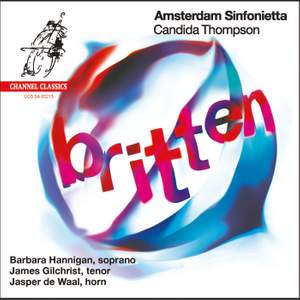
Britten: Works for voice & string orchestra

Britten: Works for voice & string orchestra


Britten:

Les illuminations, Op. 18

Barbara Hannigan (soprano)

Variations on a theme of Frank Bridge, Op. 10

Serenade for Tenor, Horn & Strings, Op. 31

James Gilchrist (tenor) & Jasper de Waal (horn)

Now Sleeps the Crimson Petal, for tenor, horn and strings

James Gilchrist (tenor) & Jasper de Waal (horn)


Amsterdam Sinfonietta, Candida Thompson (artistic director)

In 2013 it is exactly one hundred years ago that the English genius Benjamin Britten was born. Britten’s brilliant manner of writing for string orchestra, his unique treatment of text, and his rich repertory of musical colours are all abundantly clear from the masterpieces featured on this recording. Besides the excellent soprano Barbara Hannigan, who sparkles in ‘Les Illuminations’, tenor James Gilchrist and hornist Jasper de Waal deliver an impressive contribution to this production with Amsterdam Sinfonietta.

The orchestra herself indulges in all imaginable techniques, colours and dynamic extremes that Britten releases from his box of tricks for string orchestra. Amsterdam Sinfonietta is an ensemble of 22 gifted musicians from around the world. The group performs without conductor, under the direction of Candida Thompson, artistic director since 2003. The ensemble’s defining feature is the strong involvement and artistic drive of each individual member. The group has gained a reputation for its distinguished performances and innovative programming.

Amsterdam Sinfonietta collaborates with renowned artists and performs in major venues around throughout the world. In the last seasons the group toured Europe, China, the US and Australia.

“wonderfully alert readings by the Amsterdam Sinfonietta” Financial Times, 23rd February 2013

“Hannigan brings to the text the dramatic energy she has to burn in her championship of Ligeti and Boulez, while the conductorless orchestra and soloist (herself sometimes a conductor) sound a natural fit...[in the Serenade] both soloists play their parts quite straight...An enjoyable and carefully balanced CD” Gramophone Magazine, March 2013

“Gilchrist’s Serenade, with Jasper de Waal the stupendous horn soloist, is one of the best things the English tenor has done on disc — Pears-like in its intensity and crystalline diction. The Sinfonietta’s strings have a whale of a time as a band of wannabe Paganinis in the Aria Italiana of the Bridge Variations.” Sunday Times, 3rd March 2013

“Hannigan brings a fined-down intensity to the more hushed Rimbaud settings such as 'Being Beauteous', but elsewhere her tone tends to flutter under pressure...Gilchrist, by contrast, sounds at home in the Serenade for Tenor, Horn and Strings...and while his slightly reedy timbre sounds very different to Peter Pears, he brings equally valid insights into this iconic cycle.” BBC Music Magazine, April 2013 ***

“The strings were absolutely beautiful, transients and attacks were sharp, voices were natural, and the totality of the experience was musical and satisfying in every way...Frankly, I can’t imagine recorded music sounding much bette” Audiophile Audition, April 2013

“Candida Thompson’s Amsterdam Sinfonietta disc is pretty special – vibrant, incisive and colourful...Hannigan’s account of Les Illuminations is strong, her quickfire delivery in Parade a highlight...Gilchrist’s vibrato is strong but totally idiomatic, matched by Jasper der Waal’s bright-toned, very European horn sound.” The Arts Desk, 27th April 2013

Released or re-released in last 6 months

Super Audio CD

Format:

Hybrid Multi-channel

Channel - CCSSA32213

(SACD)

$17.50

In stock - usually despatched within 1 working day.

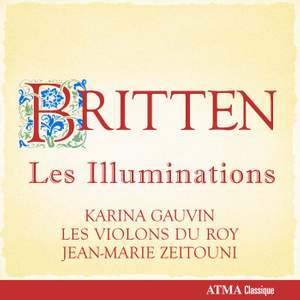
Britten: Les Illuminations

Britten: Les Illuminations


Britten:

Les illuminations, Op. 18

Prelude & Fugue for 18 strings, Op. 29

Variations on a theme of Frank Bridge, Op. 10

Now Sleeps the Crimson Petal, for tenor, horn and strings


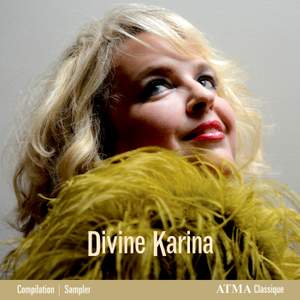
Karina Gauvin (soprano)

Les Violons du Roy, Jean-Marie Zeitouni

For this new recording of one of Britten’s most effective woks, soprano Karina Gauvin employs the full range of her expressive palette and great virtuosity. Her previous recordings have been well received; ”Her glinting soprano, bright-edged yet deliciously rounded and sensual…” The Times

“Gauvin is a seductive interpreter of [Les Illuminations]. Her glinting sound gives a diamantine shimmer to the heroic passages, yet she never sacrifices the essential warmth and sensuousness of her voice. It's perfect for Britten's 'fire seen through ice' sound world which combines purity and passion in a particularly Gallic way.” International Record Review, March 2011

Atma - ACD22601

(CD)

$17.75

(also available to download from $11.00)

Usually despatched in 2 - 3 working days. (Available now to download.)

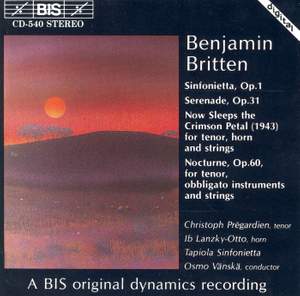
Britten: Works for Tenor & Orchestra

Britten: Works for Tenor & Orchestra


Britten:

Sinfonietta, Op. 1

Serenade for Tenor, Horn & Strings, Op. 31

Now Sleeps the Crimson Petal, for tenor, horn and strings

Nocturne, Op. 60 for tenor, obbligato instruments and strings


“Christoph Prégardien has an ideally light and sweet tenor which, even in the high tessitura of the Lyke-Wake Dirge from the Serenade, shows no strain whatsoever...he is totally in tune with the idiom.” Penguin Guide, 2010 ***

Building a Library

First Choice - May 2011

BIS - BISCD540

(CD)

$17.50

(also available to download from $11.00)

Usually despatched in 2 - 3 working days. (Available now to download.)

Benjamin Britten - The Collector’s Edition

Benjamin Britten - The Collector’s Edition


Britten:

Sinfonia da Requiem, Op. 20

Royal Liverpool Philharmonic Orchestra, Libor Pesek

Four Sea Interludes from Peter Grimes, Op. 33a

Royal Liverpool Philharmonic Orchestra, Libor Pesek

The Young Person's Guide to the Orchestra, Op. 34

Royal Liverpool Philharmonic Orchestra, Libor Pesek

Canadian Carnival Overture, Op. 19

Wesley Warren (trumpet)

City of Birmingham Symphony Orchestra, Sir Simon Rattle

Diversions for piano (left hand) and orchestra, Op. 21

Peter Donohoe (piano)

City of Birmingham Symphony Orchestra, Sir Simon Rattle

Scottish Ballad, Op. 26

Peter Donohoe & Philip Fowke (pianos)

City of Birmingham Symphony Orchestra, Sir Simon Rattle

An American Overture

City of Birmingham Symphony Orchestra, Sir Simon Rattle

Occasional Overture, Op. 38

City of Birmingham Symphony Orchestra, Sir Simon Rattle

The Building of the House

CBSO Chorus & City of Birmingham Symphony Orchestra, Sir Simon Rattle

Piano Concerto, Op. 13

Leif Ove Andsnes (piano)

City of Birmingham Symphony Orchestra, Paavo Järvi

Violin Concerto in D minor Op. 15

Ida Haendel (violin)

Bournemouth Symphony Orchestra, Paavo Berglund

Young Apollo, Op. 16

Peter Donohoe (piano), Felix Kok, Jeremy Ballard (violins), Peter Cole (viola) & Michal Kaznowski (cello)

City of Birmingham Symphony Orchestra, Sir Simon Rattle

Simple Symphony, Op. 4

Norwegian Chamber Orchestra, Iona Brown

Variations on a theme of Frank Bridge, Op. 10

Norwegian Chamber Orchestra, Iona Brown

Prelude & Fugue for 18 strings, Op. 29

Norwegian Chamber Orchestra, Iona Brown

Lachrymae for viola & strings, Op. 48a

Lars Anders Tomter (viola)

Norwegian Chamber Orchestra, Iona Brown

Gloriana - Symphonic Suite Op. 53a

Royal Liverpool Philharmonic Orchestra, Takuo Yuasa

Symphony for Cello and Orchestra, Op. 68

Steven Isserlis (cello)

City of London Sinfonia, Richard Hickox

Men of Goodwill (Variations on a Christmas Carol for orchestra)

Minnesota Orchestra, Sir Neville Marriner

Sinfonietta, Op. 1

Pauline Lowbury & Julian Tear (violins)

Britten Sinfonia, Daniel Harding

Russian Funeral

City of Birmingham Symphony Orchestra, Sir Simon Rattle

Suite on English Folk Tunes 'A Time there was', Op. 90

Peter Walden (cor anglais)

City of Birmingham Symphony Orchestra, Sir Simon Rattle

Matinées musicales (after Rossini), Op. 24

English Chamber Orchestra, Sir Alexander Gibson

Soirées musicales (after Rossini), Op. 9

English Chamber Orchestra, Sir Alexander Gibson

The Tocher (Rossini Suite)

Boys of the Choir of Paisley & Scottish Chamber Orchestra, Steuart Bedford

The Prince of the Pagodas, Op. 57

London Sinfonietta, Oliver Knussen

Rhapsody for String Quartet

Endellion String Quartet

Quartettino

Endellion String Quartet

String Quartet No. 1 in D major, Op. 25

Endellion String Quartet

Phantasy in F minor for string quintet

Nicholas Logie (viola)

Endellion String Quartet

Elegy for unaccompanied viola

Garfield Jackson (viola)

Phantasy Quartet for Oboe & String Trio, Op. 2

Endellion String Quartet

Three Divertimenti

Endellion String Quartet

String Quartet No. 2 in C major, Op. 36

Endellion String Quartet

String Quartet in D major (1931)

Endellion String Quartet

String Quartet No. 3, Op. 94

Endellion String Quartet

Suites for cello solo, Nos. 1-3

Truls Mørk (cello)

Holiday Diary Op. 5 for solo piano

Stephen Hough, Ronan O’Hara (pianos)

Three Character Pieces

Stephen Hough, Ronan O’Hara (pianos)

Moderato, Nocturne & Twelve Variations on a Theme from Sonatina romantica

Stephen Hough, Ronan O’Hara (pianos)

Five Waltzes for piano

Stephen Hough, Ronan O’Hara (pianos)

Two Lullabies for Two Pianos

Stephen Hough, Ronan O’Hara (pianos)

Introduction and Rondo alla burlesca, op.23 No.1

Stephen Hough, Ronan O’Hara (pianos)

Suite Op. 6

Alexander Barantschik (violin) & John Adey (piano)

Sonata for cello and piano in C major, Op. 65

Moray Welsh (cello) & John Lenehan (piano)

Six Metamorphoses after Ovid for solo oboe, Op. 49

Roy Carter (oboe)

Nocturnal after John Dowland, Op. 70

Julian Bream (guitar)

War Requiem, Op. 66

Elisabeth Söderström (soprano), Robert Tear (tenor), Sir Thomas Allen (baritone) & Mark Blatchly (chamber organ)

Boys of Christ Church Cathedral, Oxford, CBSO Chorus & City of Birmingham Symphony Orchestra, Sir Simon Rattle

Spring Symphony, Op. 44

Sheila Armstrong (soprano), Dame Janet Baker (contralto) & Robert Tear (tenor)

St. Clement Danes School Boys’ Choir, London Symphony Chorus & London Symphony Orchestra, André Previn

Hymn to St Cecilia, Op. 27

Richard Cross (treble)

Choir of King’s College, Cambridge, Sir David Willcocks

A Ceremony of Carols, Op. 28

James Clark, Julian Godlee (trebles) & Osian Ellis (harp)

Choir of King’s College, Cambridge, Sir David Willcocks

Missa Brevis in D major, Op. 63

Julian Brown, Christopher Anderson, Anthony Sackville, Rory Phillips & James Clark (trebles) & Ian Hare (organ)

Choir of King’s College, Cambridge, Sir David Willcocks

Festival Te Deum in E, Op. 32

Simon Channing (treble) & James Lancelot (organ)

Choir of King’s College, Cambridge, Sir Philip Ledger

Rejoice in the Lamb, Op. 30

Simon Channing (treble), James Bowman (countertenor), Richard Morton (tenor), Marcus Creed (bass), James Lancelot (organ) & David Corkhill (percussion)

Choir of King’s College, Cambridge, Sir Philip Ledger

Te Deum in C

Rory Phillips (treble) & James Lancelot (organ)

Choir of King’s College, Cambridge, Sir Philip Ledger

Jubilate Deo in C major (1961)

Choir of King’s College, Cambridge, Sir Philip Ledger

A Hymn to the Virgin

Stephen Barton (treble), Hugh Hudleston (treble), Warren Trevelyan-Jones (tenor) & Francis Pott (bass)

Winchester Cathedral Choir, David Hill

St Nicolas, Op. 42

Words by Eric Crozier

Robert Tear (tenor), Bruce Russell (treble), Andrew Davis & Ian Hare (piano duet

Cambridge Girls’ Choir, Choir of King’s College, Cambridge & Academy of St Martin in the Fields, Sir David Willcocks

Hymn to St. Peter, Op. 56a

Mark Emney, Peter Rowe (trebles) & Timothy Farrell (organ)

Wandsworth School Choir, Russell Burgess

A Hymn of Saint Columba

Mark Emney, Peter Rowe (trebles), Christopher Hughes, Timothy Farrell (organ)

Choir of King’s College, Cambridge & Wandsworth School Choir, Russell Burgess

Sacred and Profane, Op. 91

Vasari Singers, Jeremy Backhouse

The Little Sweep, Op. 45

Words by Eric Crozier

Robert Lloyd, Robert Tear, Sam Monck, Heather Begg, Catherine Benson, Cato Fordham, Catherine Wearing, Mary Wells, David Glick, Colin Huehns & Katherine Willis

Finchley Children’s Music Group, Choral Scholars of King’s College, Cambridge & Medici String Quartet, Sir Philip Ledger

A Boy was Born, Op. 3

London Sinfonietta Chorus & Choristers of St. Paul’s Cathedral, Terry Edwards

A Shepherd's Carol

Sarah Leonard (soprano), Susan Bickley (mezzo-soprano), Peter Hall (tenor) & Gordon Jones (baritone)

London Sinfonietta Chorus, Terry Edwards

Noye's Fludde

Richard Pasco, Donald Maxwell, Linda Ormiston, Alexander Gallifant, Timothy Lamb, Nicholas Berry, Catriona Johnson, Polly Hewetson & Joanna Brown

Coull String Quartet & Schools’ Orchestra from schools of Salisbury and Chester, Richard Hickox

A.M.D.G.

London Sinfonietta Chorus, Terry Edwards

The Ballad of Little Musgrave and Lady Barnard (Text: The Oxford Book of Ballads)

Baccholian Singers of London

The Company of Heaven

Peter Barkworth, Sheila Allen (narrators), Cathryn Pope (soprano), Dan Dressen (tenor) & Christopher Herrick (organ)

London Philharmonic Choir & English Chamber Orchestra, Philip Brunelle

Ballad of Heroes, Op. 14

Robert Tear (tenor)

CBSO Chorus & City of Birmingham Symphony Orchestra, Sir Simon Rattle

Praise We Great Men

Alison Hargan (soprano), Mary King (contralto), Robert Tear (tenor) & Willard White (bass)

CBSO Chorus & City of Birmingham Symphony Orchestra, Sir Simon Rattle

Les illuminations, Op. 18

Heather Harper (soprano)

Northern Sinfonia Orchestra, Sir Neville Marriner

Serenade for Tenor, Horn & Strings, Op. 31

Neil Mackie (tenor) & Barry Tuckwell (horn)

Scottish Chamber Orchestra, Steuart Bedford

Now Sleeps the Crimson Petal, for tenor, horn and strings

orch. Colin Matthews

Neil Mackie (tenor) & Barry Tuckwell (horn)

Scottish Chamber Orchestra, Steuart Bedford

Nocturne, Op. 60 for tenor, obbligato instruments and strings

Robert Tear (tenor)

English Chamber Orchestra, Jeffrey Tate

Quatre Chansons Françaises

Jill Gomez (soprano)

City of Birmingham Symphony Orchestra, Sir Simon Rattle

Our Hunting Fathers, Op. 8

Elisabeth Söderström (soprano)

Orchestra of the Welsh National Opera, Richard Armstrong

Four Folksong Settings

Elisabeth Söderström (soprano)

Orchestra of the Welsh National Opera, Richard Armstrong

Phaedra, Op. 93

Felicity Palmer (mezzo-soprano), Jane Salmon (cello) & Melvyn Tan (harpsichord)

Endymion Ensemble, John Whitfield

Five French Folksong arrangements

Felicity Palmer (mezzo-soprano)

Endymion Ensemble, John Whitfield

Seven Sonnets of Michelangelo, Op. 22

Peter Pears (tenor) & Benjamin Britten (piano)

The Holy Sonnets of John Donne, Op. 35

Peter Pears (tenor) & Benjamin Britten (piano)

On this Island, Op. 11

Robert Tear (tenor) & Sir Philip Ledger (piano)

Winter Words, Op. 52

Robert Tear (tenor) & Sir Philip Ledger (piano)

Canticles I-V

Ian Bostridge (tenor), David Daniels (countertenor), Christopher Maltman (baritone), Timothy Brown (horn), Aline Brewer (harp) & Julius Drake (piano)

Folksongs (selection)

Ian Bostridge (tenor), David Daniels (countertenor), Christopher Maltman (baritone), Timothy Brown (horn), Aline Brewer (harp) & Julius Drake (piano)

The Children and Sir Nameless (Hardy)

Neil Mackie (tenor) & Roger Vignoles (piano)

Beware! - Three Early Songs

Neil Mackie (tenor) & Roger Vignoles (piano)

To lie flat on the back with the knees flexed (No. 1 from Fish in the Unruffled Lakes)

Neil Mackie (tenor) & Roger Vignoles (piano)

Three rhymes by William Soutar

Neil Mackie (tenor) & Roger Vignoles (piano)

Tit for Tat

Jonathan Lemalu (bass baritone) & Malcolm Martineau (piano)

Two Ballads for two voices and piano

Felicity Lott (soprano) & Ann Murray (mezzo-soprano)

Folksongs (selection)

Robert Tear (tenor) & Sir Philip Ledger (piano)

Folksongs (selection)

Sarah Brightman (soprano) & Geoffrey Parsons (piano)

Paul Bunyan

Soloists, Chorus & Orchestra of the Plymouth Music Series, Philip Brunelle

Peter Grimes

Recorded: VI.1992, Watford Town Hall

Anthony Rolfe Johnson, Felicity Lott, Thomas Allen, Patricia Payne, Maria Bovino, Gillian Webster, Stuart Kale, Stafford Dean, Sarah Walker, Neil Jenkins, Simon Keenlyside, David Wilson-Johnson

Chorus and Orchestra of the Royal Opera House, Covent Garden, Bernard Haitink

The Turn of the Screw

Recorded: 17–19.I.2002, Maltings Concert Hall, Snape, Suffolk

Ian Bostridge, Joan Rodgers, Julian Leang, Caroline Wise, Jane Henschel, Vivian Tierney

Mahler Chamber Orchestra, Daniel Harding

A Midsummer Night's Dream

Recorded: XI.1990

James Bowman, Lillian Watson, Dexter Fletcher, John Graham-Hall, Henry Herford, Della Jones, Jill Gomez, Norman Bailey, Penelope Walker

Trinity Boys’ Choir, City of London Sinfonia, Richard Hickox

The Rape of Lucretia

Abridged recording of the revised version (1947), Recorded: 16–19.VII. & 19.X.1947, No.1 Studio, Abbey Road, London

Nancy Evans (Lucretia), Peter Pears (Male Chorus), Joan Cross (Female Chorus), Frederick Sharp (Tarquinius), Norman Lumsden (Collatinus), Dennis Dowling (Junius), Margaret Ritchie (Lucia), Flora Nielsen (Bianca)

English Opera Group Chamber Orchestra, Reginald Goodall

Night covers up the rigid land (No. 2 from Fish in the Unruffled Lakes)

Neil Mackie (tenor) & Roger Vignoles (piano)

If it's ever Spring again (Hardy)

Neil Mackie (tenor) & Roger Vignoles (piano)


Benjamin Britten was born on the day of the Patron Saint of Music – St. Cecilia – 22nd November in 1913 in Lowestoft. He showed remarkable skill at composition from his earliest days. In 1924 he met Frank Bridge (1879-1941), a fine composer in his own right, and became his pupil; through him he developed an appreciation of contemporary music with scores by Bartók and the Schönberg school, particulary Berg.

In 1930 he entered the Royal College of Music and developed the pianistic skills which made him such a brilliant interpreter of both his own music and other greats particularly Mozart and Schubert. From these times date the beautiful A Hymn to the Virgin, Quatre Chansons Françaises and the Sinfonietta, his official Op. 1. He visited Vienna in 1934 and saw Wozzeck but family resistance prevented him studying with Berg (who, in any case, died from blood poisoning caused by an insect sting a year later).

He worked for some years in the film unit of the General Post Office where he met W.H. Auden whose poetry inspired the brilliant song cycle Our Hunting Fathers. The experience in the film unit enabled him to develop the expressive immediacy and technical abilities – often using small and unconventional resources – which would assist his composition of operas in the years to come.

In 1939 he decided to follow Auden to America, accompanying him was the tenor Peter Pears (1910-1986) who was to be the inspiration behind so many great operatic roles and song cycles. There he composed the Sinfonia da Requiem, the Michelangelo Sonnets and the First Quartet. His first opera, Paul Bunyan, to an Auden libretto, was also composed there but then withdrawn (it was revived for the Aldeburgh Festival in the year he died).

He started to get the pangs of homesickness especially when he read, by chance, an article by E.M. Forster on the Suffolk poet Crabbe (whose work was to lead to arguably his greatest success) and he returned to England in 1942. He wrote A Ceremony of Carols and Hymn to St. Cecilia (another Auden text) during this year.

For British Opera the date 7th June 1945 will always remain a red-letter day as it heralded the premiere of a masterpiece, Peter Grimes. The triumph not only established Britten as Purcell’s successor as Britain’s greatest music dramatist but its numerous performances abroad showed that Britain had an international composer celebrity.

The Rape of Lucretia was premiered the following year as was the work by which Britten is probably best remembered – certainly by thankful schoolchildren for their guide to the Orchestra. Here he subjects the theme by Purcell to a series of ingenious variations played by each member of the orchestra and then as groups and finally a fugue where everything comes together in a simply unforgettable coda.

Indeed when one examines Britten’s output it is hard not to credit him with at least one work of genius, if not a masterpiece, virtually every year for the rest of his composing life – whether it be an opera, for example The Turn of the Screw in 1954 or A Midsummer Night’s Dream in 1960; a choral work, for example Spring Symphony in 1949 or the War Requiem in 1961, a large vocal work, for example Serenade for tenor, horn and strings in 1943, Nocturne in 1958 and Phaedra in 1975; a smaller vocal work, for example the Canticles of 1947, 1952, 1954, 1971 & 1974; the works he wrote for Mstislav Rostropovich – the Cello Sonata in 1961, the Cello Symphony in 1963 and the three Solo Cello Suites in 1964, 1967 & 1971; the two remaining string quartets in 1945 & 1975 and a full length ballet The Prince of the Pagodas in 1956.

Besides setting many classic poets from Britain including Blake, Burns, Coleridge, Donne, Hardy, Keats, Jonson, Milton, Owen, Shakespeare, Shelley, Spenser, Tennyson and Wordsworth he also set texts in French (Hugo, Rimbaud and Verlaine), Italian (Michelangelo), German (Hölderlin) and Russian (Pushkin). He was also partly responsible for the reawakening of interest in the music of his great predecessor, Henry Purcell by making realizations of a large number of his works. He also launched the music festival in his adopted town of Aldeburgh.

EMI Composer Boxes - 2175262

(CD - 37 discs)

$106.75

In stock - usually despatched within 1 working day.

Copyright © 2002-13 Presto Classical Limited, all rights reserved.