This page lists all recordings of String Trio, by Alfred Schnittke (1934-98) on CD & download (MP3 & FLAC). Generally, more recent releases are listed first, but with priority given to those that are in stock. |
Prices shown exclude VAT. (UK tax is not payable for deliveries to United States.) See Terms & Conditions for p&p rates. | |  | Kolja Blacher plays Schnittke & Prokofiev
The composer Alfred Schnittke felt at the same time German, Russian and Jewish. He himself saw a connection between his 'poly identity' and the orientation of his works. His string trio in two movements was created as a commission for the Alban Berg-Society in 1985 for what woulkd have been the 100th birthday and 50th anniversary of Berg's death. It is structurally based on seven thematic components, that range between changing colours and forms. At the same time the moods vary from friendly to gloomy, from sensous to shocking. Next to estactic-sensous broken chords and funeral march-allusions, a slow waltz motif becomes great importance, that can be understood as a homage to Vienna. Sergei Prokofiev's Violin Sonata No. 1 in F minor, Op 80 is one of the darkest and most brooding of the composer's works. He started notating the initial themes in 1938, but the invasion of the Germans, and the evacuation interrupted his work on the project. Meeting David Oistrakh, the leading violin virtuoso in the USSR, put him back on track. In the autumn of 1946, Oistrakh, to whom the first Sonata is dedicated, and his regular piano accompanist Lew Oborin presented the work, the result of a turbulent 8-year incubation period, under direction of the composer. The 'Five Melodies' Op. 35a were initially vocal pieces, 'songs without words' literally. Prokofiev made use of the opportunity to experiment with the techniques and tonalities of a human voice, which would be treated like an instrument. | | | (also available to download from $10.50) | In stock - usually despatched within 1 working day. |
|
|
| |  | Schnittke: Chamber Music Volume 2
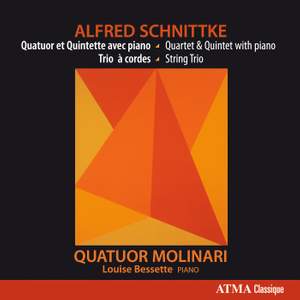
Internationally acclaimed by the public and the critics since its foundation in 1997, the Molinari Quartet has established a mandate to perform works from the 20th and 21st centuries, repertoire for string quartet, and to commission new works. Recipients of 14 Opus Prizes awarded by the Quebec Music Council, the Molinari Quartet is described by the critics as "Canada's answer to the Kronos or Arditti Quartet." | 
| | | (also available to download from $10.50) | Usually despatched in 2 - 3 working days. (Available now to download.) |
|
|
| |  | Schoenberg, Webern & Schnittke: String Trios
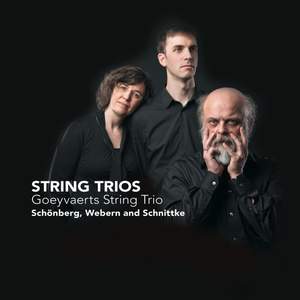
The Goeyvaerts String Trio, which was founded in 1997 and focuses exclusively on 20th and 21st century repertoire, perform works of the Second Viennese School by Schoenberg and Webern as well as the powerful and emotional String Trio of 1985 by Russian composer Alfred Schnittke. Arnold Schoenberg’s pupil Leonard Stein recalls that the composer apparently meant the many strange, seemingly incoherent events in the String Trio op. 45 as a musical depiction of the delirium that he experienced after his recent heart attack. Although dating from two decades earlier, Anton Webern’s String Trio op. 20 (1927) is, like Schoenberg’s, a work written according to serial principles. The development of Alfred Schnittke’s String Trio (1985) seems to have been a very intense emotional experience for the composer. It is fairly well known just how much Schnittke, as a Soviet composer, suffered under the cultural isolation imposed on him by the Soviet authorities. The Goeyvaerts String Trio owes its name to the late Flemish composer Karel Goeyvaerts (1923-1993) who played a key role in the fundamental changes in European new music. They have collaborated with several major contemporary composers including Giya Kancheli and Peter Swinnen, as well as performers such as Alexander Ivashkin (cellist and biographer of Alfred Schnittke), and Henk Guittart of the Schoenberg Quartet. “...this disc juxtaposes what are probably the most characterful string trios from the entire 20th century...Webern comes off best in these hyper-intense, rather over-resonant recordings, with the balance between lyricism and drama, and between dance-like and more fragmented rhythmic patterns, generally well realised.” Gramophone Magazine, Awards Issue 2010 | | | Usually despatched in 4 - 5 working days. |
|
|
| |  | Schnittke: Chamber Music
| | | (also available to download from $6.00) | Usually despatched in 2 - 3 working days. (Available now to download.) |
|
|
| |  | Schnittke: Chamber Works
| | | (also available to download from $10.50) | Usually despatched in 2 - 3 working days. (Available now to download.) |
|
|
| |  | Schnittke: Chamber Music
| | | Usually despatched in 2 - 3 working days. |
|
|
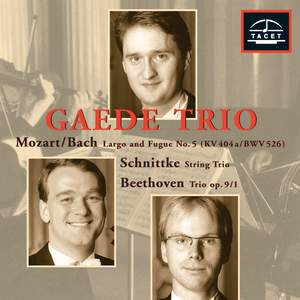
| |  | Gaede Trio play Mozart, Schnittke and Beethoven
| | | Usually despatched in 2 - 3 working days. |
|
|
| |
|